Home/Products/Containerized Water Treatment System
Containerized Water Treatment System
Containerized RO Plant & Desalination
RO & desalination
Process
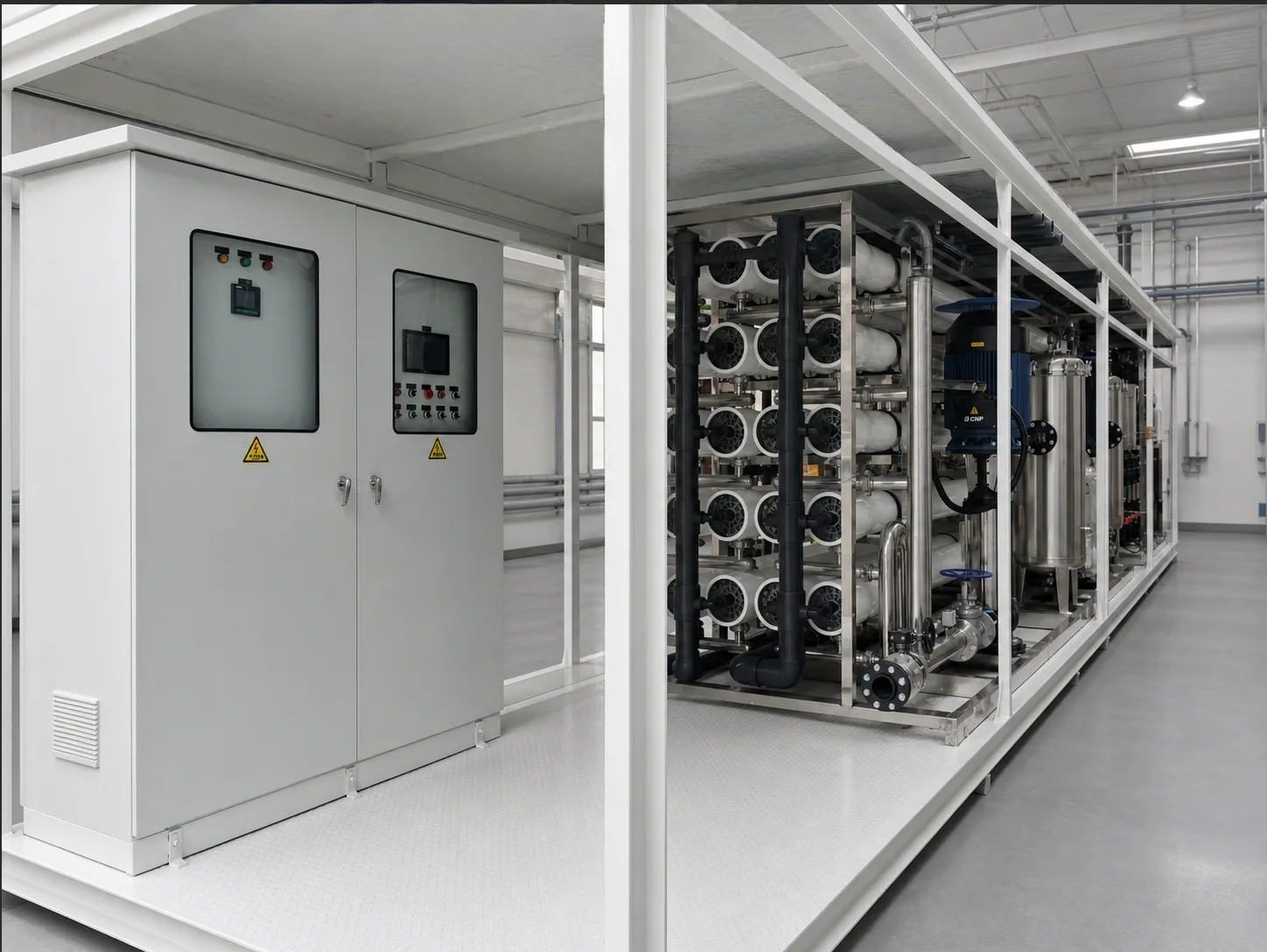
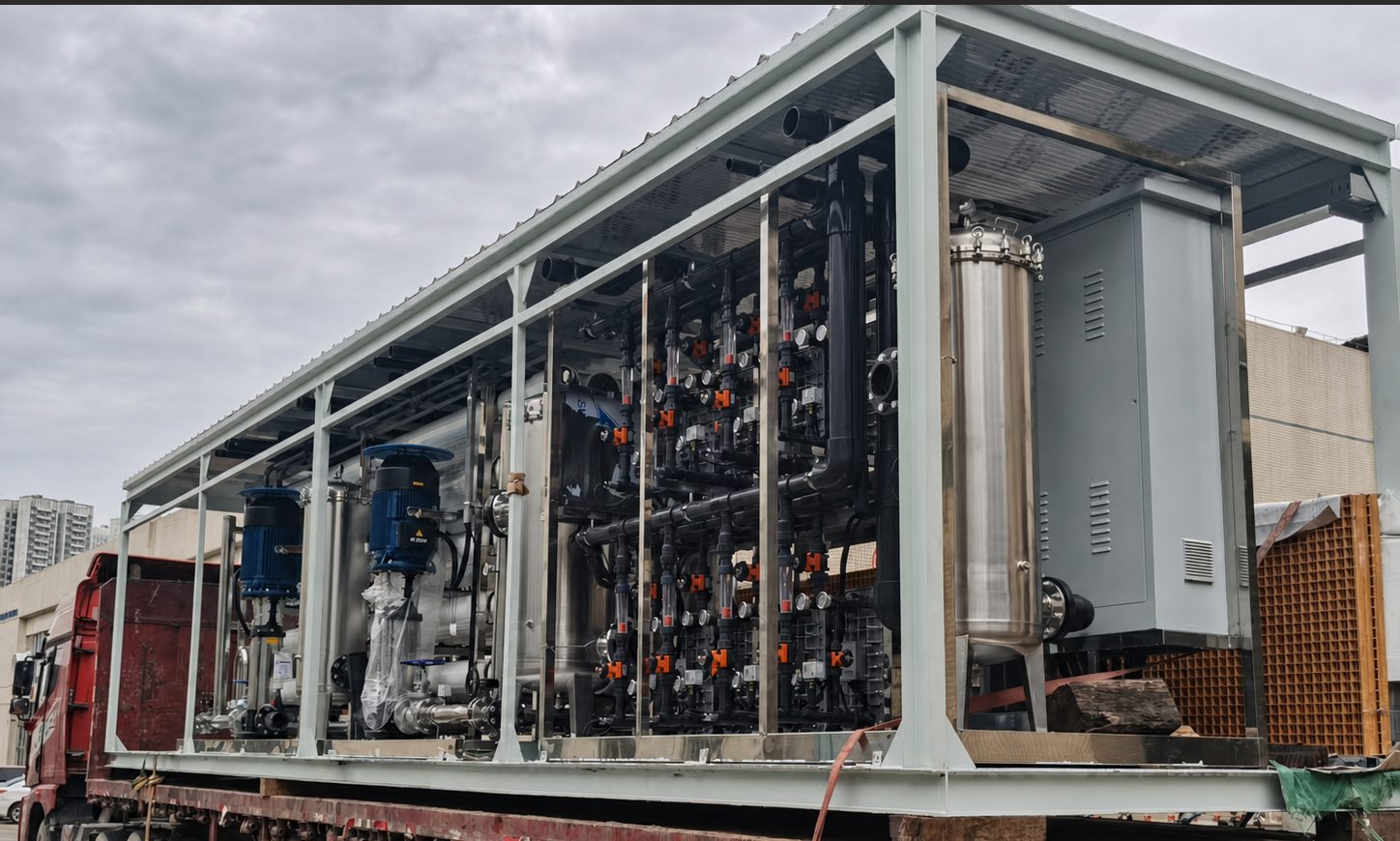
A Konche containerized water treatment system integrates core equipment, piping, controls and auxiliary components in a transport-ready enclosure. It is suitable for projects that need efficient logistics, a compact layout and practical deployment.
KONCHEINDUSTRIAL WATER TREATMENT SYSTEMSMODEL KONCHE CT · CONTAINERIZED PLANTMODULAR DELIVERYREMOTE SITESENGINEERED MODULESENGINEERED BY KONCHE · 2026
QUICK TECHNICAL ANSWER
What is a containerized water treatment system?
KONCHE containerized plants: complete RO and desalination trains pre-installed in transport-ready enclosures — process, piping, instruments and controls delivered as engineered modules for compact or remote sites.
How KONCHE scopes a containerized project
Enclosure selection is confirmed against the treatment process, capacity, transport route and site climate.
Values on this page describe reference configurations; final layout, container count and auxiliaries are confirmed after engineering review of the destination's transport and site conditions.
Containerized systems combine treatment equipment, piping, control and auxiliary components in a practical enclosure for efficient shipping, compact installation and reduced destination setup work.
01
What it is
A containerized system integrates the main water-treatment processes in one compact, factory-assembled enclosure: process equipment, piping, instruments, controls and selected auxiliaries are pre-installed and delivered as engineered modules. KONCHE packages reverse-osmosis plants, seawater and brackish-water desalination, and the KCIW integrated dosing–settling–filtration train.
02
How it is used
The plant is assembled and factory-tested before shipment, then connected to the site's water, power and drainage. Containerized RO plants integrate pretreatment, high-pressure pump, RO membrane separation, controls and optional post-treatment; desalination duty is selected from salinity, turbidity, target use, capacity and operating environment.
03
Where it fits
Industrial sites, coastal facilities, islands, remote locations, construction camps, mines, emergency-response and temporary projects, aquaculture and supplemental supply, plus rural water stations and locations with limited equipment-room construction.
04
Effectiveness
The KCIW clarification train polishes surface water (10–500 NTU) to ≤1 NTU; with disinfection the outlet meets GB 5749. Inclined 60° tube modules settle at 3–5× the efficiency of horizontal-flow basins, and containerized RO or desalination plants deliver performance equivalent to the same fixed process.
05
Energy consumption
Energy use is determined by the installed treatment process, pumps, climate control and source-water conditions rather than by the enclosure itself; the KCIW filtration train runs at a low 0.1–0.3 MPa.
06
Cost
Costs depend on process, capacity and site conditions; container shipping, compact modular layout and factory assembly reduce destination setup requirements and shorten deployment by around 60% versus separate process units, and material options cover humid, hot or saline environments.
KONCHE containerized water treatment plants integrate coagulation, inclined-tube settling and multi-media filtration in one factory-built package — 5–500 m³/h, outlet turbidity ≤1 NTU, and a footprint more than 50% smaller than separate civil units.
Product documentation
A containerized water treatment system is a complete treatment plant packaged in a transport-ready enclosure. Process equipment, piping, instruments, controls and selected auxiliaries are pre-installed and delivered as engineered modules. KONCHE packages reverse osmosis, brackish-water and seawater desalination and related pretreatment. Applications include camps, islands, industrial parks and remote sites, where modular delivery reduces destination setup work and protects equipment during logistics and operation. Container size and internal layout are engineered from capacity, access, climate, maintenance clearance and transport limits. Two projects with the same flow rating can therefore receive different enclosure arrangements. Piping, wiring and instrument integration are pre-installed rather than built on site, which reduces the assembly work remaining at the destination. Best-fit projects also include mines, emergency response and phased capacity programs, and locations with limited equipment-room construction.
A KONCHE containerized (integrated) water treatment plant combines chemical dosing, inclined-tube clarification and dual-media filtration in a single carbon-steel anti-corrosion or stainless-steel skid or container. Source water from rivers, lakes or reservoirs at 10–500 NTU is lifted into a mixing and flocculation zone (PAC as primary coagulant, typically 10–50 mg/L, with PAM as required), then clarifies across 60° inclined PP/FRP tube modules at a 2.5–5 m/h surface loading rate — three to five times the efficiency of a horizontal-flow basin — before dual-media quartz sand and anthracite filtration polishes the water to ≤1 NTU at 0.1–0.3 MPa operating pressure. Disinfection by sodium hypochlorite or UV brings the outlet to the GB 5749 drinking-water standard. Standard models span KCIW-5 to KCIW-500 (5–500 m³/h) and every unit is configured from a verified source-water analysis. Because the plant ships factory-complete, destination setup typically takes roughly 60% less time than assembling separate process units, and the compact layout leaves room for future capacity. KONCHE has manufactured this equipment since 1997, with units serving rural drinking-water stations, industrial parks, emergency and construction-site supplies across more than 20 countries.
CORE BENEFITS
01
Integrated process train
Dosing, tube settling and filtration in one package — a footprint more than 50% smaller than separate civil stages.
02
Stable outlet quality
Treated-water turbidity stays at ≤1 NTU; with disinfection the water meets the GB 5749 drinking-water standard.
03
Factory-complete delivery
The plant arrives as one unit, reducing destination setup time by around 60% and simplifying the remaining local work.
04
High-rate tube settling
60° inclined tube modules at 2.5–5 m/h surface load deliver 3–5× the efficiency of horizontal-flow basins.
05
Broad capacity coverage
Standard models from 5 to 500 m³/h, each configured around the verified source-water analysis.
06
Corrosion-conscious build
Carbon-steel anti-corrosion or stainless-steel body with PP/FRP tube modules for humid, hot or saline sites.
TECHNICAL DATA
Parameter
Specification
Model range
KCIW-5 – KCIW-500
Treated-water capacity
5–500 m³/h
Outlet turbidity
≤1 NTU
Flocculant dosing
PAC + PAM (PAC typically 10–50 mg/L)
Tube-settler inclination
60°
Tube-settler material
PP / FRP
Filter media
Quartz sand + anthracite (dual layer)
Surface loading rate
2.5–5 m/h
Operating pressure
0.1–0.3 MPa
Applicable source water
Surface water (river, lake, reservoir) at 10–500 NTU turbidity
Disinfection stage
Sodium hypochlorite or UV
Body material
Carbon steel (anti-corrosion) or stainless steel
MODEL RANGE
Model
Capacity
Typical duty
KCIW-10
10 m³/h
Small village water stations
KCIW-50
50 m³/h
Township plants and industrial parks
KCIW-200
200 m³/h
Medium water plants and large enterprises
KCIW-500
500 m³/h
Municipal supply and centralized plants
Custom
Configured to duty
Every model can be customized to the verified source water and standard
INDUSTRY APPLICATIONS
Application
System value
Rural drinking water
Village and small-town stations deliver GB 5749-compliant water from turbid surface sources.
Industrial process water
Production and pretreatment water that replaces municipal supply and cuts water cost.
Emergency supply
Fast-deployment drinking water for disaster relief and temporary camps.
Municipal supply
Compact plant deployment or capacity expansion.
Construction sites
Site process water and dust-control supply from nearby surface water.
SELECTION GUIDE
01
Confirm the water quality
Test turbidity and suspended solids (applicable range 10–500 NTU); high-turbidity sources need a pre-settling stage.
02
Define the duty
Fix the treated-water capacity, outlet standard (GB 5749 or the industrial standard) and disinfection method.
03
Size for peak demand
Calculate peak hourly demand and apply a 1.2 safety factor to select the model capacity.
04
Source from the manufacturer
Buy factory-direct: 48-hour engineering response and performance-guaranteed rectification if the outlet misses the agreed standard.
REFERENCE PROJECT
Rural drinking-water project in Ji'an, Jiangxi (delivered). A KCIW-50 plant treats 50 m³/h of reservoir water at 30–80 NTU through coagulant dosing, inclined-tube settling, multi-media filtration, a clear-water tank and sodium-hypochlorite disinfection before the distribution network. The outlet runs at 0.5 NTU — within the GB 5749 drinking-water standard — on a 40 m² footprint installed in 15 days, serving 6,000 households.
ModelKCIW-50
Capacity50 m³/h
Feed turbidity30–80 NTU
Outcome0.5 NTU · 6,000 households
MAINTENANCE
Item
Cycle
Work performed
Filter backwash
Daily
Water backwash restores filter velocity and outlet quality.
Dosing system check
Weekly
Inspect metering pumps, clear dosing lines and refill chemicals.
Disinfection system
Monthly
Check the hypochlorite metering pump or UV lamp runtime.
Tube-settler cleaning
Every 6 months
Flush deposited sludge from the inclined-tube surfaces.
Media top-up / replacement
Every 2–3 years
Replace or top up quartz sand and anthracite filter media.
FAQ
Which water sources suit this system?
Surface water — rivers, lakes and reservoirs — at 10–500 NTU turbidity. Groundwater high in iron or manganese is better served by a dedicated removal plant.
Can the treated water be drunk directly?
With the disinfection stage the outlet meets the GB 5749 drinking-water standard. Boiling before drinking is still recommended for extra safety.
Is chemical dosing required?
Yes. PAC is the primary coagulant, typically dosed at 10–50 mg/L, with PAM added when the source water needs stronger flocculation.
How much maintenance does the plant need?
A daily filter backwash, a weekly dosing-system check, semiannual tube cleaning and a media change every 2–3 years. Operation is highly automated and needs no dedicated chemical engineer.
WHY KONCHE
01
Nearly 30 years of expertise
Since 1997, Konche has accumulated practical experience across raw-water conditions, treatment processes and industrial project delivery.
02
Professional customization
Each system is designed around the water analysis, industry standard, site condition, capacity and final use.
03
Controlled system quality
Component selection, factory testing, water-quality verification and process control are managed as one complete system.
Share your water analysis, target capacity, installation location and local power standard for a containerized RO plant or desalination equipment proposal.