01
What it is
A laboratory ultrapure water system produces clean, reliable water for experiments, testing and analytical instruments.
High Purity Water Equipment
Konche laboratory ultrapure water systems are configured for critical testing, research and high-purity water applications. They remove ions, particles, organics, microorganisms and other contaminants that may affect analysis, sample preparation or research results.
Discuss Your Requirement ↗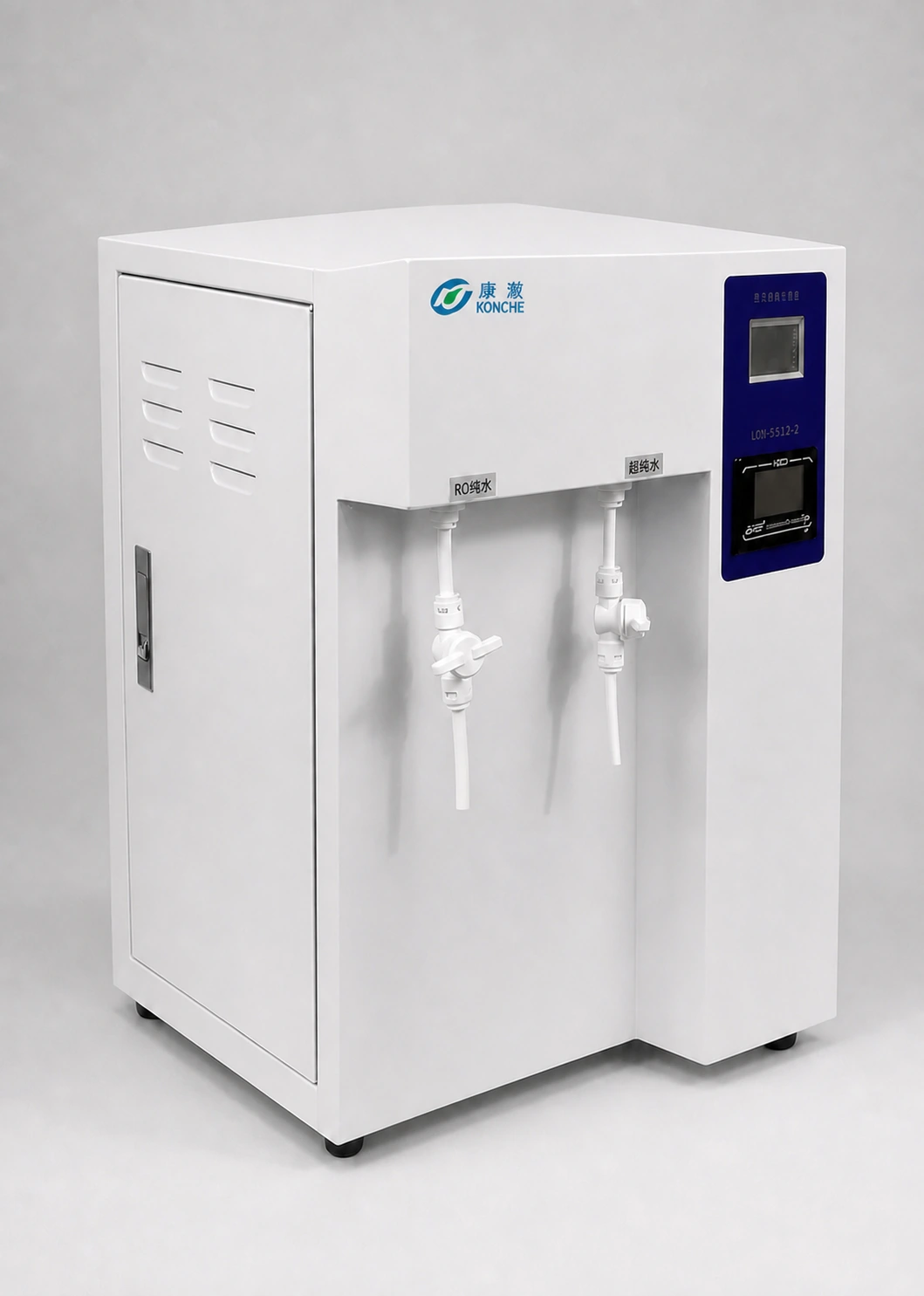
KONCHE laboratory ultrapure systems: point-of-use Type I water at 18.2 MΩ·cm and TOC ≤5 ppb — 5–100 L/h ultrapure plus 10–200 L/h pure water for analytical instruments.
Next step: Share your project inputs · Compare applications
The purification process is selected according to feed-water condition and application standard, with compact units or integrated storage and distribution configurations available.
A laboratory ultrapure water system produces clean, reliable water for experiments, testing and analytical instruments.
Tap or pretreated water passes through several purification stages and is dispensed directly where laboratory staff need it.
Universities, hospitals, pharmaceutical laboratories, testing centres, industrial R&D and quality-control departments.
It can deliver Type I ultrapure water at up to 18.2 MΩ·cm, helping protect sensitive instruments and support reproducible results.
Energy demand mainly comes from the RO pump, UV lamp and water circulation. Final use depends on feed water, demand and configuration.
Capital cost depends on feed water, daily demand, water grade, storage and dispensing points. Ongoing costs include cartridges, purification media, UV lamps and servicing.
A laboratory ultrapure water system is a point-of-use purification and dispensing plant for analytical and research work. The system removes ions, particles, organics and microorganisms that can interfere with instruments and methods. KONCHE laboratory systems deliver ultrapure water at 18.2 MΩ·cm resistivity at 25 °C. TOC ≤5 ppb is documented in selected configurations, with ultrapure capacity from 5 to 100 L/h and pure-water capacity from 10 to 200 L/h for routine duties. RO, EDI and ion-exchange stages are arranged to the verified feed water. General laboratory pure water, reagent preparation water and high-sensitivity analytical water are treated as different duties. The required grade is confirmed at the point of use, because storage and distribution can degrade polished water before dispensing. Configurations may integrate pretreatment, RO, ion exchange and terminal filtration in one system, with storage and dispensing arranged per laboratory.
KONCHE laboratory systems chain PP + activated-carbon + softening pretreatment, RO, EDI, 254/185 nm UV and ultrafiltration. Type I water reaches 18.2 MΩ·cm with TOC < 5 ppb; a second grade delivers ≥5 MΩ·cm general laboratory water. Capacities span 5–100 L/h, compliant with GB/T 33087-2016 and ASTM D1193 Type I, with a 7-inch touch screen, out-of-spec alarms, cartridge-life prediction and quiet < 50 dB operation. Typical projects: HPLC/ICP/IC analysis, life science (PCR, cell culture), pharmaceutical R&D, semiconductor wafer rinsing and clinical analyzers.
Configurations may integrate pretreatment, RO, ion exchange, EDI, UV oxidation, ultrafiltration and terminal filtration. For selected configurations, resistivity can reach up to 18.25 MΩ·cm.
Laboratory analysis, sample preparation, biopharmaceutical and life-science research, electronics-related processes, precision cleaning, semiconductor-related water preparation, universities and quality-control laboratories.
Application-based process selection, water-quality monitoring and alarm options, storage and distribution configurations, plus compatible filter cartridges, UV lamps and terminal filters for routine replacement.
Provide your application, daily water demand, feed-water condition and target water quality for a suitable laboratory ultrapure water system recommendation.
RO + EDI + UV + UF laboratory ultrapure-water equipment for analysis and research. Selected configurations deliver 18.2 MΩ·cm resistivity at 25°C, TOC ≤5 ppb, low particles and bacteria, and 5–100 L/h ultrapure-water capacity.
Displays resistivity, TOC, conductivity and temperature and supports clear operating status.
Provides alarm logic for water quality, filter life and system conditions.
Supports repeatable water collection for routine analysis and sample preparation.
Benchtop and wall-mounted configurations are available for different laboratory spaces.
Remote status and alarm options support multi-room or centralized laboratory management.
| Advantage | Customer benefit |
|---|---|
| 18.2 MΩ·cm Type I quality | Stable 18.2 MΩ·cm resistivity with TOC ≤5 ppb — meets Type I standards for trace analysis. |
| Dual-grade output | Ultrapure and pure water from one unit covers both precision analysis and routine work. |
| 7-inch touch-screen monitoring | Live resistivity, TOC, conductivity and temperature with automatic out-of-spec alarms. |
| Quiet, compact design | Operating noise below 50 dB; benchtop or wall-mount installation. |
| Smart cartridge-life alerts | Usage time tracked automatically with early replacement warnings — no quality drift. |
| Parameter | Value |
|---|---|
| Model range | KCLAB-5 to KCLAB-100 |
| Ultrapure-water capacity | 5–100 L/h |
| Pure-water capacity | 10–200 L/h |
| Resistivity | 18.2 MΩ·cm at 25 °C |
| TOC | ≤5 ppb |
| Water take-off | 1.5–2.5 L/min |
| Noise | <50 dB |
| Process | RO + EDI + UV + UF |
| Model | Capacity | Typical application |
|---|---|---|
| KCLAB-10 | 10 L/h | Small laboratories, analytical testing |
| KCLAB-30 | 30 L/h | Mid-size laboratories, life science |
| KCLAB-60 | 60 L/h | Large laboratories, R&D centres |
| KCLAB-100 | 100 L/h | Central ultrapure-water supply |
Note: capacity and configuration of every model can be customized to actual project requirements.
| Industry | Water point | System value |
|---|---|---|
| Analytical testing | HPLC / ICP / IC water | Stable baselines and accurate detection for chromatography and mass spectrometry. |
| Life science | PCR and cell-culture water | Nuclease- and endotoxin-free water protects molecular biology work and cultures. |
| Pharmaceutical R&D | Reagent and buffer preparation | High-purity water keeps standard solutions accurate and stable. |
| Semiconductors | Wafer rinsing and lithography water | Ultra-low TOC water avoids particle and organic contamination. |
| Clinical laboratories | Clinical analyzer water | Reliable, reproducible test results for clinical pathology. |
Representative KONCHE laboratory ultrapure-water projects (client names anonymized):
100 L/h central ultrapure-water supply delivered for an R&D centre in Shenzhen.
One KCLAB-100 system covers more than 20 analytical laboratories with 18.2 MΩ·cm water and TOC ≤3 ppb — serving HPLC, ICP-MS and cell-culture points with stable quality over three years.
| Item | Cycle | Maintenance |
|---|---|---|
| PP filter | Every 3–6 months | Replace according to pressure drop and source-water quality. |
| Activated carbon | Every 6–12 months | Replace to protect RO and EDI. |
| RO membrane | Every 1–3 years | Replace when product-water quality and flow cannot be restored. |
| EDI module | Annually | Inspect performance and replace when water quality is not recoverable. |
| UV lamp | Annually | Replace lamp and clean quartz sleeve. |
| UF filter | Every 6 months | Replace according to pressure and product-water quality. |
Pure water is suitable for general laboratory work; ultrapure water is used where ionic, organic, particle and microbial contamination can affect results.
EDI uses an electric field and does not require the routine chemical regeneration used by conventional ion exchange, subject to correct pretreatment.
Yes. A storage and distribution loop can be configured when multiple instruments or rooms share the same water-quality requirement.
RO reduces the organic load, while UV oxidation and terminal UF are selected to control residual organics and particles.
Since 1997, Konche has accumulated practical experience across raw-water conditions, treatment processes and industrial project delivery.
Each system is designed around the water analysis, industry standard, site condition, capacity and final use.
Component selection, factory testing, water-quality verification and process control are managed as one complete system.
KONCHE supports proposal alignment, technical documentation, consumables supply, maintenance guidance and remote operational clarification.
Provide your application, daily water demand, feed-water condition and target water quality for a suitable laboratory ultrapure water system recommendation.
Get Expert Support ↗