Double-Pass RO and EDI Pure Water System for a Community Healthcare Center in China
Published 19 October 2026 · Customer identity withheld
A community healthcare center needed one municipal-water treatment project to serve dental and endoscopy rooms while also providing a smaller, higher-purity stream for its laboratory department. The project specification called for at least 1.5 tonnes per hour of purified water at 25°C, of which 300 L/h was intended for laboratory use. KONCHE's project scope combined pretreatment, two-pass reverse osmosis, UV treatment, fine filtration and EDI. The completed project passed acceptance against its contractual requirements, as confirmed by KONCHE.
What did the healthcare center need from one pure-water system?
The incoming water source was municipal tap water. The facility had more than one point of use: dental and endoscopy areas required purified water, while the laboratory department required its own higher-purity supply. That made it important to define the water quality and delivery capacity for each outlet, rather than specify an RO skid solely by its headline flow rate.
| Project parameter | Requirement recorded in the project specification |
|---|---|
| Feedwater | Municipal tap water; incoming supply of at least 3 m³/h |
| Total purified-water production requirement | At least 1.5 tonnes/h at 25°C, serving the uses described in the specification |
| Laboratory-water allocation | Of that total, 300 L/h was intended for the laboratory department; it is not an additional 300 L/h on top of the 1.5 tonnes/h requirement |
| General purified-water conductivity | Below 10 µS/cm, specified as a design target |
| General purified-water microbiology | Total bacterial count of no more than 100 CFU/mL, specified as a design target |
| Laboratory-water reference | The project document cited GB/T 6682-2008, without stating a laboratory-water grade in the material reviewed |
The important design question was how to support several departments with different water needs from one treatment project. The specification gave the laboratory a 300 L/h allocation within the total production requirement and set water-quality criteria for the broader pure-water supply. For a new healthcare project, the buyer should define each device's point-of-use quality, its usage schedule and the acceptance criteria before final design.
How was the treatment train specified?
The project started with pretreatment for municipal feedwater: a raw-water pump, multimedia filtration, activated-carbon filtration, resin softening and a cartridge security filter. These units were specified ahead of the membrane stages to prepare a stable feed for RO operation and to make the upstream cleaning and regeneration duties clear.
The membrane section comprised a first-stage high-pressure pump and RO unit followed by a second-stage high-pressure pump and RO unit. The project scope also listed pure-water storage, an EDI feed pump, UV equipment, precision filtration and an EDI unit. This gave the laboratory water stream additional polishing within the same project, rather than treating every outlet as an identical draw from the main RO supply.
The procurement list is more specific than a generic “RO + EDI” label: it includes an EDI module specified at 300–500 L/h, dedicated EDI feed pumps, and UV and fine-filtration equipment in the pure-water supply scope. The configuration reflects the separate 300 L/h laboratory allocation alongside the broader departmental demand.
For the membrane technology category, see KONCHE's single- and double-stage RO systems. A buyer comparing laboratory polishing options can also review the laboratory ultrapure water system; that product page describes a separate product category and should not be mistaken for a list of components installed at this center.
How was the system designed for operation and maintenance?
The contracted control scope allowed automatic operation with manual intervention. Automatic functions covered high- and low-level signals from filtered-water, first- and second-stage, and terminal tanks; pump starts and stops responding to level and pressure; and automatic RO flushing. Manual functions covered forward/backwash of multimedia and carbon filters, softener flushing and salt regeneration, and adjustment of RO operating parameters.
These details matter to an EPC contractor or facility engineer because the plant must work with site utilities and staff routines after installation. The project document called for at least 3 m³/h of raw-water supply and power brought to the equipment cabinet. It also specified the water-treatment scope from the raw-water pump through terminal supply, including pumps, instruments, controls, pipework and valves. A new quotation should still confirm peak simultaneous demand, storage autonomy, feedwater analysis, available space, electrical supply and the local maintenance plan.
What installation interfaces were included?
The construction requirements specified UPVC for the clean-in-place pipework, CL-PVC for EDI permeate and terminal supply, and sanitary 304 stainless steel for other listed pipes and valves. They also called for pipe supports, equipment grounding, internal pipe cleaning and pressure/leak testing after connection. Specifying these interfaces as part of the water-treatment package helped connect the treatment equipment to the facility's terminal supply system.
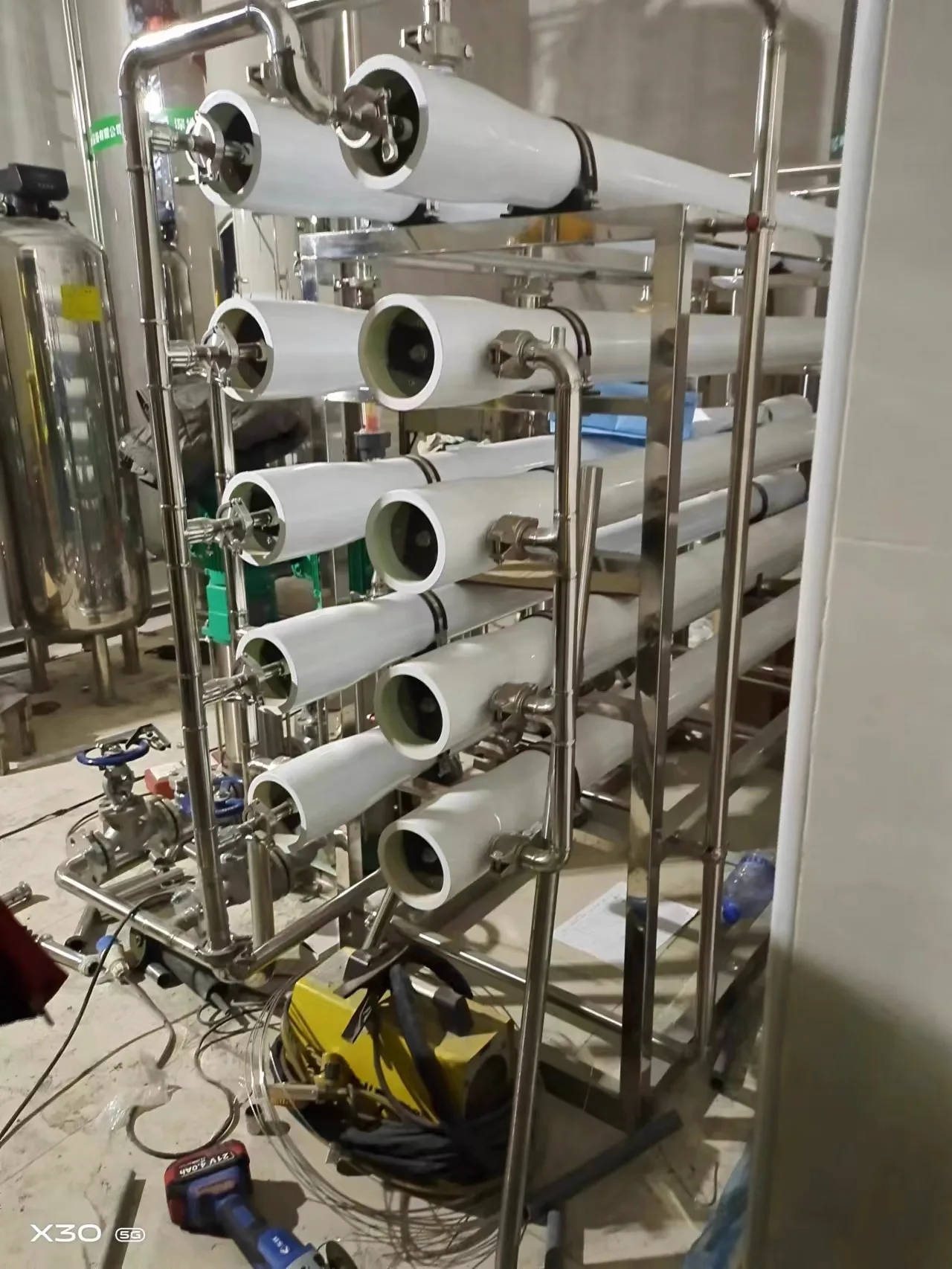
Site photographs show the RO membrane housings, stainless-steel vessels and piping during installation. They provide a view of the equipment and the space needed to connect the plant to the healthcare center's water distribution system.
Project outcome: a healthcare pure-water system accepted against its contract
The available contract and photographs document a defined healthcare pure-water project rather than a hypothetical product application. The specification set a total production requirement of at least 1.5 tonnes/h, including 300 L/h intended for laboratory use, and included pretreatment, two-pass RO, UV, precision filtration, EDI, controls and distribution interfaces in one scope.
KONCHE confirms that the completed project passed acceptance, which required the specified contractual requirements to be met. The project brings together a total pure-water production requirement of at least 1.5 tonnes/h and a 300 L/h laboratory allocation within one treatment scope. It is a relevant reference for healthcare facilities and EPC contractors designing departmental water supply alongside a laboratory polishing stream.
Frequently asked questions
Is the 300 L/h laboratory stream additional to the 1.5 tonnes/h total requirement?
No. The specification places the 300 L/h laboratory allocation within the at-least-1.5-tonnes/h total requirement. The two figures should not be added together when sizing the project's headline output.
Why use two RO passes before EDI?
The project document specified both a first and second RO stage, then listed EDI and its supporting equipment for the higher-purity requirement. The precise water-quality contribution of each stage at this site has not been established from the records available for this case. A new system should be designed from feedwater analysis and point-of-use specifications, not copied from the stage count alone.
Did the healthcare pure-water project pass acceptance?
Yes. KONCHE confirms that the completed project passed acceptance against its contractual requirements. The contract cited GB/T 6682-2008 for the laboratory stream without naming a specific water grade, so this case does not assign one.
Can municipal tap water feed the same configuration at another healthcare site?
Municipal tap water was the specified source for this project. Another site's hardness, chlorine residual, conductivity, microbial conditions, peak demand and device requirements may differ. KONCHE would need that site's water analysis and outlet-quality requirements before proposing a configuration.
What should an EPC or healthcare buyer send for a technical proposal?
Send the feedwater analysis, a list of dental, endoscopy and laboratory points of use, flow and peak-demand estimates, each outlet's applicable water-quality requirement, available space, utility conditions, and proposed acceptance tests. If the laboratory water must meet a named grade, state that grade and the point where compliance is to be measured.
Discuss a healthcare pure-water project
If your facility needs separate dental, endoscopy and laboratory water streams, request a technical configuration review. Share the municipal-water report, required flows and the water-quality criteria for each outlet so KONCHE can review the treatment and distribution scope against the actual project.
Discuss a healthcare
pure-water project.
Send your feedwater report, departmental flow requirements and outlet-quality criteria for a technical configuration review.
Request a Technical Proposal ↗