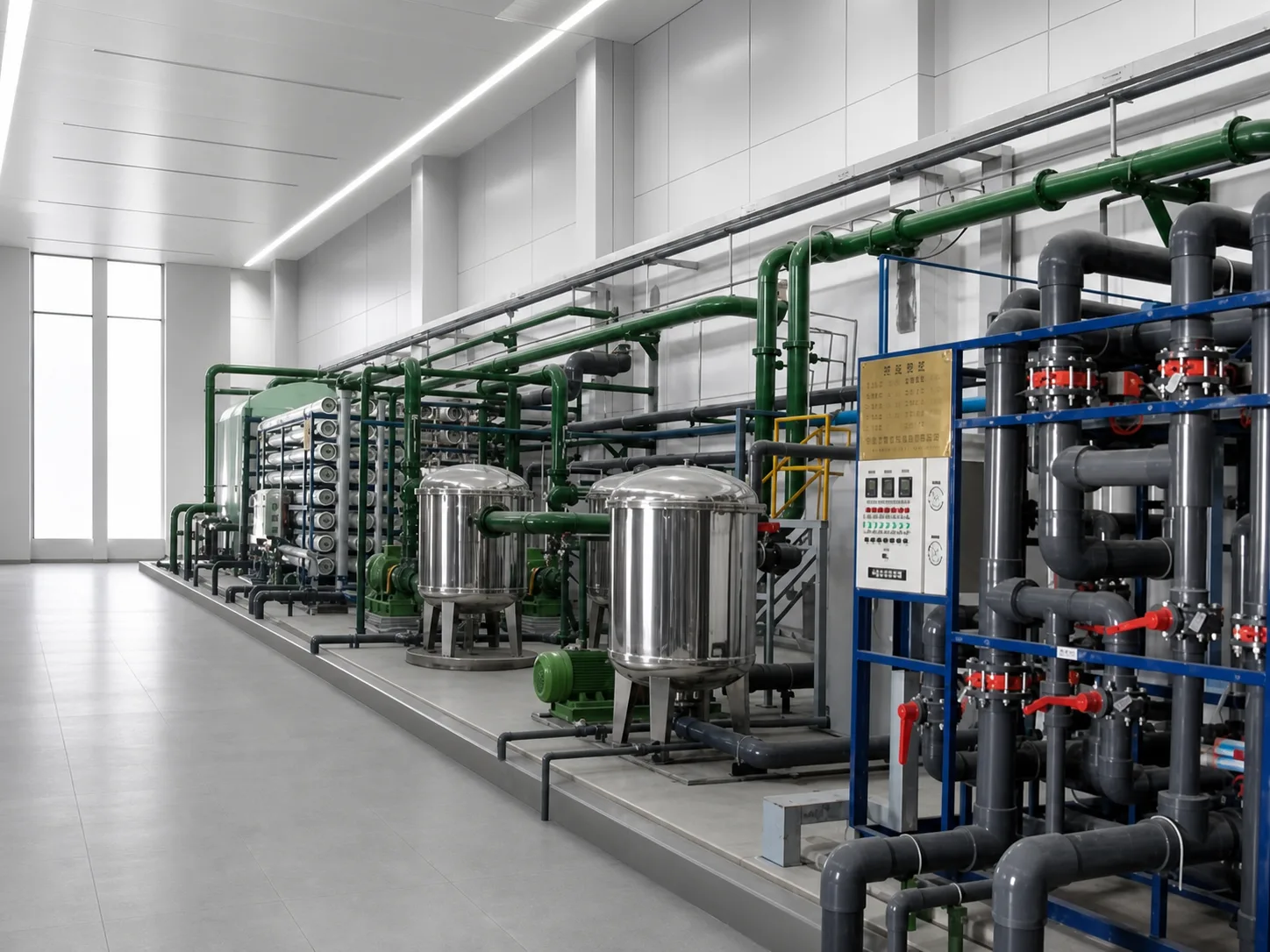
1-year whole-machine warranty from commissioning. Exclusions: membranes, UV lamps, filter cartridges and other consumables. First-tier brand membranes and components (e.g., Dow, Hydranautics) and control configuration are selected for your feed-water scenario and quality targets.
KONCHEINDUSTRIAL WATER TREATMENT SYSTEMSMODEL KONCHE UPW · INDUSTRIAL ULTRAPURE WATER1-YEAR WARRANTY72-HR SPARE-PARTS DISPATCH24-HR RESPONSEOEM / ODMENGINEERED BY KONCHE · 2026
KONCHE ultrapure systems combine multi-media and activated-carbon pretreatment, double-pass RO, EDI and UV sterilization with an optional polishing mixed bed. Capacities span 0.25–50 m³/h with resistivity ≥18.2 MΩ·cm and TOC ≤0.5 μg/L, engineered to GB/T 11446.1 electronic-grade water. Typical projects: semiconductor and wafer fabs, PCB, optoelectronic displays, photovoltaics, lithium batteries and electroplating lines.
INDUSTRY APPLICATIONS
Find your industry below — the process point where ultrapure water decides results, the quality target that decides yield, and the KONCHE route engineered behind it.
Semiconductors / Wafer Fabs
WATER POINTWafer rinsing, etching solutions
QUALITY TARGET≥18.2 MΩ·cm at the point of use — resistivity you can certify
Note: capacity and configuration of every model can be customized to actual project requirements.
Full system technical data
Parameter
Value
Product-water resistivity
≥18.2 MΩ·cm at 25 °C
TOC
≤0.5 μg/L
Particles ≥0.2 μm
≤1 particle/mL
Microorganisms
≤1 CFU/mL
Silica
≤5 μg/L
Capacity
0.25–50 m³/h; custom systems available
Recovery
60–85 %, subject to process design
Control
PLC automatic control + touchscreen
APPLICATION — PHARMACEUTICAL PURIFIED WATER
The same product family delivers pharmacopoeia purified water — conductivity ≤2 μS/cm, microbes ≤100 CFU/mL, TOC ≤500 ppb — on hygienic 316L trains designed around GMP qualification workflows.
316L hygienic piping, valves and storage; wetted surfaces electropolished to Ra ≤0.4 μm
Full-circulation distribution loop with 80–85 °C hot-water sanitization
Online conductivity, TOC, flow and temperature monitoring for operating records and deviation review
DQ, IQ, OQ and project-specific PQ documentation support
Reference: Chinese Pharmacopoeia 2020 purified water · KC-PW series 0.5–20 m³/h, custom to 50 m³/h · PLC + touchscreen with data-recording options.
10 m³/h ultrapure-water system delivered for an electronics plant in Shenzhen.
IndustryElectronic manufacturing
Capacity10 m³/h
ProcessDouble-pass RO + EDI
Municipal feed water; output resistivity stable at 18.2 MΩ·cm. Replacing the previous mixed-bed system eliminated acid and caustic regeneration entirely. The plant has run continuously and stably for three years.
FAQ
How is system price determined?
Price is driven by capacity, feed-water condition, final-water target, materials and monitoring scope. Send your water analysis for a budget quotation.
How do I choose EDI or a polishing mixed bed?
EDI gives continuous, chemical-free deionization at 15–18.2 MΩ·cm. Add a polishing mixed bed only when the approved water-quality target requires a final barrier.
Why can resistivity fall?
Typical causes are exhausted pretreatment, RO fouling, EDI scaling, CO₂ ingress or loop contamination. Trending the resistivity curve locates the stage.
What determines operating cost?
Power, recovery, pretreatment consumables, membrane cleaning and UV replacement dominate the operating bill. EDI removes regenerant chemicals from it.
Does EDI require chemical regeneration?
No — the DC field and water dissociation regenerate the resin continuously during operation.
How often is the resin regenerated?
Mixed-bed resin regenerates typically every 8–24 operating hours, depending on feed salinity; RO pretreatment extends the cycle substantially.
How does purified water differ from WFI?
Purified water is RO + EDI at ≤2 μS/cm; WFI is distilled with endotoxin ≤0.25 EU/mL for injectable preparations. Purified water can serve as WFI feed.
MAINTENANCE
Maintenance schedule
Item
Reference cycle
Work
Pretreatment media
6–12 months
Inspect pressure drop and water quality; replace or service as required.
RO membranes
Clean every 6–12 months; replace by condition
Track flow and desalination and clean when performance declines.
EDI module
Annual inspection
Trend resistivity, current, voltage, pressure and recovery.
UV lamps
By operating hours
Replace according to lamp specification and intensity trend.
Distribution loop
Ongoing
Maintain circulation, monitor return water and sanitize according to the approved procedure.
WHY KONCHE
Since 1997Nearly 30 years of industrial project delivery
Custom-engineeredDesigned around your water analysis, standard and site
Factory-verifiedComponents, testing and water quality checked as one system
Full-cycle serviceDocumentation, consumables, maintenance and remote support
RELATED SYSTEMS
Continue your system selection.
Linked systems share configuration inputs or process stages with this page.