1-year whole-machine warranty from commissioning. Exclusions: membranes, UV lamps, filter cartridges and other consumables. First-tier brand membranes and components (e.g., Dow, Hydranautics) and control configuration are selected for your feed-water scenario and quality targets.
KONCHEINDUSTRIAL WATER TREATMENT SYSTEMSMODEL KONCHE LUV · LOW-PRESSURE UV STERILIZERCHEMICAL-FREENO BY-PRODUCTSDOSE MONITOREDENGINEERED BY KONCHE · 2026
PRODUCT DOCUMENTATION
254 nm low-pressure high-intensity UV for chemical-free water disinfection. Typical capacity is 0.25–50 m³/h, sterilization performance can reach 99.99% in suitable conditions, with actual results depending on feed water quality and applied UV dose; lamp life is typically 8,000–10,000 operating hours.
KONCHE low-pressure sterilizers use 254 nm high-output quartz lamps in polished 304/316L chambers. Capacities span 0.25–50 m³/h with up to 99.99% inactivation and 8,000–10,000 h lamp life; in-line installation is same-day, and 185 nm versions handle ultrapure-water TOC duty. Typical projects: food plants, purified-water systems, secondary-supply tanks in buildings, pools and aquaculture.
CORE BENEFITS
Advantage
Customer benefit
High kill rate
Up to 99.99% with stable microbiological compliance at the outlet; actual performance depends on feed water quality and applied UV dose.
No chemical residue
No dosing, no by-products — safe for food, beverage and pure water.
Food-grade chamber
304/316L stainless, internally and externally polished, hygienic.
Low operating cost
Only power and lamps; cost per tonne below chemical dosing.
Flexible installation
In-line mounting on new or existing lines — delivered and installed the same day.
Monitored dose
UV intensity sensor with low-level alarm verifies output around the clock.
Separated electronics
Electronic ballasts (power factor ≥0.95) mounted in a separate cabinet, indoors or outdoors.
TECHNICAL DATA
Full technical data
Parameter
Value
Wavelength
254 nm; 185 nm optional
Capacity
0.25–50 m³/h
Sterilization
≥99.99% in suitable conditions
Lamp life
8,000–10,000 hours
Material
304 or 316L stainless steel
Quartz sleeve
High-transmission fused silica
Pressure
≤0.6 MPa
Treatment time
Approximately 3–5 seconds
MODEL RANGE
Model
Capacity
Typical application
KC-UV-0.5/2
0.5–2 m³/h
Pure-water machine outlets, laboratories
KC-UV-5/15
5–15 m³/h
Food and beverage, purified-water lines
KC-UV-20/60
20–60 m³/h
Secondary supply, pool circulation
KC-UV-100+
100 m³/h and above
Municipal and EPC projects (custom)
Note: capacities and configurations can be customized to actual project requirements.
COMPACT & IN-TANK CONFIGURATIONS
Besides the standard in-line reactors above, the low-pressure range extends to two compact forms: small threaded in-line units for low-flow duties, and submersible in-tank UV that disinfects the water and the tank headspace inside storage vessels — preventing secondary contamination at the point of draw-off.
With about 10 seconds of exposure at the rated dose, E. coli inactivation exceeds 99% in suitable conditions. Configurations are selected by tank geometry, draw-off pattern and water quality; values are reference ranges, not project guarantees.
In-line UV disinfection delivered for a food plant's purified-water line in Dongguan.
IndustryFood and beverage
ProcessIn-line UV after RO permeate
ResultStable microbiological compliance
Total bacteria counts stay reliably in specification and the plant passed its customer audit. Lamps are replaced on an 8,000–10,000 operating-hour schedule, keeping annual maintenance cost in the low hundreds of RMB.
MAINTENANCE
Item
Cycle
Maintenance
System check
Quarterly
Check lamp status, intensity, ballast and alarm response.
Quartz sleeve cleaning
Every 3–6 months
Clean scale and deposits to maintain UV transmission.
UV lamp
8,000–10,000 operating hours
Replace according to operating hours and intensity trend.
Electronic ballast
Continuous
Check current, temperature and alarm state during routine service.
FAQ
Can UV remove dissolved salts or particles?
No. UV provides disinfection. Filtration or RO is required for particles, dissolved salts and other impurities.
Is a fine filter required before UV?
A fine filter is recommended when particles or turbidity may reduce UV transmittance.
Does UV leave a residual disinfectant?
No. UV is chemical-free and does not leave a disinfectant residual, so downstream protection and hygiene should be considered.
How is the correct UV model selected?
Selection uses flow, UV transmittance, target dose, water temperature, pressure and installation conditions.
What is the difference between in-line and submersible UV?
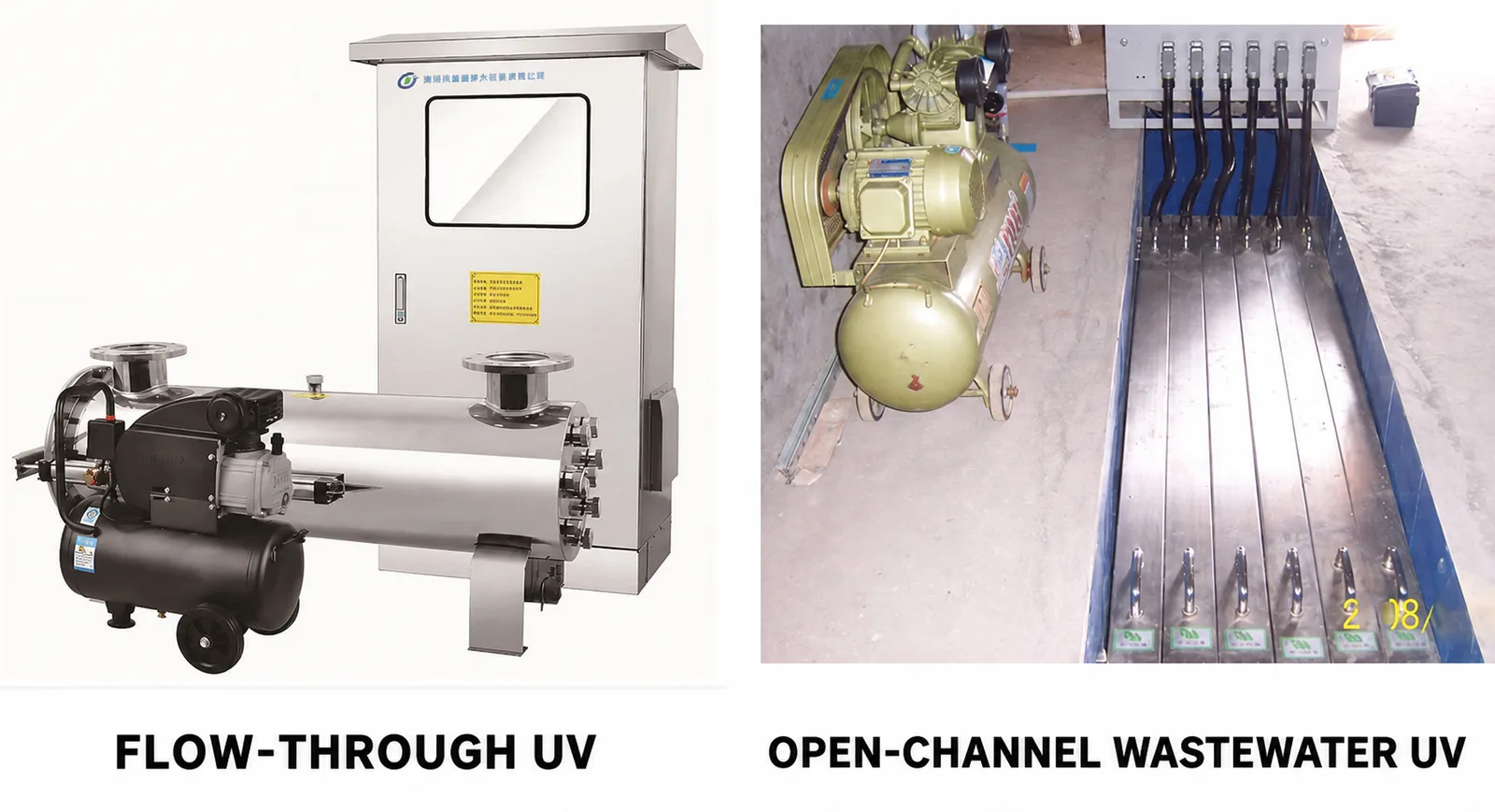
In-line units disinfect flowing water inside the pipe. Submersible in-tank UV works inside the storage vessel, treating the water and the tank headspace — the right choice when secondary contamination in tanks is the concern.
WHY KONCHE
01
Nearly 30 years of expertise
Since 1997, KONCHE has supplied 254 nm low-pressure sterilizers for food, pharmaceutical and process water — in-line units sized by flow, transmittance and dose.
02
Professional customization
Each system is designed around the water analysis, industry standard, site condition, capacity and final use.
03
Controlled system quality
Component selection, factory testing, water-quality verification and process control are managed as one complete system.