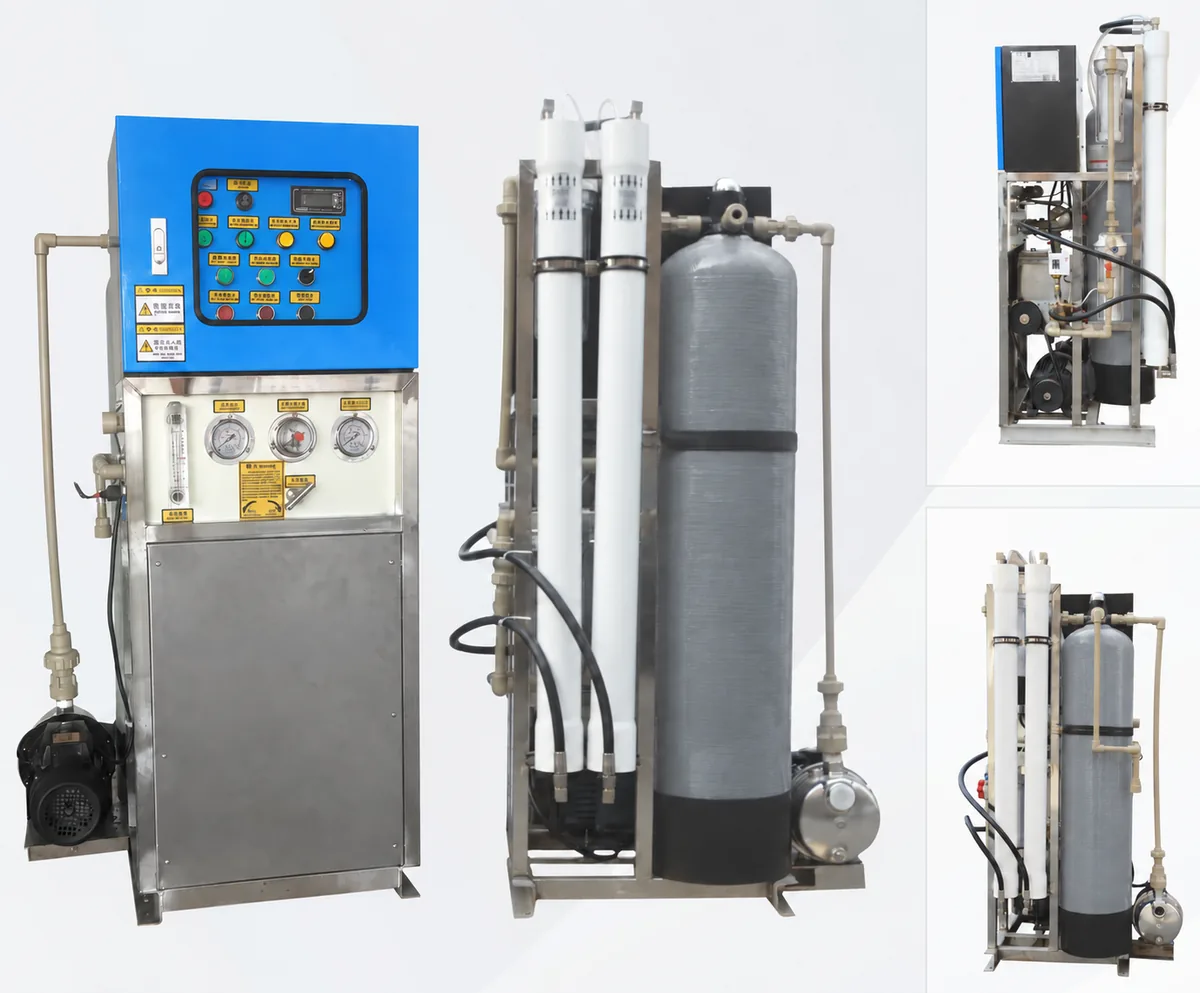
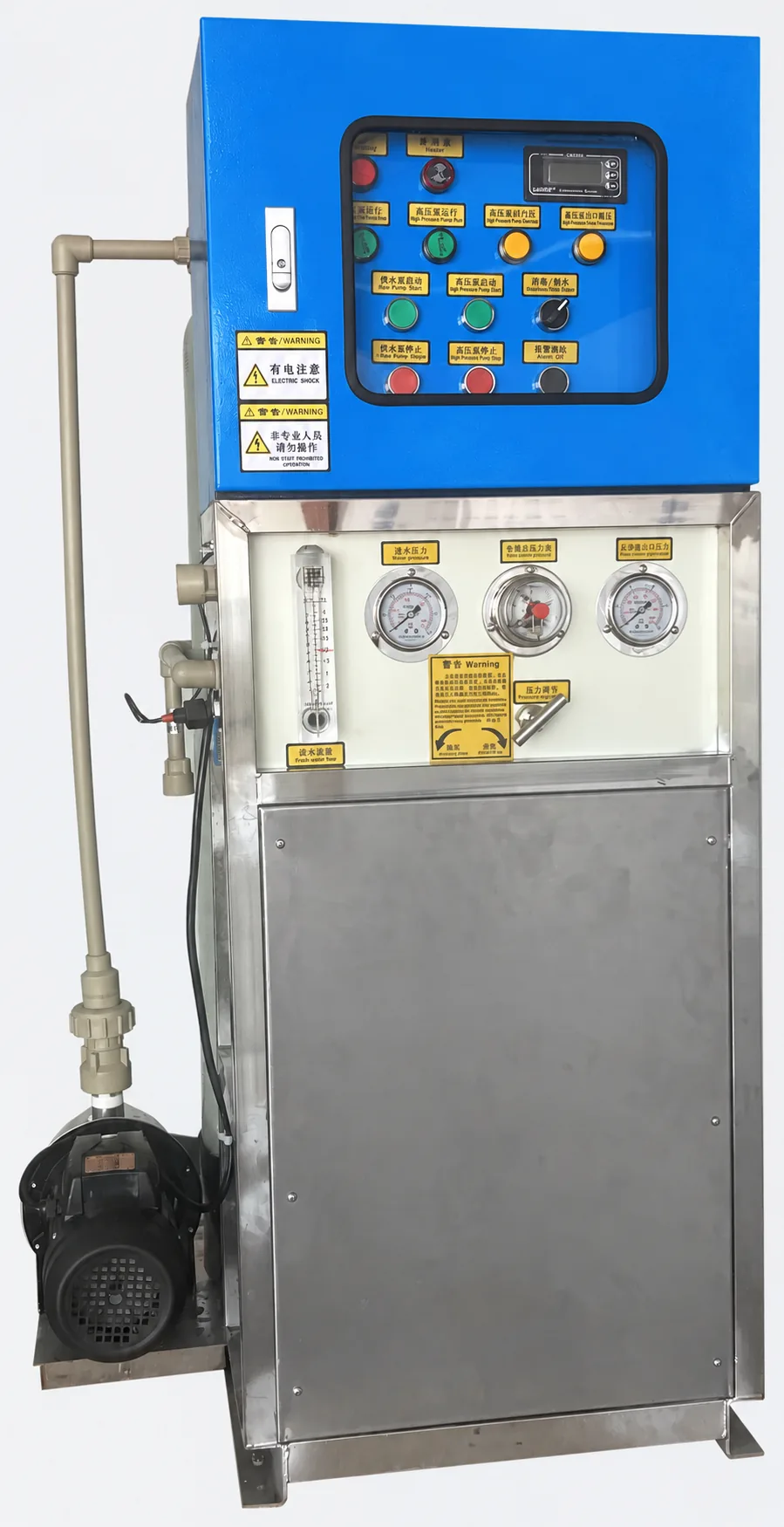
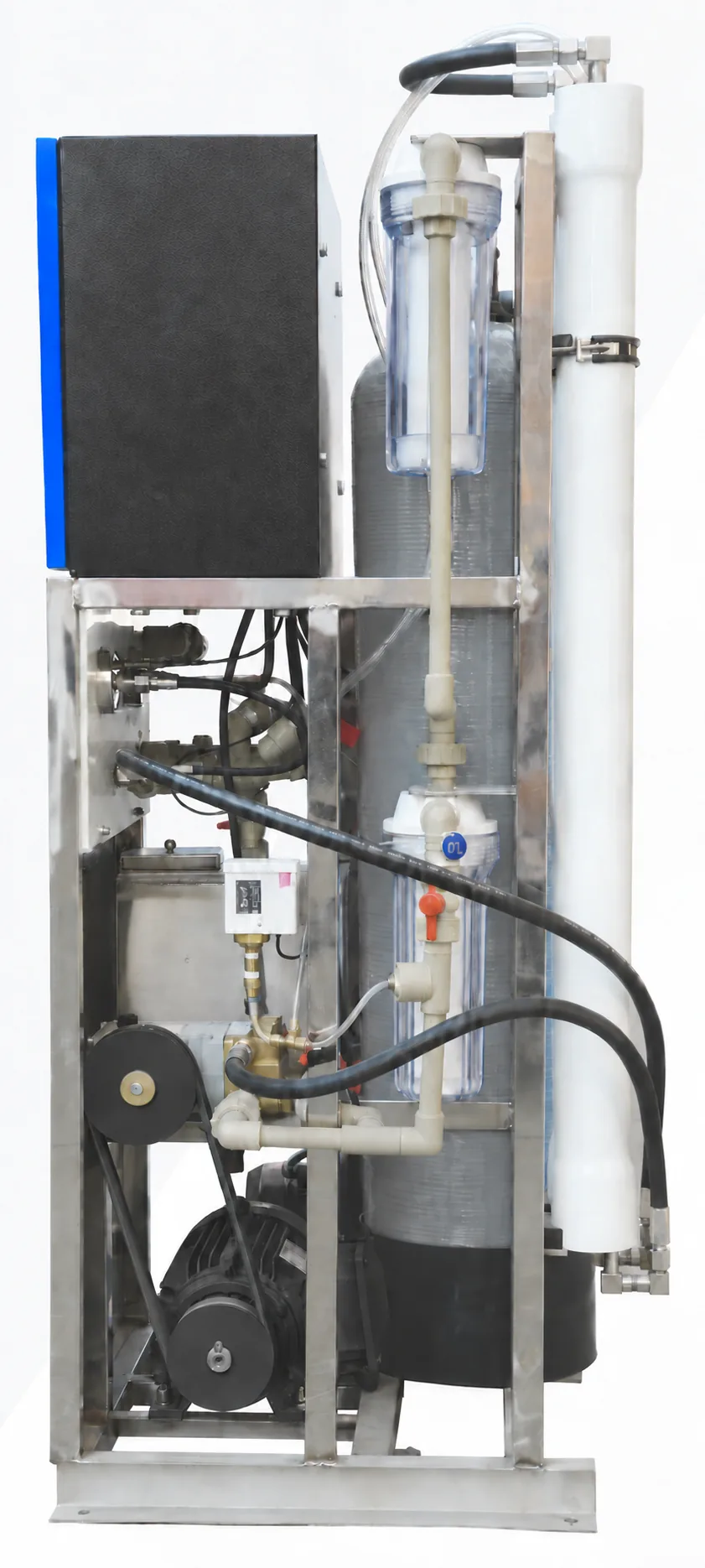
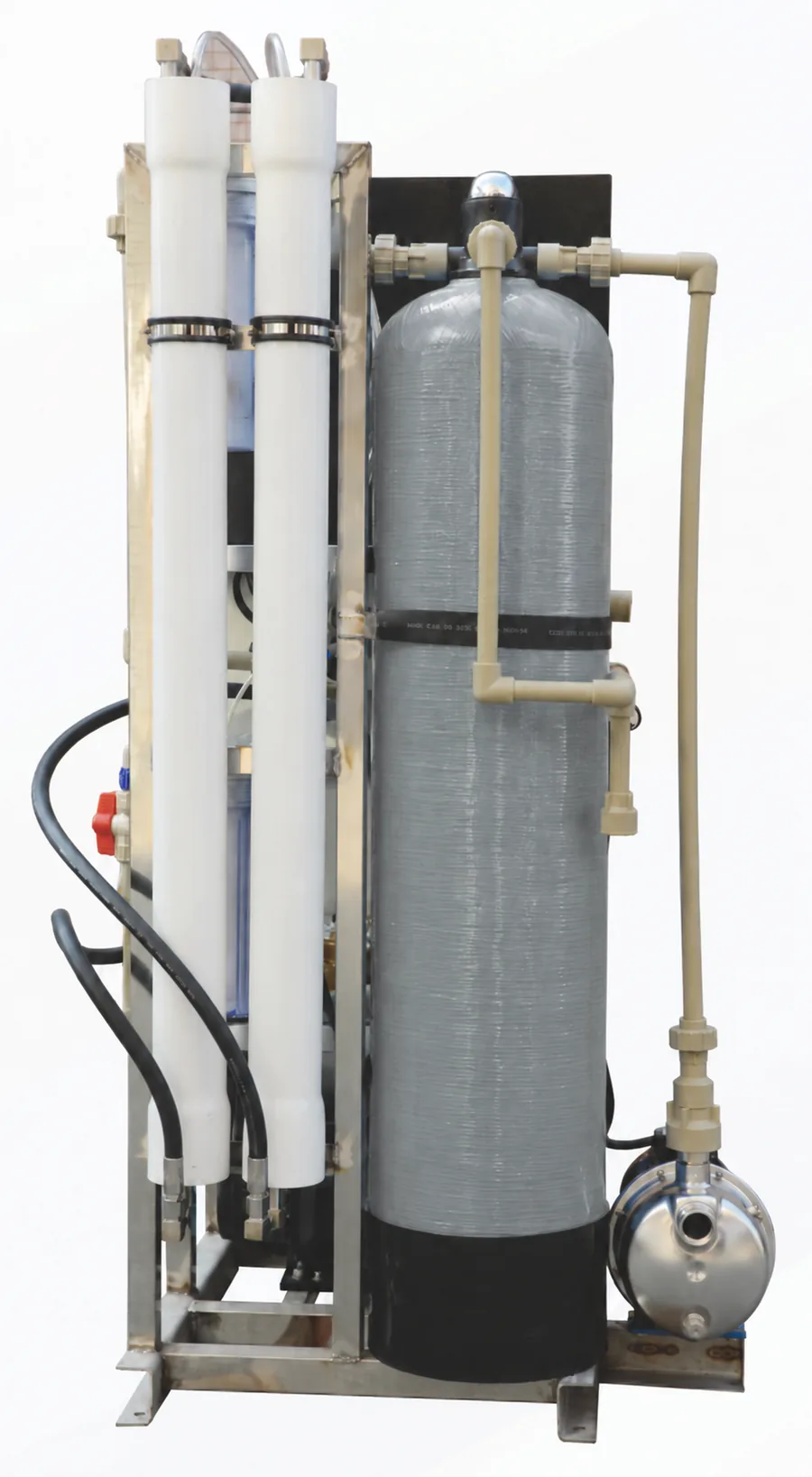
1-year whole-machine warranty from commissioning. Exclusions: membranes, filter cartridges and other consumables. First-tier brand membranes and components (e.g., Dow, Hydranautics) and control configuration are selected for your feed-water salinity and quality targets.
KONCHEINDUSTRIAL WATER TREATMENT SYSTEMSMODEL KC-SW · SEAWATER DESALINATION (SWRO)99.2% REJECTION0.5–500 m³/DENGINEERED BY KONCHE · 2026
PRODUCT DOCUMENTATION
Product documentation
A seawater desalination plant and RO system is configured from the feed-water analysis and the required product-water quality. Project inputs include the intake conditions, salinity, temperature, SDI, target capacity and product-water requirements.
Each KC-SW unit is factory-assembled and tested before shipment. The control system runs a touch-screen HMI with online display of operating status and faults, manual alarm acknowledgement and silencing. Protective functions stop the high-pressure pump automatically with a sound-and-light alarm when outlet pressure exceeds 6.5 MPa or when feed pressure falls below 0.05 MPa. The multimedia filter is backwashed and forward-flushed through a manual or automatic multiport valve, and a built-in RO cleaning system performs physical flushing, concentrate displacement, chemical cleaning (CIP) and preservative dosing for shutdowns. High-spec variants add IP56-rated electric control and a tighter ≤20 ppm product-water option. KONCHE has manufactured water treatment equipment since 1997 and configures every desalination unit from a verified feed-water analysis.
CORE BENEFITS
01
Full-strength seawater duty
Membrane train rated for feed water up to 40,000 ppm TDS — open-sea salinity — with 99.2% salt rejection.
02
Drinkable-grade output
Product water at ≤700 ppm TDS; with disinfection the outlet is engineered to the GB 5749 drinking-water standard as its design basis.
03
0.5–500 m³/d project range
Capacity is selected from the verified feed-water data, required daily output and product-water requirements.
04
50 Hz & 60 Hz ready
AC380V/50Hz, AC440V/60Hz and AC480V/60Hz three-phase options cover export grids without re-engineering.
05
Built-in cleaning & protection
Integrated membrane CIP (flush, displacement, chemical clean, preservative) plus 6.5 MPa over-pressure and 0.05 MPa under-pressure pump protection.
06
Factory-direct since 1997
Manufactured by KONCHE in Shenzhen with first-tier membranes and components selected for your salinity and duty.
TECHNICAL DATA
Full technical data
Parameter
Specification
Model series
KC-SW 0.5 – KC-SW500
Fresh water output
0.5–500 m³/d
Feed water TDS
< 40,000 ppm (seawater)
Desalination rate
99.2%
Product water TDS
≤ 700 ppm (high-spec variant ≤ 20 ppm)
Working pressure
3.5–5.5 MPa
System recovery
≈ 25–35% (depending on temperature and feed water)
Operating temperature
5–45 °C
Feed water pH
3–10
Power supply
AC380V/50Hz · AC440V/60Hz · AC480V/60Hz, 3-phase
RO membranes
First-tier brand spiral-wound elements (e.g., Dow)
Membrane cleaning
Built-in CIP: physical flush, concentrate displacement, chemical clean, preservative dosing
High-pressure pump protection
Shut-down + sound/light alarm at >6.5 MPa outlet or <0.05 MPa inlet pressure
Electric control protection
IP56 on high-spec variants; touch-screen HMI with online status/fault display
Packing
Project-specific; confirm the approved packing and shipping scope during quotation.
MODEL RANGE
Two duty classes cover every seawater desalination project.
Small-scale Sea Water Desalination Treatment
Model
Fresh water output
Installed power
Net weight
Footprint L×W×H (mm)
KC-SW0.5
0.5 m³/d
0.75 kW
15 kg
680×250×350
KC-SW1.5
1.5 m³/d
1.1 kW
100 kg
800×500×650
KC-SW3
3 m³/d
1.5 kW
150 kg
500×570×1,350
KC-SW5
5 m³/d
2.2 kW
400 kg
910×500×1,540
KC-SW10
10 m³/d
5.5 kW
600 kg
1,520×780×1,935
KC-SW20
20 m³/d
10 kW
900 kg
1,520×830×2,025
KC-SW30
30 m³/d
15 kW
1,200 kg
2,440×1,000×2,120
Large-scale Sea Water Desalination Treatment
Model
Fresh water output
Installed power
Net weight
Footprint L×W×H (mm)
KC-SW40
40 m³/d
15 kW
1,600 kg
2,300×1,100×2,310
KC-SW50
50 m³/d
18.5 kW
2,000 kg
2,300×1,100×2,310
KC-SW60
60 m³/d
21 kW
2,200 kg
2,350×1,200×2,300
KC-SW100
100 m³/d
45 kW
4,500 kg
5,000×2,000×1,900
KC-SW200
200 m³/d
60 kW
5,500 kg
5,000×2,000×1,900
KC-SW500
500 m³/d
110 kW
14,500 kg
9,500×2,000×2,000
FIND YOUR CONFIGURATION
By feed-water quality — which system treats my water?
Seawater and high-salinity wells up to 40,000 ppm TDS belong on this KC-SW SWRO line. Brackish well water below roughly 10,000 ppm is handled more economically by a single or double-stage RO system. Turbid surface water from rivers and lakes (10–500 NTU) does not need desalination at all — a containerized clarification plant is the correct train.
By daily output — which model size fits?
Use the verified 24-hour demand to define the required daily output within the current 0.5–500 m³/d project range. Final selection also depends on the intake conditions, salinity, temperature, SDI and required product-water quality; capacity alone is not enough to select the system.
By industry — where are these plants deployed?
Island resorts and hotels use SWRO for guest, laundry and kitchen water. Coastal food, textile and process plants replace trucked water with desalinated make-up. Mining and construction camps secure independent supply where no municipal network exists. Villages and island communities gain a drinking-water source designed to the GB 5749 standard with disinfection. Offshore oil and gas platforms draw from the same line — typically 5 m³/d and above, sized to crew count and process demand. Vessels use the compact 0.5–10 m³/d skids.
INDUSTRY APPLICATIONS
Application
System value
Island resorts & hotels
Seawater treatment configured from the intake conditions and required product-water quality.
Coastal industry & F&B
Process and boiler make-up water without municipal dependency; ≤20 ppm variant feeds further polishing.
Mining & construction camps
Project-configured seawater treatment for remote coastal sites.
Villages & island communities
Community drinking water engineered to the GB 5749 standard as design basis, with disinfection.
Marine & offshore
Compact 0.5–10 m³/d units for vessels, yachts and offshore quarters.
Offshore oil & gas platforms
Crew and process fresh water on self-contained platforms; duties typically start at 5 m³/d and scale with headcount.
SELECTION GUIDE
01
Test the feed water
Confirm TDS (must be <40,000 ppm), turbidity and temperature; high-turbidity seawater needs added pretreatment.
02
Fix the duty
Define verified daily demand, product-water target (≤700 ppm standard or ≤20 ppm high-spec) and disinfection requirement.
03
Match power & footprint
Confirm the site's power supply and installation footprint against the selected project configuration.
04
Buy from the manufacturer
Send your water analysis and duty to KONCHE factory-direct for a configured proposal, 24-hour engineering response and performance-guaranteed rectification if the outlet misses the agreed standard.
MAINTENANCE
Item
Trigger / cycle
Work performed
Multimedia filter backwash
Pressure-drop or timer based
Backwash and forward flush via the multiport valve restore filter capacity.
RO membrane cleaning
Normalized pressure drop / flux decline
Built-in CIP: physical flush, concentrate displacement then chemical cleaning.
Cartridge & chemicals check
Routine service visit
Replace pretreatment cartridges, verify dosing and membrane condition.
Shutdown preservation
Before extended stops
Dose preservative through the built-in system to protect the membranes.
FAQ
What feed water does a KC-SW unit accept?
Seawater and high-salinity sources below 40,000 ppm TDS, at pH 3–10 and 5–45 °C. Feed turbidity should be controlled by the multimedia pretreatment; very turbid or oily seawater needs extended pretreatment configured per the water analysis.
Can the product water be drunk directly?
The RO stage delivers ≤700 ppm TDS fresh water (≤20 ppm on the high-spec variant). With the disinfection stage, output is engineered to the GB 5749-2006 drinking-water standard as the design basis; local potable compliance remains the project's responsibility and should be verified on site.
Will it run on my country's power grid?
Yes — the series is offered in AC380V/50Hz, AC440V/60Hz and AC480V/60Hz three-phase versions, covering 50 Hz and 60 Hz export markets without custom re-engineering.
SWRO or brackish-water RO — which do I need?
It is decided by feed TDS, not preference. Feed above roughly 10,000 ppm needs the SWRO pressure class on this page; lower-salinity brackish wells are served more efficiently by a single or double-stage RO system — see the Saudi Arabia selection guide in Related reading for the full decision logic.
Which countries do you supply?
Systems have been supplied to Saudi Arabia, Kuwait, Qatar, Singapore, Kenya, Morocco, Ghana, Egypt, Gabon and other markets across the Middle East, Africa and Southeast Asia. Share your location and duty and we will confirm the shipping configuration and documentation for your port.
How is the equipment shipped?
Packing and shipment are confirmed during quotation for the approved project configuration.
How much does a seawater desalination plant cost?
Pricing is project-specific because a seawater desalination plant must be configured from the intake conditions, feed-water salinity, temperature and SDI, required capacity, and product-water requirements. Share these inputs so KONCHE can prepare the technical scope and quotation; capacity alone is not enough for a reliable price.
How does a seawater RO system work?
A seawater RO system conditions the incoming seawater through project-specific intake arrangements and pretreatment before the SWRO membranes separate dissolved salts from the feed. The permeate then receives post-treatment selected for its intended use, with UV included only where the application requires it.
What information is needed to design a seawater RO system?
Provide the intake or source arrangement, feed-water salinity, temperature and SDI, target capacity, and required product-water quality or use. These inputs define the project-specific process scope and quotation.
GLOBAL DELIVERY
KONCHE seawater desalination systems have been supplied to buyers across the Middle East, Africa and Southeast Asia — including Saudi Arabia, Kuwait, Qatar, Singapore, Kenya, Morocco, Ghana, Egypt and Gabon, among other markets.
Saudi Arabia
Kuwait
Qatar
Singapore
Kenya
Morocco
Ghana
Egypt
Gabon
& more markets worldwide
Every unit ships factory-tested with project-specific packing and complete documentation, and our engineering team supports remote commissioning guidance across time zones.
WHY KONCHE
01
Nearly 30 years of expertise
Since 1997, KONCHE has accumulated practical experience across raw-water conditions, treatment processes and industrial project delivery.
02
Professional customization
Each desalination unit is configured from the verified feed-water analysis, duty, power standard and installation footprint.
03
Controlled system quality
First-tier membranes and pumps, factory testing and water-quality verification are managed as one complete system.
Share your feed-water analysis (TDS, turbidity, temperature), daily demand, product-water target and local power standard for a configured seawater desalination proposal.