Rainwater Filtration System for Drinking Water at a University Campus in Shenzhen
Project design published 22 October 2026 · Institutional client not named
KONCHE engineered this rainwater filtration system to turn harvested campus rainwater into drinking water for a Sino-foreign university campus in Shenzhen. Roof rainwater changes from storm to storm — its organic load, suspended solids and colour all vary — so the system was designed around filtration, membrane separation and final disinfection to handle that variation.
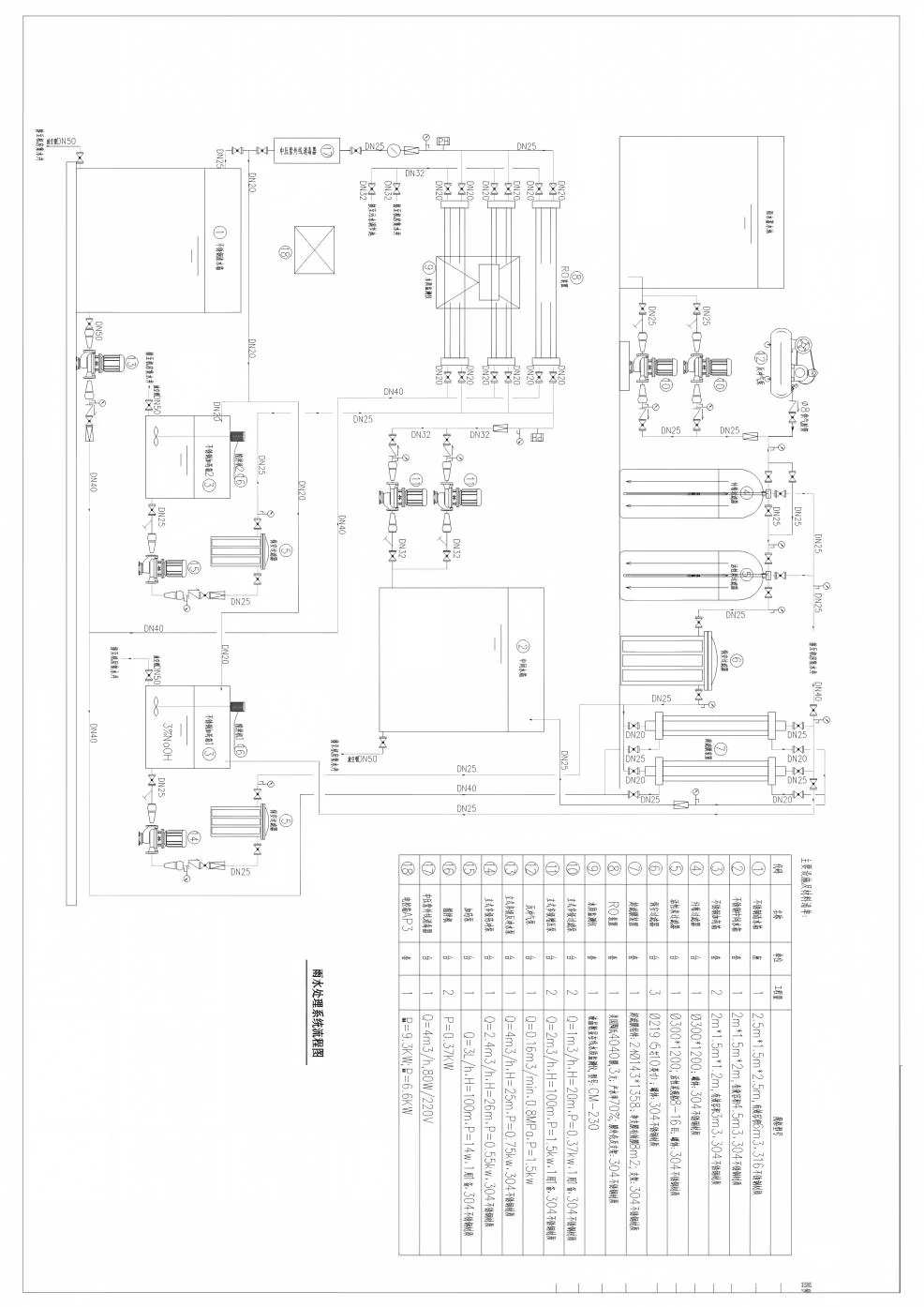
The system treats 12 m³/day of collected rainwater through fiber filtration, activated-carbon filtration, cartridge filtration, ultrafiltration (UF), reverse osmosis (RO) and UV disinfection, with an RO permeate output of approximately 1 m³/h. The design target is China's national drinking-water standard (GB 5749).
Confidentiality note: The institution's name and identifying commercial details have been withheld. The photographs show the equipment during installation and are not water-quality results.
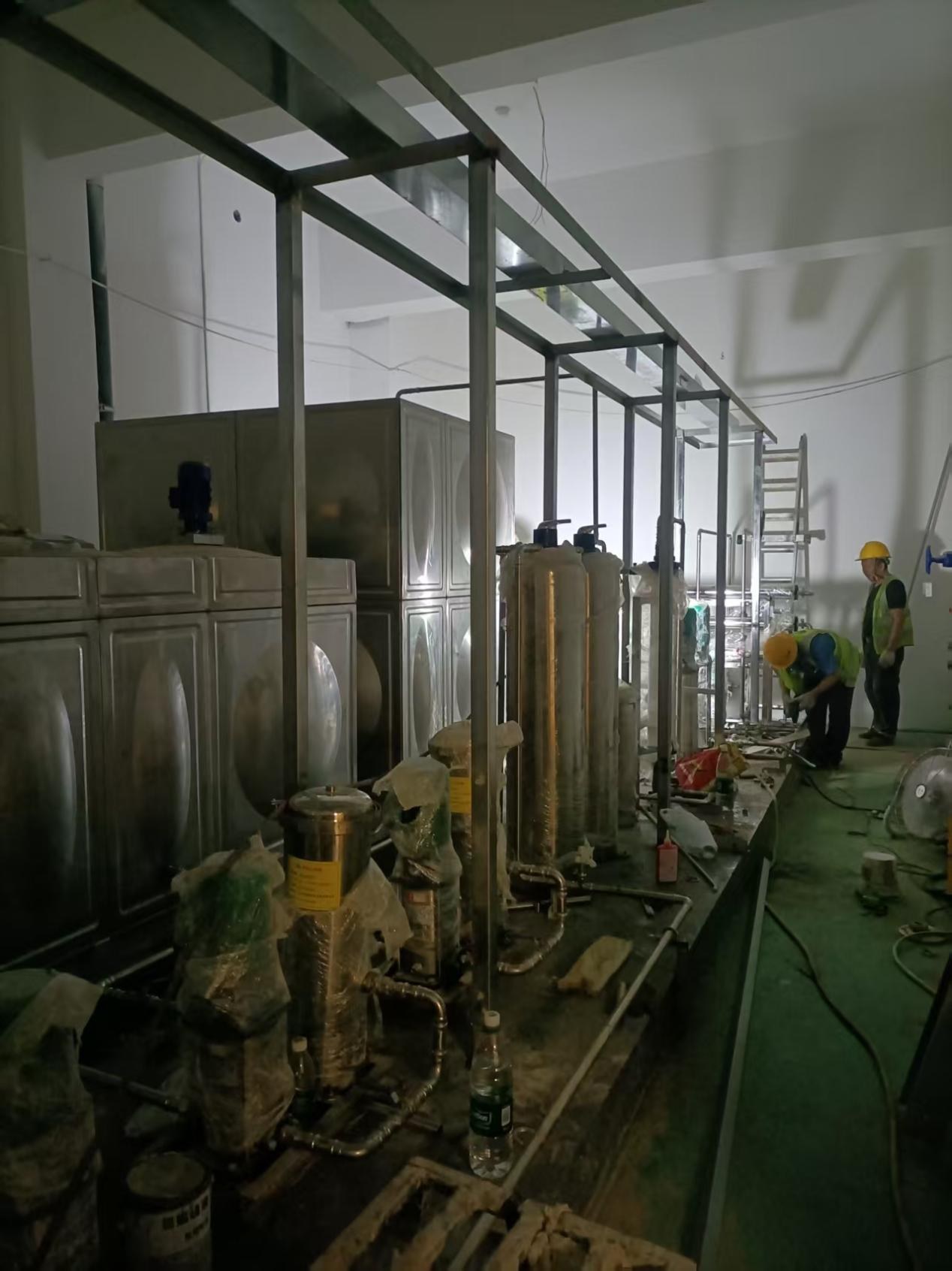
Campus rainwater filtration system design at a glance
- Location
- University campus, Shenzhen, China
- Water source
- Harvested roof rainwater from campus buildings
- Intended use
- Campus drinking water
- Daily treatment volume
- 12 m³/day
- RO permeate output
- Approximately 1 m³/h (design value)
- Raw-water design basis: CODcr
- Up to 100 mg/L
- Raw-water design basis: suspended solids
- Up to 40 mg/L
- Raw-water design basis: colour
- Up to 40 degrees
- Product-water target
- China national drinking-water standard (GB 5749)
- Treatment process
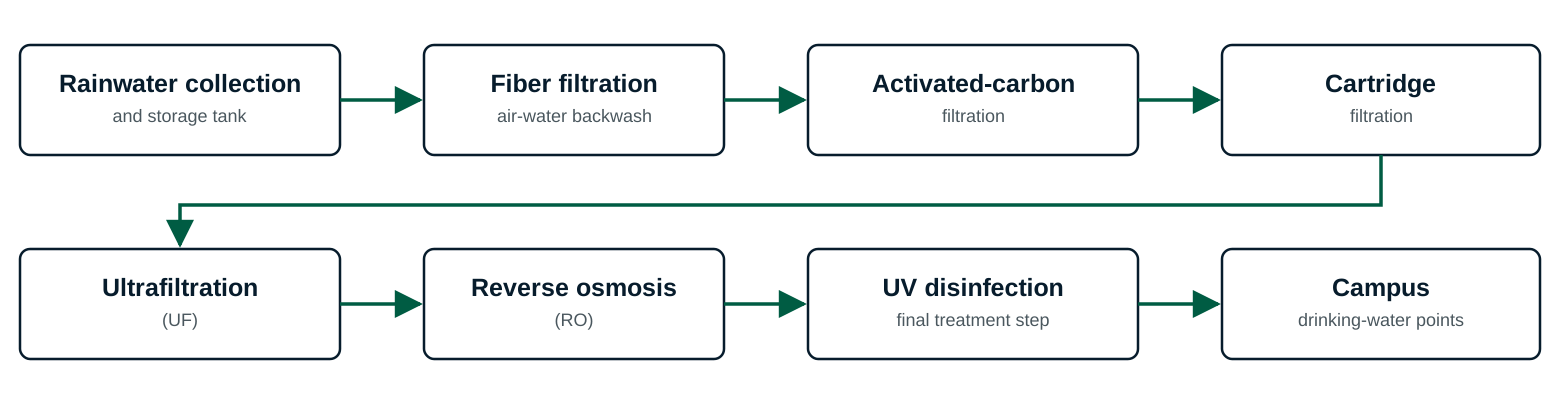
- Fiber filtration → activated-carbon filtration → cartridge filtration → ultrafiltration → reverse osmosis → UV disinfection
- Status
- Design, layout, electrical drawings and site installation completed
Why does roof rainwater need full treatment before it is potable?
Collected rainwater is not clean. Between rainfall events, roof and catchment surfaces accumulate organic matter and particles, and the first flush of each storm carries the highest load. In this project, the design basis reached CODcr 100 mg/L, suspended solids 40 mg/L and colour 40 degrees — far beyond what potable use allows without treatment. Storage also creates microbial risk, which is why disinfection comes at the end of the process.
The design treats rainwater like any other variable surface water: test the raw quality, protect the membranes with pretreatment, remove dissolved impurities with RO, and disinfect the treated water right before it is used.
What treatment process turns this campus rainwater into drinking water?
The treatment sequence is shown below. Each stage protects the next: media filtration and activated carbon remove the particles, organics and colour that would foul the membranes; cartridge filtration is the last particle barrier; UF and RO handle the fine separation and the dissolved impurities; and UV disinfection is the final step before the drinking-water points.
1. Fiber filtration
The fiber filter reduced the suspended-solids and particle load entering the downstream stages. It was designed for automatic air–water backwashing, with a water-wash intensity of 4–6 L/s·m², an air-wash intensity of 14–16 L/s·m² and a 5–8 minute backwash sequence. The specified trigger is a head-loss build-up of approximately 5–6 m across the filter bed. These are this project's design values; another site with different rainwater may need different settings.
2. Activated-carbon filtration
The activated-carbon stage reduces the organic load (the CODcr in the design basis), colour and any oxidants that could damage the membranes downstream. Carbon capacity is finite and rainwater organics vary by season, so replacement should follow measured performance, not just a calendar.
3. Cartridge filtration
A cartridge filter is the last particle barrier between the media filters and the membranes, catching any carry-over before it can reach the UF modules and the RO high-pressure pumps.
4. Ultrafiltration (UF)
The UF stage was placed before RO as a fine particle and microbial barrier. In this project it was specified with a combined forward-flush and backwash regime — a 30-second forward flush followed by a 60-second backwash on alternating 60-minute cycles — plus periodic chemical cleaning with a 0.3% NaOH solution at 60–180 day intervals. Putting UF before RO was a project-specific choice for this highly variable raw water; other projects may arrange the membranes differently.
5. Reverse osmosis (RO)
The RO section removes the dissolved impurities and produces the approximately 1 m³/h permeate sized for the campus drinking-water demand. The design also fixed the cleaning routine: when the pressure drop across an RO stage exceeds 0.35 MPa, the membranes are chemically cleaned for about 1.5 hours and then rinsed with permeate for at least 20 minutes; acid is dosed during cleaning if the solution pH drifts out of its set range.
6. UV disinfection
UV disinfection is the final treatment step, right before the campus drinking-water points. It adds chemical-free microbial control where storage and distribution could otherwise bring contamination risk back. UV is a final barrier — it does not replace hygienic storage, clean piping and local potable-water checks.
How are the filters and membranes kept clean?
Cleaning design is what keeps a rainwater system stable through seasonal raw-water changes. Three cleaning layers were specified in this project:
- Regular media cleaning. Automatic air–water backwash of the fiber filter, triggered by head-loss rather than a fixed schedule alone.
- Membrane flushing. Alternating forward-flush and backwash cycles for the UF stage on a 60-minute rhythm, to keep fouling from building up between chemical cleanings.
- Chemical cleaning (CIP). Periodic UF chemical cleaning with 0.3% NaOH at 60–180 day intervals, and condition-triggered RO membrane cleaning when stage differential pressure exceeds 0.35 MPa, each followed by a defined rinse.
These intervals are this project's design values. A new project should set its own cleaning regime from its actual water analysis and operating conditions, not copy this case.
What affects the cost of a commercial rainwater filtration system?
Two rainwater systems with the same nominal output can require very different equipment. The main cost drivers are:
- the catchment size, storage volume and equalization capacity between rainfall events;
- the variability of the raw rainwater and the pretreatment stages needed to protect the membranes;
- the required product-water standard — technical reuse, drinking water and food-contact uses need different levels of treatment and verification;
- the membrane arrangement, cleaning design, materials of construction and level of automation;
- site power, installation space, concentrate disposal, shipping, commissioning, documentation and spare-parts scope.
For this reason we do not publish the project's quotation. A comparable system can only be priced once the buyer shares the raw-water situation, the intended use and standard, and the required output.
What should buyers verify before building a rainwater-to-drinking-water project?
Potable use of rainwater is regulated everywhere. This system was designed against China's national drinking-water standard (GB 5749); a project in another country must be checked against the local drinking-water rules, and KONCHE confirms those rules at the start of every project.
Before manufacturing, the engineering review should confirm:
- the catchment description, storage arrangement and expected raw-water quality range;
- the intended use, applicable standard and any local approval pathway;
- hygienic storage and distribution design after treatment;
- the membrane projection, recovery and cleaning regime against the confirmed analysis;
- the documentation package: process description, equipment list, control logic, operation and maintenance guidance, and agreed spare parts.
Frequently asked questions
Can rainwater be turned into drinking water?
Yes — when the rainwater is collected, stored and treated as a designed raw-water source, not just assumed to be clean. In this project, variable roof rainwater with high COD, suspended solids and colour was treated through filtration, ultrafiltration, reverse osmosis and UV disinfection to meet a national drinking-water standard. Untreated rainwater is not potable, and every project must be checked against its local requirements.
How do you filter rainwater to drinking-water quality?
A rainwater system must remove both particles and dissolved impurities. This project used fiber and activated-carbon filtration for suspended solids, organics and colour, cartridge filtration to protect the membranes, ultrafiltration as a fine particle and microbial barrier, reverse osmosis for dissolved impurities, and final UV disinfection. The exact sequence depends on the raw water, so it should always be confirmed from a water analysis and the required standard.
Why is UV disinfection installed after the RO system?
RO permeate is low in dissolved impurities but not sterile, and storage and distribution can bring microbial risk back. In this project, UV disinfection sits on the treated-water line as the final step before the drinking-water points. It is a chemical-free microbial barrier — but it does not replace hygienic storage, clean piping and local potable-water checks.
What does a commercial rainwater filtration system cost?
Cost is driven by configuration, not just by capacity. The main variables are collection and storage volume, how much the raw rainwater varies, the pretreatment needed to protect the membranes, the target standard, and the level of controls and monitoring. We do not publish this project's price; a comparable system is quoted from a defined water analysis and a defined treatment target.
What information is needed to design a rainwater-to-drinking-water system?
Useful design inputs include the catchment area and expected rainwater yield, storage volume, raw-water quality and its seasonal variation, the required daily and hourly output, the intended use and applicable standard, available power and installation space, and how the membrane concentrate (reject water) will be discharged. With these inputs, the treatment sequence, membrane selection and cleaning design can be engineered for the specific project.
Turn rainwater into a
designed drinking-water supply.
Send KONCHE your catchment description, raw-water quality, target standard and required capacity for a project-specific rainwater treatment design.
Request a Technical Proposal and Quotation ↗