How Does Reverse Osmosis Work? Selecting an Industrial RO Water Treatment System
This guide explains what RO removes, how a complete system is arranged, how river water, well water, and seawater change the design, when to use single-pass or double-pass RO, how to calculate the basic water balance, and what an industrial quotation must state.
A reverse osmosis (RO) water treatment system uses pressure and a semi-permeable membrane to separate dissolved salts and other rejected substances from water, producing a treated stream called permeate and a concentrated stream called reject or concentrate. In plain language, pressure pushes water through the membrane while much of the dissolved salt stays behind. Selecting an industrial RO system starts with four inputs: a current feed-water analysis, the required product-water specification, continuous and peak demand, and the site's operating constraints. The RO membrane is the central separation stage, but a reliable plant also needs pretreatment, controls, cleaning provisions, post-treatment, and a documented concentrate route. The correct system is therefore a treatment train designed around the water and its final use, not a standard membrane skid selected from flow alone.
Get an Equipment Quote ↗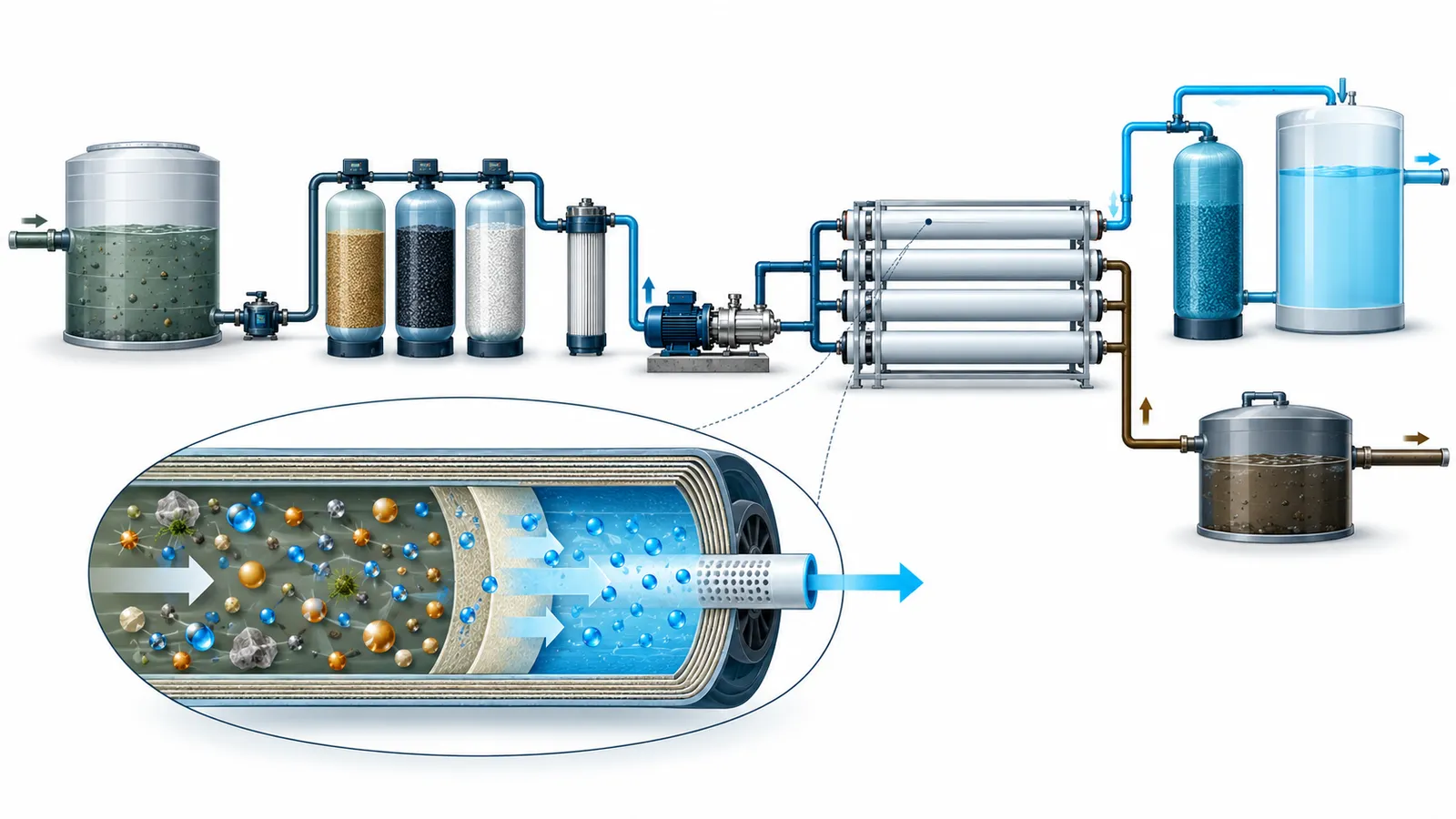
How Does Reverse Osmosis Work? Selecting an Industrial RO Water Treatment System
A reverse osmosis (RO) water treatment system uses pressure and a semi-permeable membrane to separate dissolved salts and other rejected substances from water, producing a treated stream called permeate and a concentrated stream called reject or concentrate. In plain language, pressure pushes water through the membrane while much of the dissolved salt stays behind. Selecting an industrial RO system starts with four inputs: a current feed-water analysis, the required product-water specification, continuous and peak demand, and the site's operating constraints. The RO membrane is the central separation stage, but a reliable plant also needs pretreatment, controls, cleaning provisions, post-treatment, and a documented concentrate route. The correct system is therefore a treatment train designed around the water and its final use, not a standard membrane skid selected from flow alone.
On this page
- What does reverse osmosis remove from water?
- What equipment is in an industrial RO system, and what does the process diagram include?
- How does the water source change the RO process?
- When do you need single-pass or double-pass RO?
- How do you calculate RO capacity and recovery?
- How should RO pretreatment be selected?
- What comes after reverse osmosis?
- What should an industrial RO quotation state?
- Frequently asked questions
Related: KONCHE single- and double-stage RO equipment page · single-pass versus double-pass RO guide · river-water treatment and RO pretreatment guide · well water treatment hub
What does reverse osmosis remove from water?
RO is a pressure-driven membrane process. Feed pressure overcomes osmotic pressure and moves water through the membrane while most dissolved salts and many larger dissolved substances remain in the concentrate. Actual rejection depends on the membrane, ion or compound, temperature, pressure, pH, recovery, membrane condition, and system design; a single headline rejection percentage is not a complete performance guarantee.
| Feed-water constituent | Typical role of RO | What must still be considered |
|---|---|---|
| Dissolved salts and conductivity | Bulk reduction | Product target, feed salinity, temperature, recovery, membrane selection |
| Hardness ions | Strong reduction | Scale control and softening or antiscalant may still be needed before RO |
| Silica, nitrate, fluoride and boron | Rejection varies by species and conditions | Require ion-specific projections and guarantees where a limit matters |
| Dissolved organics | Many are reduced | Molecular size and chemistry affect passage; pretreatment may be required |
| Particles, silt and colloids | Should be removed before the membrane | RO is not a substitute for clarification, multimedia filtration, or ultrafiltration |
| Microorganisms | The membrane can form a physical barrier | Integrity, storage hygiene, and final disinfection still require separate control |
| Dissolved gases such as carbon dioxide | May pass through the membrane | Degassing, pH adjustment, or polishing may be needed for low conductivity |
RO is therefore selected from the complete water analysis, not total dissolved solids (TDS) alone. If the main problem is suspended solids or microbes and the dissolved-salt level is already acceptable, filtration and disinfection may meet the duty without RO.
What equipment is in an industrial RO system, and what does the process diagram include?
A commercial RO plant normally contains six functional blocks:
- Feed and equalization — source pump, raw-water tank where required, flow control, and protection against dry running or unstable supply.
- Pretreatment — screening, clarification, multimedia filtration, activated carbon, softening, antiscalant dosing, iron removal, ultrafiltration, or another process selected from the source water.
- Cartridge protection and high-pressure pumping — the final physical guard followed by a pump sized for the membrane duty point.
- RO membrane array — pressure vessels, membrane elements, staging, concentrate control, flushing connections, and clean-in-place provisions.
- Instrumentation and controls — conductivity, pressure, flow, temperature, alarms, interlocks, data logging, and a programmable logic controller (PLC).
- Post-treatment and storage — remineralization, pH adjustment, ultraviolet (UV) disinfection or ozone where appropriate, protected storage, and distribution.
The KONCHE single- and double-stage RO equipment page shows the commercial platform, while the detailed single-pass versus double-pass RO guide explains how the membrane architecture changes when a lower product-water conductivity is required.
How does the water source change the RO process?
The water source determines the pretreatment load, pressure range, recovery limit, membrane type, and concentrate volume. "RO system" is therefore a family of designs rather than one fixed machine.
| Source water | Main design risks | Typical route before and through RO | Main decision |
|---|---|---|---|
| River or reservoir | Seasonal turbidity, silt, algae, organics, microbial load | Screening → clarification or ultrafiltration → cartridge filtration → RO if dissolved-salt or process targets require it | Whether RO is necessary after clarification |
| Municipal water | Chlorine, hardness, stable dissolved salts | Activated carbon or dechlorination → softening/antiscalant → cartridge → RO | Single-pass versus double-pass target |
| Fresh or brackish well | Hardness, iron, manganese, hydrogen sulfide, salinity | Oxidation/filtration and scale control → brackish-water RO | Pretreatment and recovery based on ion balance |
| Seawater | High osmotic pressure, marine solids and biology, boron | Robust intake pretreatment → high-pressure seawater reverse osmosis (SWRO) with energy recovery | Intake, energy, recovery, corrosion, brine discharge |
| Treated wastewater or reuse stream | Organics, biofouling, variable chemistry, trace contaminants | Biological/tertiary treatment → ultrafiltration (UF) or equivalent barrier → RO | Fouling control, monitoring, concentrate route |
For variable surface sources, use the dedicated river-water treatment and RO pretreatment guide. The well water treatment hub covers hardness, iron, odor, salinity, and testing in process order. For saline feeds, compare the borehole desalination guide with the seawater desalination systems guide and the component-level SWRO plant guide.
When do you need single-pass or double-pass RO?
A single-pass RO system sends the pretreated feed through one RO system. A double-pass or two-pass RO system sends first-pass permeate through a second RO system for further ion removal and more stable low-conductivity water. This is different from membrane staging, where concentrate flows through successive pressure-vessel groups within the same pass.
Choose the number of passes from the required product-water specification and a membrane projection at the design feed conditions. General industrial washing, ingredient preparation, lower-pressure boiler makeup, and many drinking-water duties may use single-pass RO. Electronics, pharmaceutical support systems, high-pressure boiler makeup, or feeds to electrodeionization (EDI) may require double-pass RO or further polishing.
Do not select two passes only because the raw-water TDS exceeds an arbitrary number. A properly designed single pass may meet the target on one feed, while another project may need two passes because of a strict conductivity, silica, boron, or process limit.
How do you calculate RO capacity and recovery?
Start with the required net product-water flow, not the nominal membrane capacity. Then account for operating hours, storage, planned downtime, temperature, membrane aging, and the water used by pretreatment and cleaning.
The basic membrane water balance is:
Feed flow = product flow ÷ recovery
Concentrate flow = feed flow − product flow
For a plant required to deliver 10 m³/h of permeate:
| Design recovery | Required RO feed | Concentrate flow |
|---|---|---|
| 50% | 20.0 m³/h | 10.0 m³/h |
| 70% | 14.3 m³/h | 4.3 m³/h |
| 80% | 12.5 m³/h | 2.5 m³/h |
Higher recovery reduces concentrate volume but increases salt concentration at the tail of the array and can raise scaling and fouling risk. Recovery must be supported by the full ion analysis and membrane-design calculation; it is not a sales preference. Storage should cover demand peaks and maintenance windows instead of forcing the membrane plant to chase short hourly peaks.
How should RO pretreatment be selected?
Pretreatment is selected by the foulants that must be controlled at the membrane inlet:
- Suspended solids and colloids: clarification, multimedia filtration, or the industrial ultrafiltration system.
- Hardness and scale-forming ions: softening, antiscalant, pH control, or a combination based on the concentrate chemistry.
- Iron and manganese: oxidation and filtration before the membrane.
- Free chlorine: activated carbon or reducing-agent dosing where the selected membrane requires dechlorination.
- Organics and biological load: source control, coagulation, carbon, UF, biocide strategy, and shutdown hygiene as appropriate.
A conventional media sequence is quartz-sand or multimedia filtration first, followed by activated carbon when organic load, taste and odor, or free chlorine must be controlled. Softening or ion exchange—when justified by hardness and concentrate scaling—is placed after the relevant media treatment and before the final cartridge filter and high-pressure pump. For seawater, ion exchange is often uneconomic because the ionic load is high; antiscalant and pH control are more common. The design must leave room for bypasses and later upgrades when source-water risk can change.
Pretreatment must be sized for the worst credible feed condition, not the average laboratory result. A river may change after a storm; a coastal well may become more saline in the dry season; municipal disinfectant residual can change within its permitted range. The quotation should state the feed-water operating envelope the guarantee depends on.
Likewise, nominal capacity is meaningful only with its test conditions. A plant can show higher flow on low-salinity factory water than on cold or high-salinity field feed. Ask for guaranteed net permeate at a stated conductivity or TDS, temperature, recovery and membrane-age basis, with pretreatment and cleaning consumption deducted where applicable.
What comes after reverse osmosis?
RO permeate is not automatically finished water. The downstream treatment depends on use:
- Drinking water may need pH adjustment, remineralization, final disinfection, and protected storage.
- Boiler makeup may require deaeration or polishing; the boiler feedwater selection guide explains the complete train.
- Electronics and laboratory uses may add EDI, ion exchange, organic control, and recirculation; see the laboratory water purification guide.
- Remote projects may package the complete train inside a containerized water treatment system.
Post-RO risks also matter. The RO storage-tank hygiene guide explains how clean permeate can be recontaminated after treatment. The UV systems guide and ozone water-treatment guide compare final barriers and oxidation duties without treating either as a replacement for RO.
What should an industrial RO quotation state?
Require every bidder to state the same design and acceptance information:
- Feed-water analysis, source, sampling date, temperature range, and design limits.
- Net product flow, operating hours, peak demand, and storage assumption.
- Guaranteed product-water parameters against a named standard or process specification.
- Membrane projection showing recovery, permeate quality, feed pressure, flux, and concentrate chemistry.
- Pretreatment and post-treatment scope with the purpose of each stage.
- Pump, membrane, pressure-vessel, piping, and wetted-material specifications.
- Energy use, chemical consumption, cartridge use, and membrane-replacement assumptions.
- Cleaning connections, automatic flush, instruments, alarms, data logging, and remote support scope.
- Factory acceptance test and site verification method.
- Exclusions: civil works, intake, tanks, distribution, concentrate disposal, power, installation, and commissioning.
KONCHE has manufactured commercial and industrial water-treatment equipment since 1997, with packaged RO systems from 0.25 to 50 m³/h. That range covers many skid-mounted and containerized duties, but final performance should be tied to the project's water analysis, operating envelope, and acceptance criteria.
Frequently asked questions
Is reverse osmosis suitable for river, well, and seawater?
Yes, but not with the same design. River water usually needs strong solids and organic pretreatment; well water may need hardness, iron, manganese, or odor control; seawater requires high-pressure membranes, marine-compatible materials, energy recovery, and a brine-discharge plan.
Does every water-treatment plant need RO?
No. RO is justified when dissolved salts, specific ions, or a low-conductivity process target require membrane desalination. Filtration and disinfection may be enough where the dissolved-water chemistry already meets the final specification.
What is the difference between RO recovery and salt rejection?
Recovery is the percentage of feed flow converted to permeate. Salt rejection describes how strongly the membrane reduces a dissolved constituent under stated conditions. Raising recovery does not automatically improve rejection and may increase scaling risk.
Can RO produce drinking water directly?
RO can provide the desalination barrier, but a complete drinking-water system also considers remineralization, pH, microbial control, storage hygiene, distribution, and verification against the applicable national standard.
What information is needed to select an RO system?
Provide a recent full water analysis, source and seasonal variation, required product-water standard, average and peak demand, operating hours, available power, site conditions, storage plan, and concentrate-disposal route.
Does reverse osmosis remove fluoride, hardness, bacteria, and salt?
RO can substantially reduce dissolved salts, hardness ions, and fluoride, and an intact membrane can provide a physical barrier to many microorganisms. Actual rejection depends on the membrane and operating conditions, while microbial safety also requires protected storage, distribution hygiene, and final disinfection where the application demands it.
- US EPA, Overview of Drinking Water Treatment Technologies — Reverse Osmosis/Nanofiltration
- WHO, Guidelines for Drinking-water Quality, fourth edition incorporating the first addendum
- DuPont, FilmTec Reverse Osmosis/Nanofiltration Membranes Technical Manual (45-D01504-en)
- World Bank, The Role of Desalination in an Increasingly Water-Scarce World (2019)
Recommended systems for this application
Systems commonly specified for the duties discussed in this guide:
0.25–50 m³/h single- and double-stage RO skids for process and drinking water.
View specifications ↗CONTAINERIZEDContainerized Water Treatment SystemComplete treatment trains factory-built and wet-tested inside ISO freight containers.
View specifications ↗ULTRAFILTRATIONIndustrial UF Ultrafiltration System0.01 μm ultrafiltration barrier for particles and microbes before RO.
View specifications ↗Start with
your water report.
Send the feed-water analysis, product target and demand. KONCHE designs the RO train — pretreatment, recovery, passes and acceptance criteria on stated conditions.