Planning a Seawater Desalination Plant in the Philippines: A Guide for Islands, Resorts and Municipalities
An island resort can use seawater reverse osmosis (SWRO) to produce drinking water, but the quotation should begin with the actual source-water test, the water demand by use and season, and the hours the plant can run. Product-water storage, intake works, power supply, concentrate disposal and local approvals belong in the same project scope.
Get an Equipment Quote ↗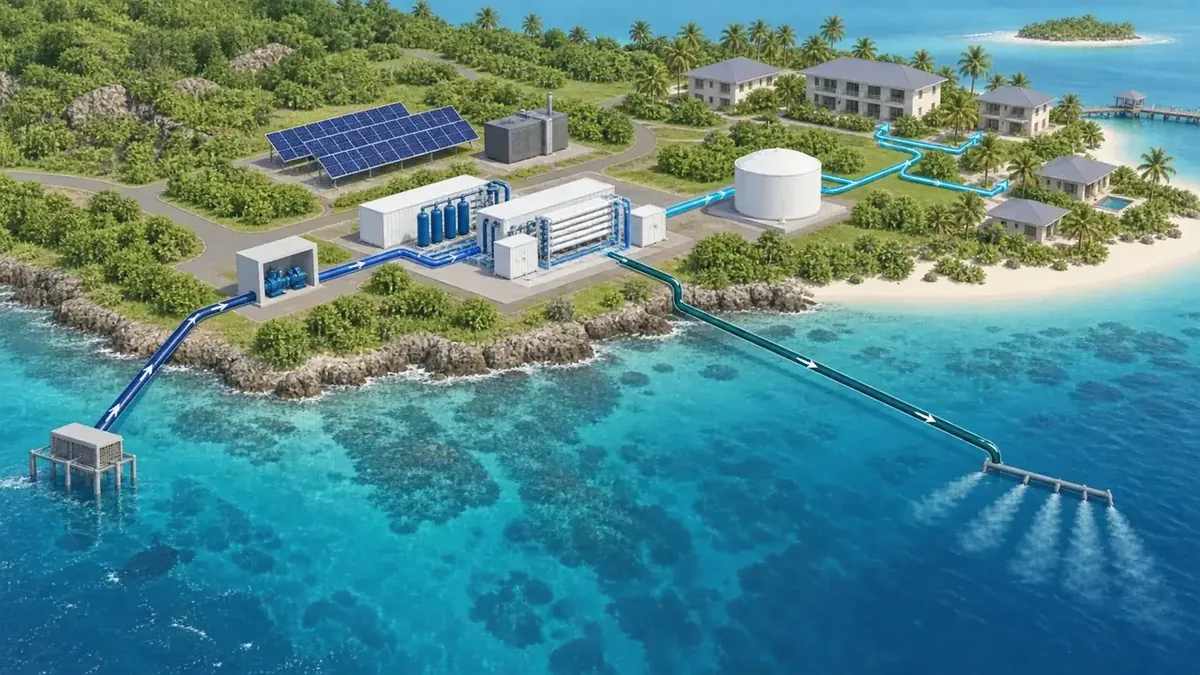
Planning a Seawater Desalination Plant in the Philippines: A Guide for Islands, Resorts and Municipalities
An island resort can use seawater reverse osmosis (SWRO) to produce drinking water, but the quotation should begin with the actual source-water test, the water demand by use and season, and the hours the plant can run. Product-water storage, intake works, power supply, concentrate disposal and local approvals belong in the same project scope. A plant rating alone does not show whether the whole water-supply system will meet a resort's busiest day. Use the five steps below to give suppliers a common design basis and compare what each quotation includes.
On this page
- How can an island make drinking water from seawater?
- Step 1: Test the water you actually have
- Step 2: Define demand honestly — and size for the peak
- Step 3: Choose between brackish RO and seawater RO from the source analysis
- Step 4: Compare containerized and building-based installation
- Can solar power run an island desalination plant?
- Step 5: Prepare the site inputs and the quotation checklist
- Frequently asked questions
Related: seawater RO vs brackish water RO · Philippines water refilling station guide · seawater desalination systems (SWRO) · containerized water treatment systems
How can an island make drinking water from seawater?
An SWRO system normally needs source-water intake, pretreatment, the seawater RO stage, suitable post-treatment and a hygienic distribution system. If the source is a coastal well rather than open seawater, analysis may point to a different RO design. Neither a low permeate TDS reading nor a membrane specification alone establishes that water is safe at the tap. The finished system and its operating and testing plan must address the applicable local drinking-water requirements.
The choice is especially consequential when a resort relies on delivered water, groundwater that becomes saline during dry periods, or a source whose quantity changes with tourism. These are project questions, not reasons to assume every Philippine island needs the same treatment train. A Philippine environmental impact assessment draft for the Crimson Mactan desalination project documents one resort-linked desalination proposal; its scale and proposed works are specific to that project and are not a template for a smaller resort.
Start by separating where water comes from from where treated water goes. Potable use, laundry, irrigation, pool makeup and any community connection may require different volumes and water-quality decisions. This prevents an oversized potable-water line, but only after the owner and designer define which uses it actually serves.
Step 1: Test the water you actually have
Collect a representative sample from the proposed intake, with the sampling point, date, tide or operating condition and season recorded. If you are considering a beach well and an open intake, obtain data for both rather than treating the well as seawater with an automatic natural filter. A proposed beach well needs a site-specific yield and feasibility assessment; an open intake needs an assessment of changing suspended solids and other feed conditions.
| Source-water input | What the supplier must assess |
|---|---|
| Salinity or TDS, conductivity and a full ion analysis | Whether the source is brackish or seawater, and how to size pressure, membranes and post-treatment |
| Temperature, including seasonal range | Membrane output and the operating conditions behind any performance estimate |
| Turbidity and fouling indicators such as SDI | Intake and pretreatment requirements; measurements should use a stated method |
| Iron, manganese, hardness, pH and alkalinity | Fouling, scaling, chemical dosing and conditioning needs |
| Microbiological results and intended end use | Treatment barriers, storage hygiene and finished-water monitoring |
| Source yield and variation | Whether the intake can reliably supply the proposed plant |
Do not select BWRO or SWRO from one generic salinity threshold. Ask the supplier to show the design feed analysis, operating envelope and assumptions behind the process recommendation. Our seawater RO versus brackish-water RO comparison explains the technical distinction; its Saudi market context is not a Philippine compliance basis.
If you have a coastal well that has recently become salty, establish whether the issue is seasonal, progressive or linked to abstraction. The Philippines water-refilling station guide covers a different business model; its small-unit equipment examples should not be treated as SWRO resort ratings. KONCHE's published 1,000 LPH brackish-well RO case illustrates why documented source-water information matters, but it is a BWRO project outside the Philippines, not a resort SWRO reference.
Step 2: Define demand honestly — and size for the peak
Obtain three separate demand measures: normal daily use, peak-season daily use and the highest hourly withdrawal from storage or distribution. Room count alone does not answer how much water the treatment plant must make. Occupancy, laundry arrangements, food service, staff facilities, reuse and a possible community obligation can change the result. If metered records are unavailable, label every assumption and validate it with the owner before equipment selection.
What should a resort include in its daily water-demand estimate?
Copy this worksheet into the RFQ. Record a source for each number, such as a meter record, guest-night count, laundry contract or an explicitly labeled estimate. Enter zero only when that use is genuinely absent. The final column requires an owner decision; it must not be prefilled by the supplier.
| Use and activity at peak | Normal m³/day | Peak m³/day | Basis or meter record | Required water quality | Supplied by this RO line? |
|---|---|---|---|---|---|
| Guest rooms: occupied rooms and guests | ___ | ___ | ___ | ___ | Yes / No / undecided |
| Kitchen, bar and food service: covers/day | ___ | ___ | ___ | ___ | Yes / No / undecided |
| Laundry: on-site loads or outsourced volume | ___ | ___ | ___ | ___ | Yes / No / undecided |
| Staff accommodation and facilities | ___ | ___ | ___ | ___ | Yes / No / undecided |
| Pool makeup and maintenance | ___ | ___ | ___ | ___ | Yes / No / undecided |
| Irrigation and landscape use | ___ | ___ | ___ | ___ | Yes / No / undecided |
| Possible barangay or other off-site supply | ___ | ___ | ___ | ___ | Yes / No / undecided |
| Other identified use and allowance | ___ | ___ | ___ | ___ | Yes / No / undecided |
Add only the peak-day uses assigned to the proposed RO product-water line. A preliminary production rate is peak-day net product water to be supplied by this line (m³/day) ÷ verified plant operating hours per day. This arithmetic is a starting point, not a final equipment rating: engineering review must also account for planned maintenance, feed variation, product-water losses where applicable, storage drawdown, a backup source and the required reliability. Do not silently assume that pool makeup, irrigation or community distribution must all use potable SWRO water.
How do operating hours and product-water storage change the equipment quote?
The same daily volume can imply different plant capacities when power or operating hours differ. Product-water storage can bridge supply peaks or maintenance, but the required volume follows the outage target and withdrawal profile. Compare these inputs before requesting a fixed tank size or number of RO trains.
| Operating and storage input | Normal season | Peak season | Evidence or open question |
|---|---|---|---|
| Electricity available (hours/day) | ___ | ___ | Grid, generator or solar profile: ___ |
| Planned RO operating hours (hours/day) | ___ | ___ | Includes maintenance window? ___ |
| Highest delivery rate from storage (m³/hour) | ___ | ___ | Meter or estimate: ___ |
| Usable existing product-water storage (m³) | ___ | ___ | Tank condition and hygiene: ___ |
| Target time to serve demand without RO production | ___ | ___ | Owner's resilience target: ___ |
| Backup water source or second plant available | ___ | ___ | Capacity and switchover: ___ |
Fewer production hours generally require a higher hourly production rate, more usable storage, a backup supply or some combination. The choice depends on the service level the owner needs and the site's power profile. Ask each bidder to identify the exact operating hours, storage assumption and maintenance allowance behind its quoted capacity. The RO storage and bacterial regrowth guide explains why storage also needs a hygiene plan.
Step 3: Choose between brackish RO and seawater RO from the source analysis
The feed source, not the site's distance from the coast, determines the membrane duty. A saline well can be much less saline than open seawater or can vary enough that a simple BWRO label is misleading. Pretreatment also depends on fouling and scaling risk, not salinity alone.
| Possible source | Decision question | Design information to request |
|---|---|---|
| Inland or coastal groundwater | Is treatment needed for dissolved salts, another contaminant, or both? | Full water analysis, sustainable yield and seasonal variation |
| Beach or coastal well | Does the well remain stable in flow and chemistry through the season? | Well testing, salinity range, solids/fouling data and abstraction conditions |
| Open seawater | How will intake water change during storms, algal events or tidal conditions? | Intake concept, temperature, salinity, turbidity/SDI and pretreatment basis |
Ask the supplier to state the feed salinity and temperature used for any projected permeate flow, product-water quality, recovery and energy figure. A value quoted at one design condition should not be compared directly with a value quoted at another. Product-water quality targets also need an agreed sampling point and test method. KONCHE's seawater desalination system page describes a possible pretreatment–SWRO–post-treatment architecture; the plant must still be configured from this project's water analysis.
Step 4: Compare containerized and building-based installation
A containerized plant can integrate equipment, piping and controls before shipment and reduce some assembly tasks on an island. It does not eliminate source works, a stable installation base, power connection, product-water storage, discharge facilities, transport handling or commissioning. A building-based installation may fit an existing plant room or a project with different access and expansion needs.
Before choosing a delivery form, check the landing point, road width and load limits, lifting equipment, site footprint, ventilation, corrosion exposure and service access. Ask whether the quoted package includes pretreatment, RO, post-treatment, controls and factory testing, or only a subset. KONCHE offers containerized water-treatment integration; a seawater-duty process train must be specified for seawater feed. The containerized plant selection guide covers the broader delivery-format comparison.
Can solar power run an island desalination plant?
Solar power can be considered where the site's electrical profile and water-storage strategy support it. Compare daytime-only operation, solar with batteries, and solar with a generator or grid backup against the same peak-day demand and reliability target. The PV array, battery, pump starts and any energy-recovery device belong in a coordinated electrical and process design; neither “solar-powered” nor “off-grid” identifies a standard plant size.
| Power arrangement to examine | Key information to compare |
|---|---|
| Daylight operation with water storage | Reliable operating hours, seasonal sunlight, usable water storage and cloudy-day supply |
| PV with battery support | Load profile, battery duty, controls and required operating hours |
| PV with grid or generator backup | Available backup power, fuel/logistics and switchover plan |
If one quote assumes shorter operating hours, its RO production capacity or storage scope may differ from another quote. Have bidders show the same daily demand, power availability and backup requirement rather than judging the equipment price alone. A solar option is feasible only after the site's electrical and water-supply assumptions are checked.
Step 5: Prepare the site inputs and the quotation checklist
A usable RFQ lets each bidder price the same water problem and declare the same interfaces. Send the source-water report and the two demand/operating worksheets above. Specify whether the quotation should cover equipment only, installation support, or a wider project scope. Do not assume that an equipment quotation includes marine civil works, local permits or a distribution network.
Which intake, power and brine works are included in a resort SWRO quotation?
| Work or interface | Owner or EPC should provide | Bidder should mark included/excluded | Verify on site or with authority |
|---|---|---|---|
| Source-water tests | Sampling location, date and analysis | Design assumptions and further testing needed | Well yield or seawater-intake feasibility |
| Intake and civil works | Proposed intake route and access | Intake equipment, piping and civil boundary | Land rights, constructability and approvals |
| Pretreatment and SWRO | Feed-water design range and required product volume | Equipment, controls, factory tests and performance basis | Footprint and maintenance access |
| Post-treatment and disinfection | Intended end uses and product-water target | Conditioning, disinfection and monitoring scope | Applicable local testing and approvals |
| Storage and distribution | Existing tanks, peak hourly use and service target | Tanks, pumps, controls and tie-in boundary | Tank condition and pipe route |
| Concentrate route | Proposed discharge or management concept | Pumps, piping and outfall boundary | Receiving environment and local permission |
| Power | Grid/generator/PV data and connection point | Electrical scope and stated demand | Connection capacity, backup and site conditions |
| Island logistics | Port, road, lift and site access details | Packing, freight, crane, unloading and insurance boundary | Route and lifting feasibility |
| Installation and handover | Site readiness and local contractor role | Supervision, commissioning, training, spares and acceptance tests | Local service and operator capability |
| Permits and agency approvals | Responsible applicant and known conditions | Documents or design support, if any | Authority's current project-specific requirements |
This table is deliberately blank on responsibility: mark every interface in the contract. A public Australian resort environmental management plan shows how storage, power, distribution, intake and concentrate management can sit in one proposal; its numerical design and approvals do not apply automatically in the Philippines. Likewise, US National Park Service resort-lease questions illustrate the need to identify existing assets and permit responsibilities, not a Philippine rule.
What makes two desalination quotations comparable?
Use the same RFQ fields for every bidder:
- Sampling point/date and full source-water analysis, including TDS, temperature and fouling indicators.
- Normal and peak net product-water demand, intended uses, required product quality and sampling point.
- Assumed daily operating hours, planned downtime, usable storage and backup-water target.
- Proposed intake, pretreatment, SWRO, post-treatment and disinfection scope.
- Concentrate route and the party responsible for assessment, design and permissions.
- Power source, connection limits and the design conditions for any stated energy figure.
- Quoted performance at a defined feed condition, acceptance test, warranty boundary and exclusions.
- Factory tests, island freight, unloading, civil tie-ins, installation, commissioning and operator training.
- Consumables, recommended spares, service access and maintenance responsibilities.
The equipment purchase price is only one part of the project. Our commercial desalination equipment buyer guide explains cost categories in more detail; this page focuses on the island-specific assumptions that can make two apparent equipment prices incomparable. For any Philippine resort, confirm current water-quality, intake and discharge requirements with the relevant local authorities and qualified project advisers. A supplier's design target is not a permit or a finished-water test result.
Frequently asked questions
How do I estimate SWRO capacity for an island resort?
List normal and peak daily demand by use, mark which uses the SWRO line will serve, and divide the peak-day net production assigned to that line by verified daily operating hours for a preliminary hourly rate. Then ask an engineer to check storage, downtime, feed variability and backup needs. Do not select a membrane train solely from room count.
How much does an island desalination plant cost in the Philippines?
No single equipment price is comparable without a defined feed, production target and scope. Request itemized inclusion and exclusion statements for intake, pretreatment, SWRO, post-treatment, storage, power, concentrate management, transport, installation and testing. Compare bids against the same design conditions and acceptance basis.
Is water from a seawater RO plant automatically safe to drink?
No. The whole treatment, post-treatment, storage and monitoring system must be designed for the applicable drinking-water target and verified at agreed points by appropriate testing. Discuss the Philippine National Standards for Drinking Water of 2017 (FDA Administrative Order No. 2017-0010) and any current local requirements with the authority and testing laboratory; an RO permeate TDS reading is insufficient evidence by itself. UV disinfection may form one barrier where the design calls for it.
Is a beach well always preferable to an open seawater intake?
No. A beach well can have useful filtration characteristics, but feasibility, yield, salinity stability, land access and permissions are site-specific. An open intake may need more robust pretreatment under changing conditions. Evaluate actual source data and both routes before pricing the plant.
Can one plant serve the resort and a nearby community?
It may be technically possible, but the owner must first define each use, daily and hourly demand, water-quality target, storage, metering and operating responsibility. Community supply can change the distribution, testing and approval scope. It should not be added to the resort quotation as an unmeasured allowance.
What should I send KONCHE for an initial configuration review?
Send the source-water report, completed demand and operating-hour worksheets, the intended water uses, site location, intake and concentrate concepts, available power, existing storage and the scope you expect the supplier to provide. KONCHE can then discuss a project-specific pretreatment–SWRO–post-treatment configuration and a stated quotation boundary. Use the existing contact page and ask for a technical configuration review.
Recommended systems for this application
Systems commonly specified for the duties discussed in this guide:
Review seawater-duty models and select a configuration from your feed-water analysis and daily demand.
View specifications ↗CONTAINERIZEDContainerized Water Treatment SystemReview the containerized delivery format; specify a seawater-duty treatment train for seawater feed.
View specifications ↗Start with
your water report.
Send the source-water report, completed demand and operating-hour worksheets, intended uses, site details and the supply scope you need for a technical configuration review.