What Size Ozone Generator Do You Need for Water Treatment?
An ozone generator for water treatment is selected by four numbers and two conditions: the ozone demand of your water (from the analysis), the dose your application needs, your peak water flow, and the generator's output in grams per hour at a stated concentration — under the conditions of feed gas (air or oxygen) and cooling. "Bigger is better" and "one size fits all" are both wrong here: an undersized generator never reaches disinfection residual (the system "works" only on paper), while a grossly oversized one wastes energy and raises by-product risk on bromide-containing waters. This guide gives the selection method, the specification checklist, and the lifecycle costs that separate honest quotations from catalog pages.
Get an Equipment Quote ↗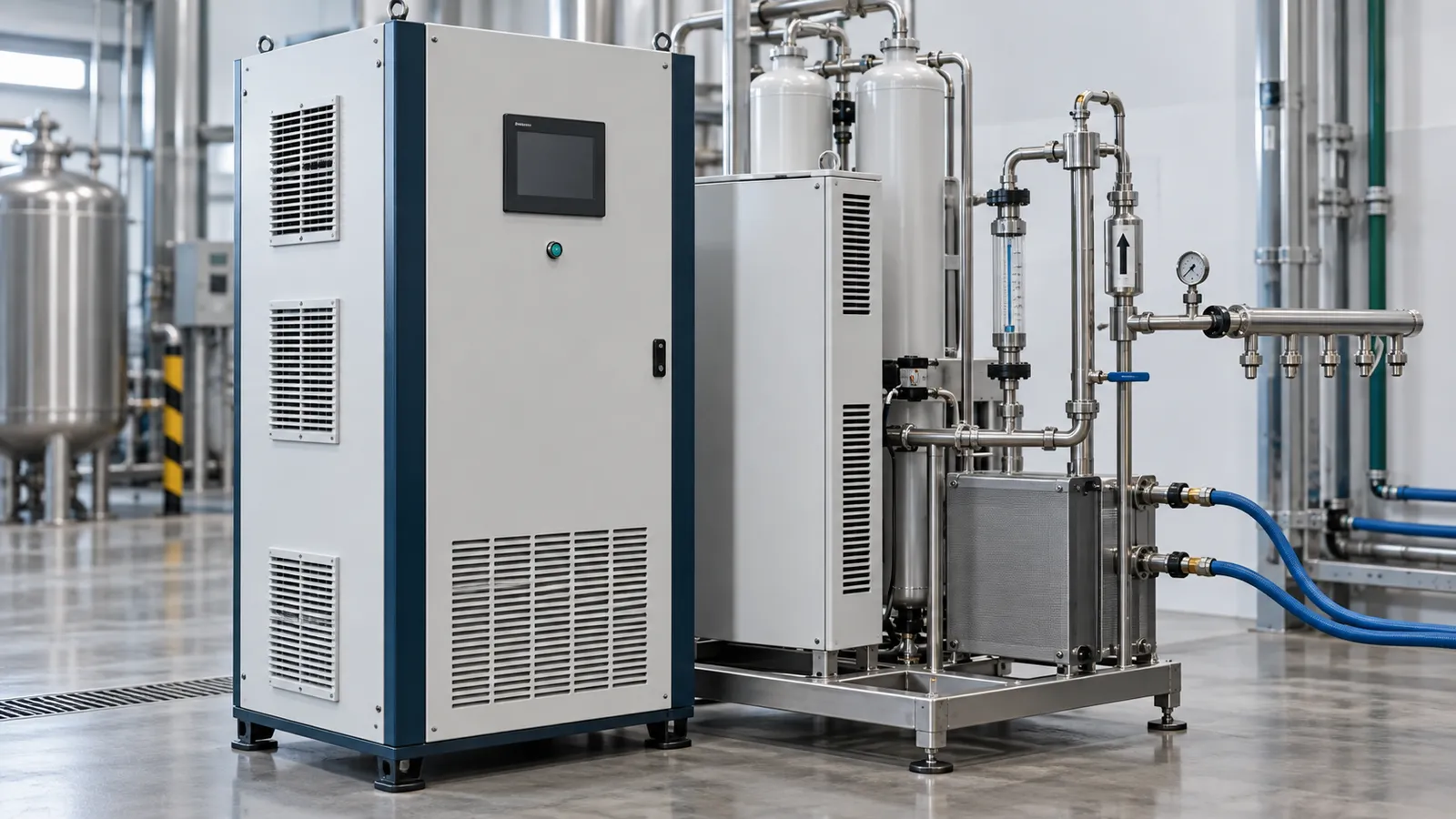
What Size Ozone Generator Do You Need for Water Treatment?
Size an ozone generator with its feed-gas, injection, contact and off-gas systems; compare water flow, treatment duty and quotation scope.
On this page
- How does an ozone generator work in a water treatment system?
- The four selection inputs
- Air-fed or oxygen-fed ozone generator: which should you choose?
- The specification checklist for quotations
- Lifecycle costs — where generators actually differ
- Frequently asked questions
Related: ozone water-treatment system · well water treatment guide · iron and manganese guide · RO storage-tank guide
How does an ozone generator work in a water treatment system?
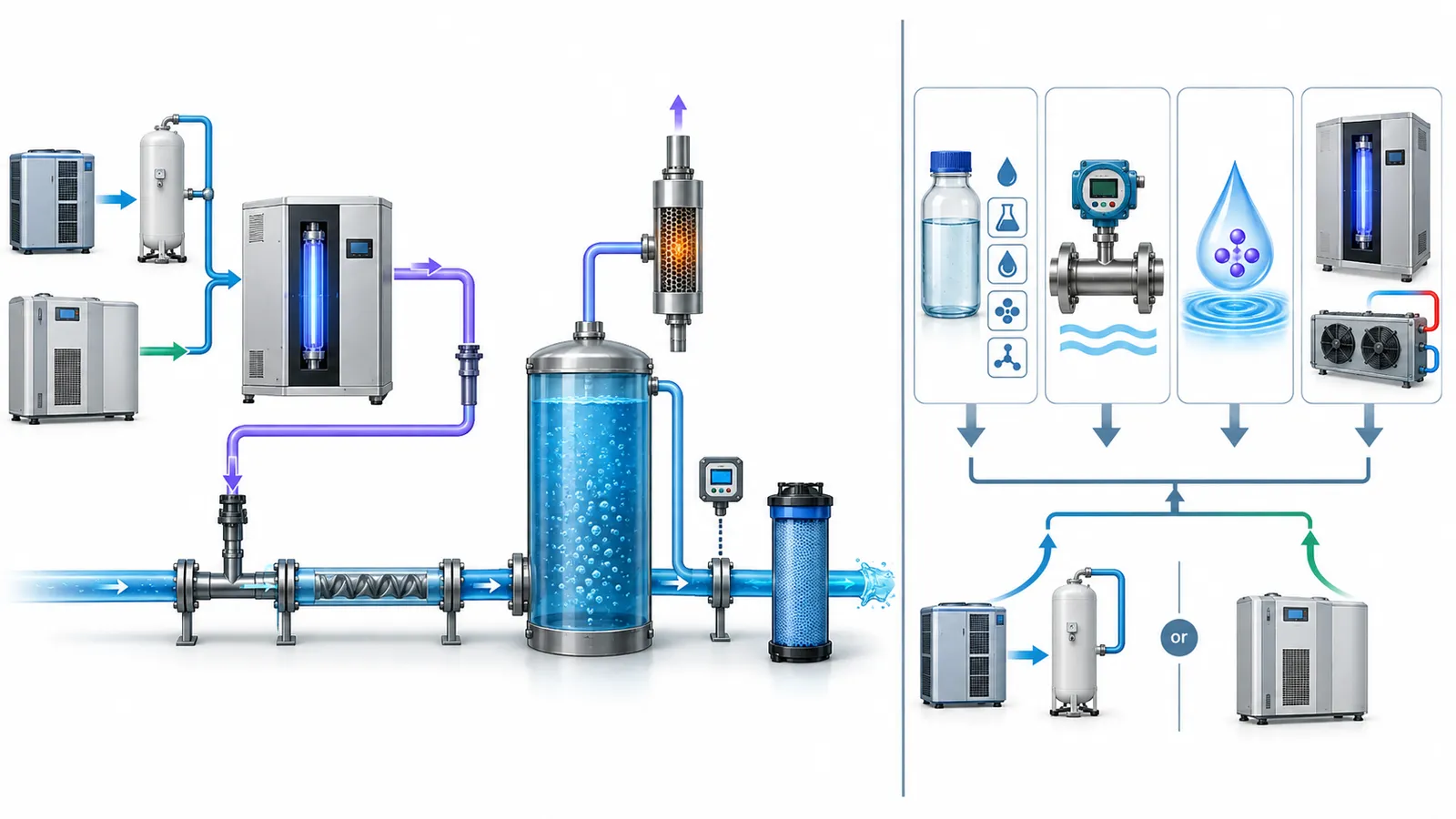
The generator is the heart of an ozone water-treatment system: it produces ozone on demand from air or oxygen using corona discharge (the industrial standard) or ultraviolet-lamp methods for small units. Four support blocks surround it: feed-gas preparation using dry air, a pressure-swing adsorption (PSA) oxygen concentrator, or liquid oxygen (LOX); injection and mixing; a contact tank; and residual and off-gas control. Buying a generator without its support system is like buying an engine without a drivetrain; the blocks must be sized together.
The four selection inputs
| Input | Where it comes from | What it decides |
|---|---|---|
| Ozone demand of the water | Water analysis (organics, iron, manganese, sulfide) | The g/h consumed before any disinfection residual exists |
| Applied dose for the application | Application design (disinfection CT, oxidation target, or bottled-water residual) | Total g/h at design conditions |
| Peak water flow (m³/h) | Your demand profile | g/h = dose (g/m³) × flow; size for peak, verify turndown |
| Feed gas & cooling conditions | Site facts | Oxygen-fed generators dominate above small scale; cooling (air/water) affects sustained output |
The classic selection error is skipping row one: in water with measurable iron or organics, ozone demand can consume the applied dose before the target residual is established. This is the same analysis-first discipline used throughout the well water treatment guide. The iron and manganese guide shows one common oxidation duty that must be included in the calculation.
Air-fed or oxygen-fed ozone generator: which should you choose?
| Feed option | Typical niche | Trade-offs |
|---|---|---|
| Dry air-fed | Small units, modest output | Lower concentration, larger equipment for same g/h; simplest logistics |
| PSA oxygen concentrator | Midsize commercial — a common choice | Higher concentration, self-contained; concentrator maintenance added |
| Liquid oxygen | Large plants | High concentration and output; LOX supply logistics and safety program required |
For the 0.25–50 m³/h commercial class — bottling plants, community systems, food plants — PSA oxygen-fed generators are the practical default, and this is where established treatment-system manufacturers such as KONCHE, which has built commercial water-treatment plants since 1997, integrate generation as a plant stage rather than an accessory.
The specification checklist for quotations
- Output basis: g/h at a stated ozone concentration and gas flow — an output quoted without concentration is not a comparable number
- Feed gas and cooling stated for that output (output drops fast with poor cooling or wet feed gas)
- Turndown range: how low the generator can modulate — oversizing without turndown wastes energy every hour
- Materials in the ozone path: ozone-compatible (e.g., certain stainless grades, PTFE-family, glass); standard air-path materials embrittle and fail
- Cooling requirement: air- or water-cooled, and the duty your site can provide
- Safety package: ambient ozone monitor and interlock for the plant room; ozone destruct on vent lines
- Monitoring: dissolved-ozone measurement at contact and post-contact points (the verification of dose)
- Service schedule: electrode and dielectric service intervals, power-supply-unit (PSU) life, and prices for each item
Items 1 and 4 often expose under-specified offers: output stated without operating conditions and incompatible materials in the ozone path are common causes of early failure.
Lifecycle costs — where generators actually differ
| Cost block | Behavior |
|---|---|
| Energy (generator + oxygen plant) | Runs every hour; oxygen-fed efficiency differences compound |
| Electrode/dielectric service | Scheduled; priced spares distinguish suppliers |
| Cooling energy and water | Site-dependent; water-cooled operation requires an adequate site-water and heat-rejection plan |
| Monitoring & safety upkeep | Sensor calibration — small, but skipped calibration silently voids the whole control loop |
Two generators with the same purchase price can have very different lifecycle costs. Compare their energy use in kWh per kg of O₃ produced, specified operating concentration, cooling demand, and priced service schedules. Downstream residual management and tank hygiene should also align with the RO storage-tank guide, while non-residual applications should be compared with the UV water-treatment overview.
Frequently asked questions
What size generator does a bottling line need?
Size from the arithmetic: applied dose (g/m³) × peak water flow (m³/h), plus the measured ozone demand of the water, with the filling-line residual requirement included in the dose target. Bottling context: water refilling business guide; disinfection comparisons at UV vs ozone.
Can one generator serve oxidation and disinfection?
Yes — that is normal (iron/H₂S oxidation ahead of disinfection in one train) — but the demand calculation must include both duties, or the disinfection stage starves.
How is generator output verified?
Verify gas-phase concentration and output and, most importantly for the treated-water duty, measure dissolved ozone at the contact tank against the design value during commissioning. Include the test method and acceptance threshold in the contract.
Are ozone generators hazardous to operate?
With standard industrial practice — ambient monitoring, interlocks, destruct on vents — they are routine industrial equipment. Ozone itself cannot be stored, which removes the storage hazard associated with stored oxidants.
Ozone generator or UV system — which should we buy?
They solve different problems, and many plants use both. The decision table is in the ozone water-treatment guide and the UV vs ozone comparison.
Recommended systems for this application
Systems commonly specified for the duties discussed in this guide:
1–200 g/h ozone generation with injection, contact and off-gas control.
View specifications ↗CONSUMABLESWater Treatment ConsumablesCartridges, filter media and spares for commercial treatment plants.
View specifications ↗UVUV Water SterilizerLow-pressure UV disinfection units for final microbial barriers.
View specifications ↗Start with
your water report.
Send the water analysis and target residual. KONCHE sizes the generator on measured demand and peak flow, with feed gas, cooling and service schedule stated.