What Well Water Treatment System Do You Need? A Guide for Farms, Communities and Businesses
The well water treatment system you need depends on what the water test finds and what the finished water must be used for. Treatment removes specific problems — iron, manganese, hardness, hydrogen sulfide (rotten-egg odor), salt, bacteria, or turbidity — by matching each problem to its proven process: oxidation-filtration for iron and manganese, ion exchange for hardness, aeration or oxidation for sulfur odor, reverse osmosis for dissolved salt, and disinfection for microbiology. The sequence that succeeds is the same in almost every project: test first, prioritize by use, treat in process order, and verify with follow-up testing. For commercial users — farms, communities, resorts, water-refilling businesses, food plants — systems between roughly 0.25 and 50 m³/h are standard packages from established manufacturers. This guide is the hub: each section below answers one question directly and links to the specialist guide that treats it in full.
Get an Equipment Quote ↗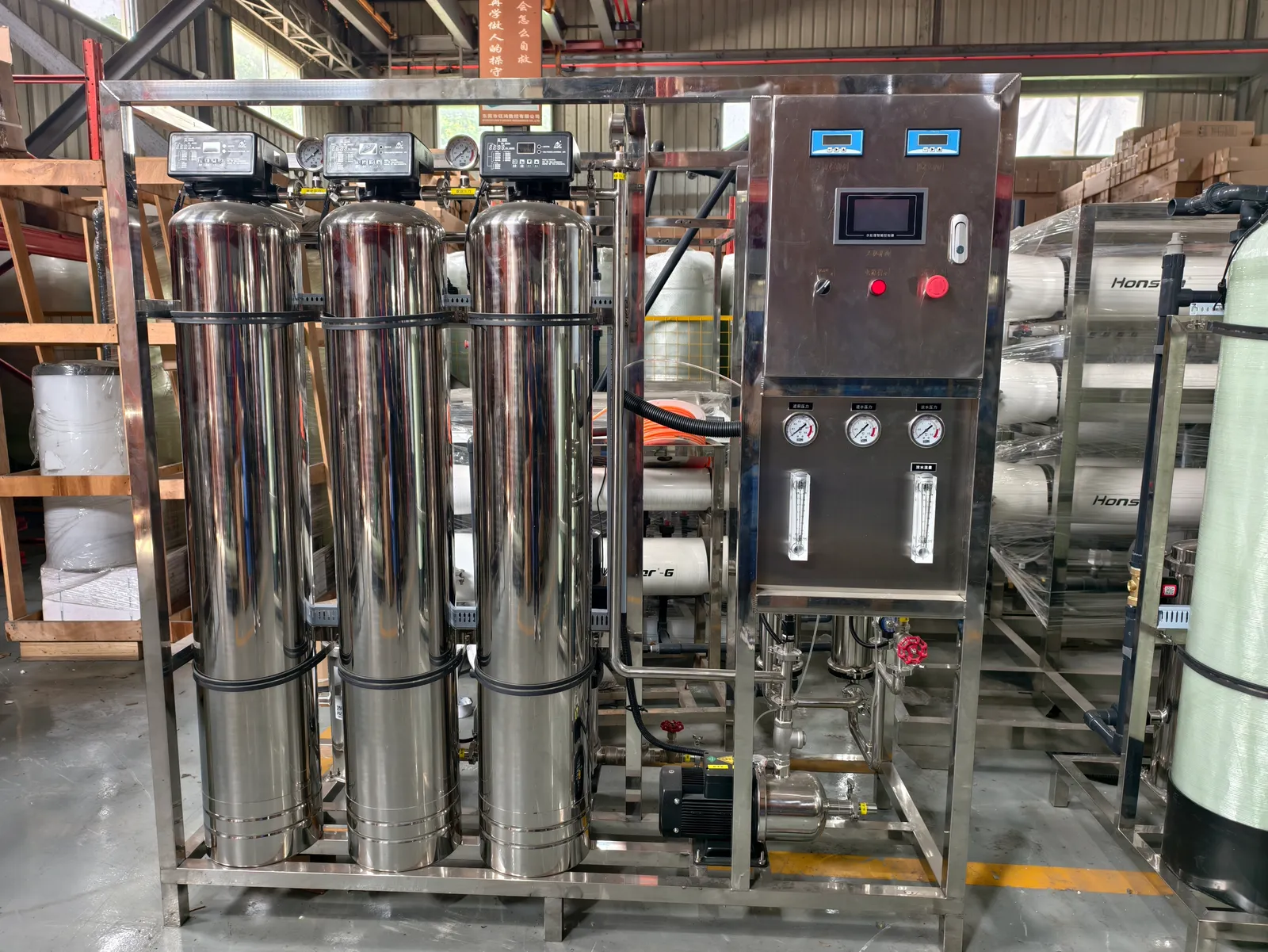
What Well Water Treatment System Do You Need? A Guide for Farms, Communities and Businesses
Use a laboratory water test to select treatment for iron, manganese, hardness, sulfur odor, salinity and microbiology in commercial well-water supplies.
On this page
- Why well water needs treatment at all
- What should your water test cover?
- How do you remove iron and manganese?
- How do you fix sulfur smell in well water?
- What about hardness and scaling?
- What if the well is salty?
- What water treatment system do you need for well water?
- How is treatment different for a business or community?
- Frequently asked questions
Related: well water testing guide · how to remove iron and manganese from well water · sulfur smell in well water: causes and treatment · well water treatment systems guide
Why well water needs treatment at all
Well water often needs treatment because groundwater can carry dissolved minerals, salts, gases, and microorganisms that affect safety, taste, staining, scale, and the reliability of downstream equipment.
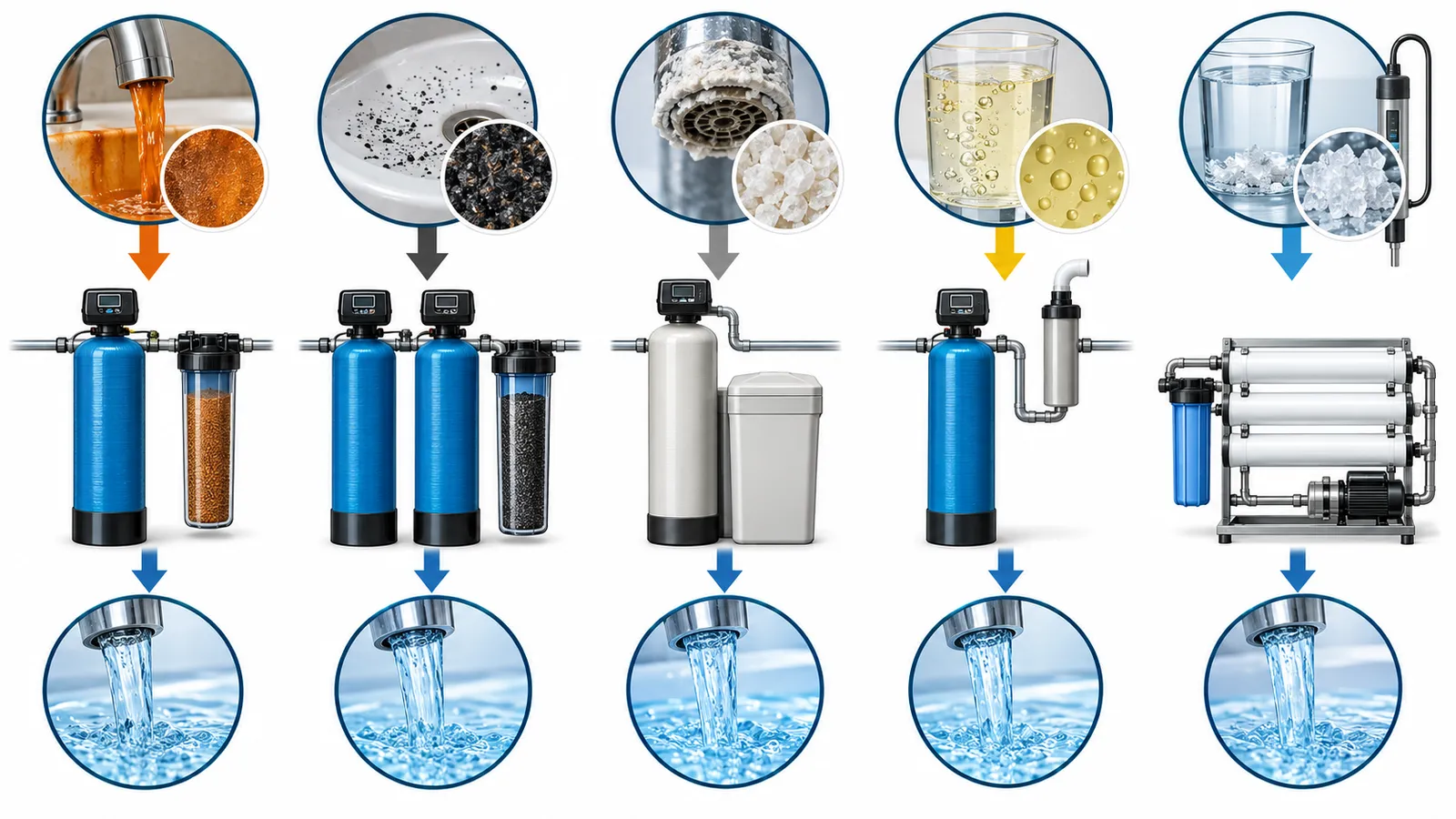
Groundwater picks up its character from the geology it moves through: iron and manganese dissolved from rock, hardness from limestone, hydrogen sulfide from sulfur-bearing formations and bacteria, salt from marine deposits or coastal intrusion. Unlike municipal water, nobody else treats it for you — the well owner is the water utility. And unlike a household, a commercial user has additional stakes: equipment damage (boilers, irrigation emitters, food plant surfaces), product quality (bottled water, food processing), and community health obligations when the well serves many people.
The most expensive mistake in this field is buying equipment before testing. The second most expensive is testing once and assuming the well is stable — coastal and drought-affected aquifers change.
What should your water test cover?
A treatment-grade water test for a commercial well covers, at minimum, total and dissolved iron and manganese, hardness, pH, total dissolved solids (TDS) with sodium and chloride, hydrogen sulfide supported by field odor observations, turbidity, and microbiology such as total coliforms and E. coli. Nitrate, arsenic, and fluoride matter regionally, so include them where local geology, land use, or regulation warrants.
The full testing protocol — how to sample correctly, which accredited lab panel to request, and how to read the report against equipment limits — is in our well water testing guide.
How do you remove iron and manganese?
Iron shows as staining and metallic taste; manganese as black deposits and bitter taste; both commonly co-occur. Dissolved (ferrous) iron must first be oxidized — by aeration, chlorine, or specialized media — then filtered. The process choice depends on concentration, pH, and flow, and manganese needs a higher oxidation potential than iron, which is why "the iron filter worked but black specks remained" is a classic misdiagnosis story.
The complete decision guide — oxidation methods compared, media types, and the acceptance test to agree before ordering — is in how to remove iron and manganese from well water.
How do you fix sulfur smell in well water?
The rotten-egg odor is hydrogen sulfide — from the aquifer's geology or from sulfur-reducing bacteria living in the well and plumbing. Treatment differs completely by source: geological H₂S responds to aeration or oxidation-filtration; bacterial H₂S requires shock chlorination of the well and system, then prevention. Treating the wrong source wastes the entire equipment budget.
The diagnosis-first guide — including source checks and treatment options by concentration — is in sulfur smell in well water: causes and treatment.
What about hardness and scaling?
Hardness (calcium and magnesium) scales heaters, boilers, RO membranes, and plumbing. At commercial scale the answer is ion-exchange softening sized to flow and hardness load, with regeneration water and salt logistics planned as part of the installation — not an afterthought. Softening also protects downstream treatment: an RO system fed with hard, unsoftened water scales its membranes first, which is why softening frequently sits upstream of RO in complete trains.
Selection data — capacity sizing, regeneration options (time vs meter), and when softening belongs before or after other stages — is in our well water treatment systems guide.
What if the well is salty?
Dissolved sodium chloride — from coastal intrusion, marine sediments, or drought — passes straight through filters and softeners. The standard removal route at commercial scale is reverse osmosis (nanofiltration for partial cases; distillation only for special duties). Salinity level decides the RO class: brackish RO for wells to roughly 10,000 mg/L TDS, with the full decision logic in our borehole and well water desalination guide and the deeper process comparison in SWRO vs BWRO.
What water treatment system do you need for well water?
Commercial trains follow process order, each stage protecting the next:
| Stage | Purpose | Typical technology |
|---|---|---|
| 1. Oxidation / aeration | Convert dissolved iron, manganese, and H₂S to filterable forms | Aeration tower, dosed oxidant, catalytic media |
| 2. Filtration | Remove precipitated iron/Mn, sediment | Multi-media / catalytic media filters |
| 3. Softening | Remove hardness, protect downstream | Ion exchange (or antiscalant dosing before RO) |
| 4. Desalination (if needed) | Remove dissolved salt | Brackish RO |
| 5. Disinfection | Microbiological barrier | UV (or ozone in bottling) — see UV systems and UV vs ozone |
| 6. Storage & distribution | Preserve quality to point of use | Covered tanks with hygiene management per our RO storage guide |
Not every well needs every stage — the test decides. But stages must be ordered correctly; reversing oxidation and filtration, or placing softening where it cannot protect the RO, produces systems that rarely reach design performance.
How is treatment different for a business or community?
Three differences from household treatment:
- Duty cycle: commercial systems run hours daily at steady flow — sizing, materials, and redundancy follow industrial practice, not household peaks
- Verification: communities and food businesses carry a microbiological responsibility — logging, routine verification testing, and operator training are part of the plant, not extras
- Economics: lifecycle cost (energy, media, salt, and membranes), not purchase price alone, should decide the bid; the comparison framework in our containerized plant guide applies equally to well-water plants
For water-refilling businesses on wells — a rapidly growing category as more wells salinize — the commercial planning (demand, pricing, station economics) is in our water refilling station guide, with equipment context in the 1,000 LPH community RO system and 500 LPH compact RO system.
KONCHE has manufactured commercial water-treatment systems since 1997, with packaged capacities from 0.25 to 50 m³/h. Regardless of supplier, require the quotation to state the source-water design basis, treatment sequence, guaranteed outlet targets, acceptance test, and priced spares.
Frequently asked questions
Can one system fix everything wrong with my well?
A correctly sequenced train handles multiple problems — but it is engineered from your test, stage by stage. "All-in-one" units that promise iron, salt, bacteria, and hardness in one box are the recurring complaint in this industry.
How often should a commercial well be tested?
Complete a full baseline panel before design. For community supply, set a routine microbiological schedule — monthly or quarterly as required by the governing authority and risk plan — and repeat the full panel annually or after floods, droughts, or any change in taste, color, or odor.
Do we need a supplier or can we self-assemble?
For households, do-it-yourself assembly can have a place. Commercial duty normally requires a documented design basis, factory testing, performance guarantees, operator training, and a priced spares list — the evidence needed for an uptime calculation.
Household treatment guides are everywhere — what's actually different here?
Scale, duty cycle, verification obligations, and lifecycle economics. This cluster is written for the people operating water as part of a business or community service.
Where do I start with one page?
Start with the well water testing guide; every downstream decision depends on the results.
Recommended systems for this application
Systems commonly specified for the duties discussed in this guide:
1 m³/h RO configuration for refilling stations, schools and small communities.
View specifications ↗COMPACT RO500 LPH Compact RO System0.5 m³/h compact drinking-water RO system for tight installation spaces.
View specifications ↗DRINKING WATERCommercial Drinking Water System0.25–50 m³/h drinking-water production with multi-stage pretreatment.
View specifications ↗Start with
your water report.
Send the well's water test and demand. KONCHE maps each problem — iron, hardness, odor, salt, bacteria — to its process stage in the right order.