What Does Ozone Do in Water Treatment? Uses, Limits and Safety
Ozone (O₃) is a powerful oxidant used for disinfection, taste and odor control, iron and manganese oxidation, and sanitation through bottled-water filling lines. It is generated on site because it cannot be stored economically, injected into the water, and then decays back to oxygen. Ozone is valuable where strong oxidation and a short-lived process residual are useful, but it is not a universal disinfectant. Bromate, a key regulated by-product that can form in bromide-containing water, must be addressed from the water analysis and process design. This guide covers how ozone systems work, what ozone is genuinely best at, the UV comparison, the bromate constraint, and how to specify a system.
Get an Equipment Quote ↗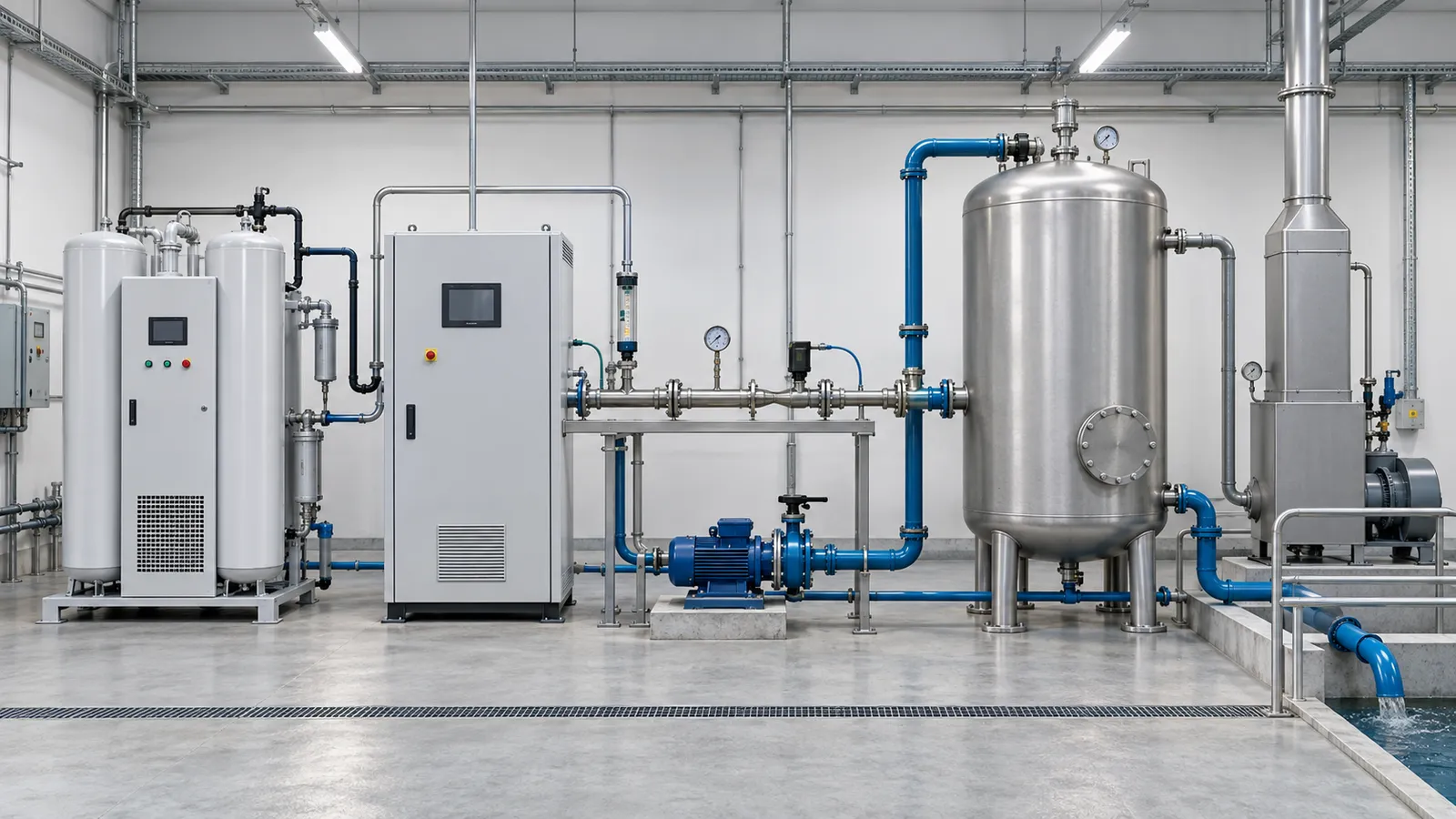
What Does Ozone Do in Water Treatment? Uses, Limits and Safety
Review ozone water-treatment applications, system components, treatment limits and safety, including feed-gas preparation, contact and off-gas control.
On this page
- How does an ozone water treatment system work?
- Does ozone kill bacteria and control taste, odor, iron, and manganese?
- Ozone or UV? The honest comparison
- The bromate constraint: design for it before you buy
- How to specify an ozone system
- Frequently asked questions
Related: water refilling station guide · sulfur-smell guide · iron and manganese guide · UV vs ozone water-treatment guide
How does an ozone water treatment system work?
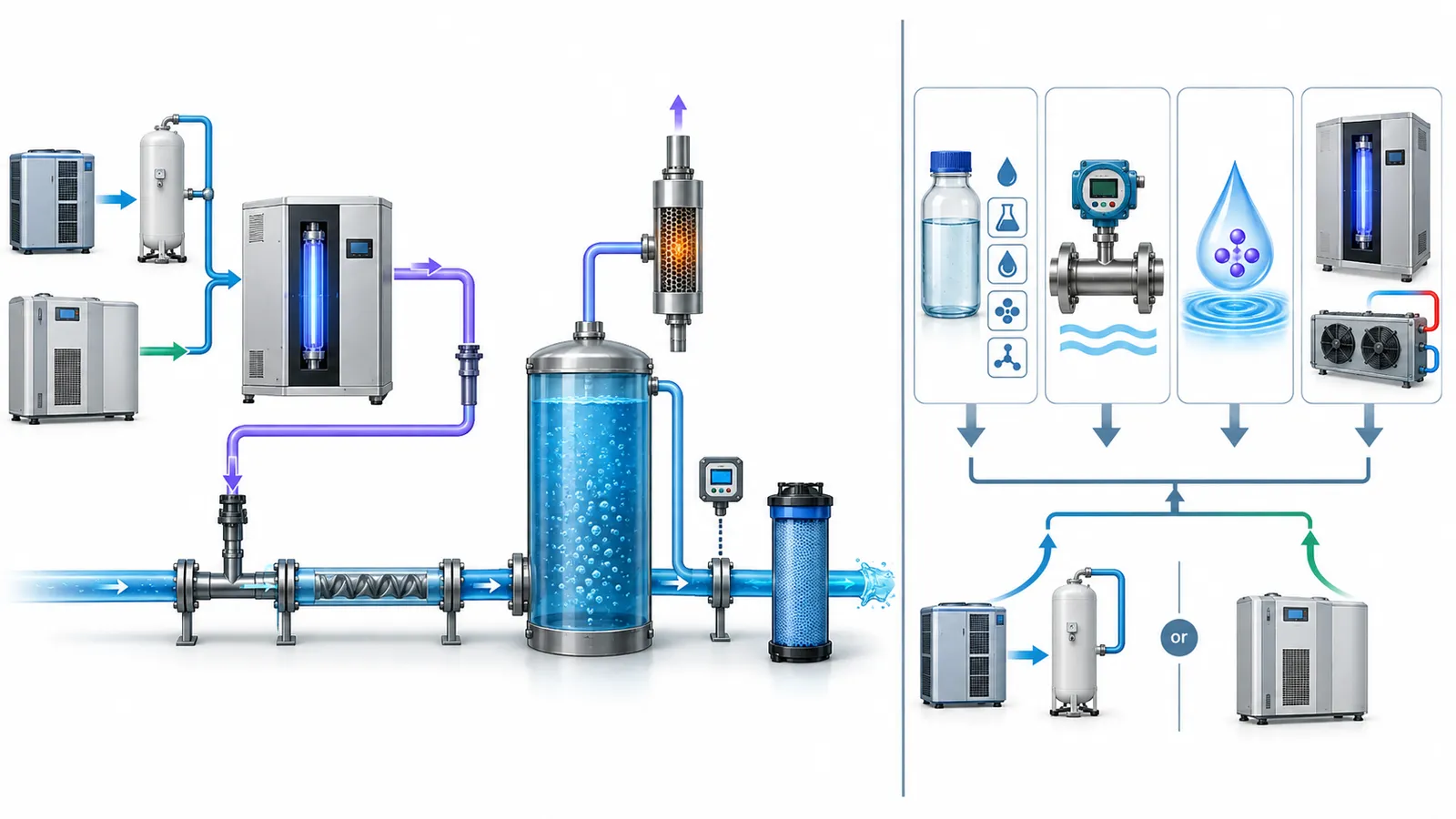
Every ozone system has the same four blocks:
| Block | Function | What varies by application |
|---|---|---|
| Ozone generator | Corona discharge (or UV-lamp) production of O₃ from air or oxygen feed | Output (g/h), concentration, feed-gas type (oxygen-fed generators are standard above small systems) |
| Injection & mixing | Venturi injector or diffuser dissolving ozone into the water stream | Contact system sizing |
| Contact tank | Reaction time — oxidation and disinfection happen here, over minutes | CT design (concentration × time) against the target organisms/compounds |
| Residual control & off-gas | Sensor/quenching of residual; ozone destruct on vented gas | Safety and post-treatment targets |
The scale logic: the generator is sized for the ozone demand of your water (measured, not guessed) plus the disinfection residual target, at your peak flow. Like every stage in this knowledge base, the sizing input is the water test — organic content and iron/manganese consume ozone before it reaches the microbiology, and that demand must be in the calculation.
Does ozone kill bacteria and control taste, odor, iron, and manganese?
Four duties where ozone outperforms alternatives:
- Bottled and packaged water — a controlled ozone residual can disinfect water and help sanitize bottle and filling-line surfaces, then decays to oxygen without leaving a persistent taste. This makes ozone common in bottled-water plants, where hygienic control at filling is critical. The business context is in our water refilling station guide.
- Taste, odor, and color — as an oxidant, ozone can break down many odor compounds, including geosmin and 2-methylisoborneol (MIB), that resist conventional filtration; see the sulfur-smell guide, where ozone is one oxidation option.
- Iron and manganese oxidation — rapid oxidation ahead of filtration without adding a persistent disinfectant; the iron and manganese guide compares ozone with aeration and other oxidants.
- Cooling towers and process water — biofilm control with lower chemical residuals in suitable waters.
Ozone or UV? The honest comparison
The two technologies answer different questions. Our UV vs ozone water-treatment guide provides the full side-by-side comparison:
| Question | Answer |
|---|---|
| Which inactivates microorganisms at the point of treatment? | Both can when correctly designed: UV uses light without adding a chemical, while ozone uses oxidation |
| Which protects the water after treatment? | Ozone — it carries a residual through pipes and filling lines; UV leaves nothing (and adds nothing) |
| Which changes water chemistry? | Ozone (oxidant — that is the point); UV does not |
| Which has a regulated by-product risk? | Ozone can form bromate where bromide is present; conventional UV disinfection does not normally form regulated disinfection by-products at drinking-water doses |
| Which is simpler to operate? | UV (lamp replacement discipline: our UV lamp guide); ozone adds gas handling and quenching |
The pattern that falls out: UV for the final barrier on potable systems; ozone where oxidizing power or a line residual is required. Many plants run both — ozone upstream for oxidation and line protection, UV as the final barrier — including in food and beverage plants.
The bromate constraint: design for it before you buy
When the source water contains bromide, ozone converts some of it to bromate — a regulated drinking-water contaminant (WHO and major national standards set a low microgram-per-liter limit; verify the current figure for your jurisdiction during design). This is not a reason to avoid ozone; it is a reason to test bromide and state the control strategy on the quotation:
- Bromide level from the water analysis
- Ozone dose and residual strategy (lower dose/contact combinations reduce bromate formation)
- Alternative approaches where bromide is high and limits are strict (membrane removal of bromide, or non-ozone disinfection for that stream)
A supplier who does not mention bromide on a bromide-containing water has not finished the engineering. Verify the applicable limit and control references at design time — the numbers belong to your regulator, not to a supplier's brochure.
How to specify an ozone system
The system-level specification checklist covers what the complete stage must do:
- Application and target: disinfection (which organisms/standard), oxidation (which metals/compounds), or bottled-water residual — the duty changes the CT design
- Water analysis including bromide, organics proxies, iron/manganese (they consume ozone first)
- Contact and residual design: contact time, target residual, quench/off-gas destruct
- Materials: ozone is aggressive — compatible piping, tanks, and seals throughout the skid
- Safety: ambient ozone monitoring for plant rooms, interlocks, destruct on vents
- Verification: commissioning test of residual at design flow, and the monitoring regime
Generator-level requirements — output basis at a stated concentration, feed gas, cooling, turndown, and the priced service schedule — are itemized separately. Generator selection — output classes, feed-gas choice, and cost trade-offs — has its own guide: ozone generators for water treatment.
KONCHE has manufactured commercial water-treatment systems since 1997, with packaged plant capacities from 0.25 to 50 m³/h. In an ozone project, the relevant supply scope is the complete stage — generation, gas preparation, injection, contact, monitoring, and off-gas control — rather than the generator alone.
Frequently asked questions
Is ozonated water safe to drink?
Properly treated, yes — ozone itself decays to oxygen; the watch-items are by-products (bromate, above) and maintaining disinfection through the network (ozone leaves no long-lasting residual, unlike chlorination — systems often add a secondary disinfectant for distribution).
Can ozone replace chlorination entirely?
Ozone may replace chlorination for some treatment duties, but its residual is short-lived and may not protect a distribution network. Bottling lines use a controlled residual at filling and allow it to dissipate after packaging.
Does ozone remove salt?
No — ozone is an oxidant, not a desalination process. Salt removal is RO's job (borehole desalination).
Why did our ozone system underperform?
Common causes are underestimated ozone demand, poor mixing, or insufficient contact time. Organics, iron, manganese, and other reduced compounds consume ozone before the disinfection residual is established, so all three design inputs must come from the water test and hydraulic calculations.
Who supplies complete ozone stages?
A complete ozone stage should be supplied or integrated by a company that can take responsibility for ozone generation, injection, contact, residual monitoring, and off-gas destruction alongside reverse osmosis and ultraviolet (UV) treatment.
Can ozone remove iron, color, or rotten-egg odor from water?
Ozone can oxidize iron, manganese, some color-forming compounds, and hydrogen sulfide so that downstream separation can remove them. The generator alone is not the complete treatment: mixing, contact time, filtration, ozone demand, and off-gas control determine whether the process works.
Recommended systems for this application
Systems commonly specified for the duties discussed in this guide:
1–200 g/h ozone generation with injection, contact and off-gas control.
View specifications ↗UVUV Water SterilizerLow-pressure UV disinfection units for final microbial barriers.
View specifications ↗DRINKING WATERCommercial Drinking Water System0.25–50 m³/h drinking-water production with multi-stage pretreatment.
View specifications ↗Start with
your water report.
Send the water analysis including bromide and the application target. KONCHE specifies the complete ozone stage — generation, injection, contact and off-gas control.