How to Choose a Containerized Water Treatment Plant for Drinking or Process Water
A containerized water treatment plant is a complete treatment system — intake pumps, filtration, reverse osmosis (RO), disinfection, and controls — pre-assembled and factory-tested inside a 20 ft or 40 ft ISO shipping container. In plain terms, it is a portable or relocatable water treatment plant built into a shipping container instead of being assembled piece by piece on site. Choosing one comes down to five inputs: your raw water analysis, the daily volume you must produce, the water quality standard you need to meet, the site conditions (power, space, climate), and the scope your supplier is genuinely quoting. For many drinking-water and process-water duties between roughly 6 and 1,200 m³/d, a well-specified containerized plant can deploy faster and move more assembly and testing into the factory than a field-built installation, provided the quotations cover the same scope. This guide walks through what a containerized plant contains, when it is the wrong choice, the seven selection factors that decide your configuration, capacity ranges, container sizing, cost structure, and the checklist your quotation should survive before you place an order.
Get an Equipment Quote ↗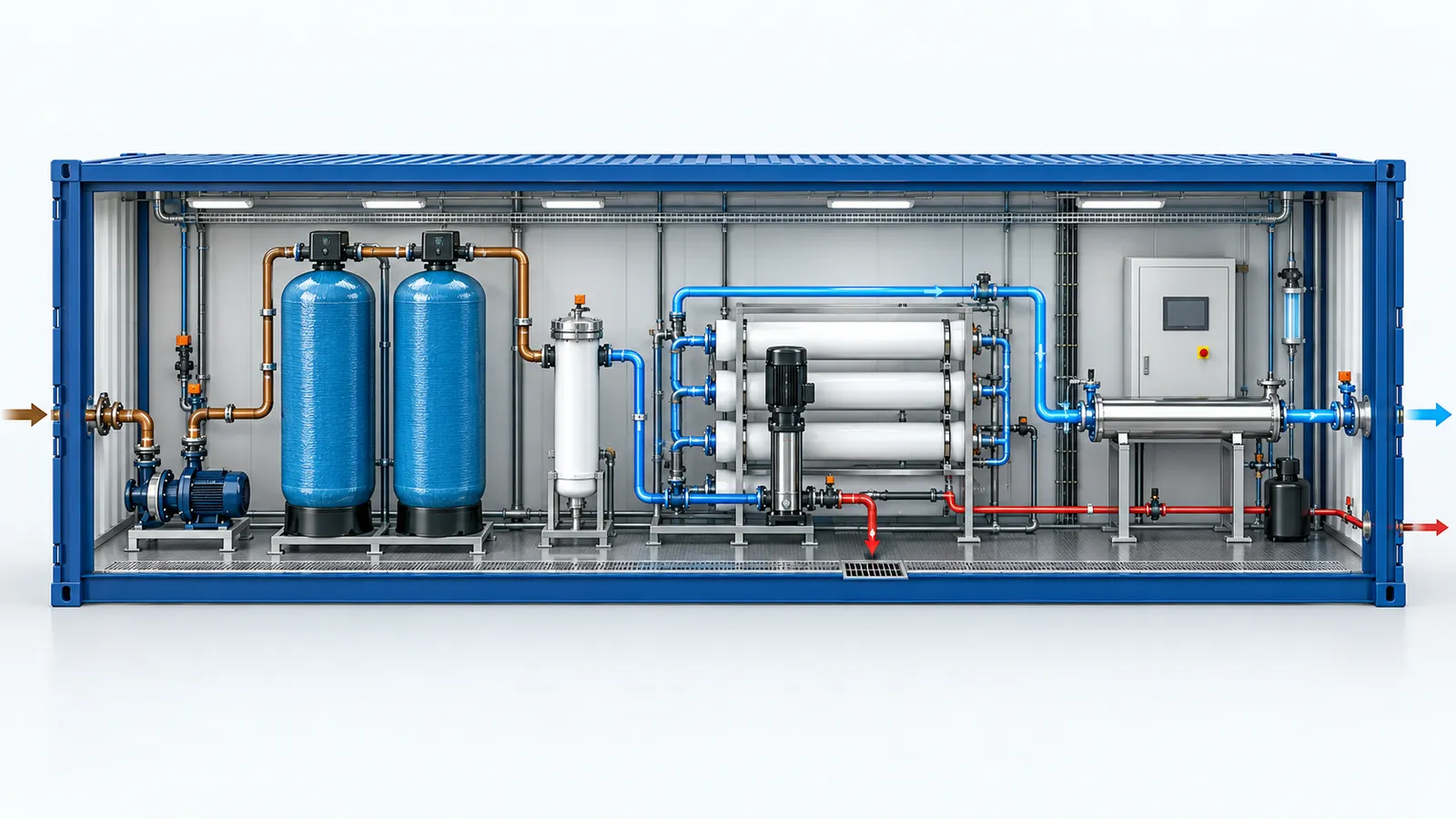
How to Choose a Containerized Water Treatment Plant for Drinking or Process Water
!Cutaway view of a containerized water treatment plant with filtration, RO, UV, controls and separate product and reject routes
On this page
- What is a water treatment system in a shipping container?
- When does a containerized plant make sense — and when does it not?
- What are the 7 selection factors for a containerized water treatment plant?
- What capacity fits inside a container?
- Containerized RO, brackish water, or seawater desalination: which process do you need?
- 20 ft or 40 ft: how does container size affect your system?
- What does a containerized water treatment plant cost?
- What contractual evidence should the containerized-plant quotation include?
- What happens after delivery: installation and commissioning
- Frequently asked questions
Related: commercial desalination machine buyer's guide · SWRO vs BWRO for Saudi projects · boiler feed water system guide · components of a seawater RO plant
What is a water treatment system in a shipping container?
A containerized water treatment plant houses a full treatment train inside a standard ISO freight container, so the plant ships as one tested unit instead of hundreds of loose components. Typical contents include:
- Raw water intake pump and, where needed, a booster stage
- Pre-treatment: multimedia or activated-carbon filtration, antiscalant and pH dosing, and for difficult feeds, ultrafiltration
- The core separation stage — reverse osmosis for desalination and demineralization, or nanofiltration/softening where only partial ion removal is required
- Post-treatment: disinfection (ultraviolet, or UV, light; or, in bottled-water plants, ozone), pH adjustment and remineralization for drinking water, and storage and distribution connections
- Programmable logic controller (PLC), instruments, and remote-monitoring interfaces
The defining advantage is that verification occurs in two stages: first at the factory, where the manufacturer demonstrates flow and permeate quality against the agreed design basis, and then on site after utilities and piping are connected. Container dimensions follow ISO 668, the international standard for freight containers, although project-specific weight, lifting, road, and site-access limits still need to be checked.
When does a containerized plant make sense — and when does it not?
Containers are an installation strategy, not a treatment technology. They win when one or more of these conditions hold:
- Remote or island sites with no local fabrication workforce — mining camps, island resorts, drilling operations, military and relief installations
- Fast deployment requirements, where the plant must produce water within weeks of order
- Relocation expectation: construction sites and temporary facilities that will move the plant after the project ends
- Climate-controlled equipment space: the container protects membranes and controls from dust, humidity, and coastal salt air, which in Gulf and Red Sea coastal environments directly extends equipment life
- Limited footprint in existing industrial compounds
A container is usually the wrong choice when your required capacity is far above what fits in one or two boxes (very large municipal plants are more economical field-built), when the plant must integrate into an existing building with specific architectural constraints, or when local regulations require civil-work tendering processes that a plug-and-play unit cannot satisfy. It is also wrong to treat the container itself as the decision: the process inside the box must still be designed around your water analysis, exactly as a field-built plant would be.
What are the 7 selection factors for a containerized water treatment plant?
Compare every offer you receive against these seven factors. Suppliers who cannot answer one of them in writing are telling you where the project will go wrong.
| # | Factor | What to specify | What a weak quotation does |
|---|---|---|---|
| 1 | Raw water data | Full analysis: TDS, ion profile, turbidity, temperature range, seasonal variation | Accepts a single TDS number |
| 2 | Capacity definition | Average and peak daily demand, in m³/h at a stated recovery rate | Quotes "500 m³/d" without recovery or temperature basis |
| 3 | Product water standard | The specific standard you must meet (WHO guidelines, national drinking-water rules, or your process spec) | Quotes only "permeate <500 TDS" with no standard reference |
| 4 | Pre-treatment robustness | What protects the RO membranes at worst-case feed quality | Minimal filtration sized for best-case water |
| 5 | Automation and monitoring | PLC functions, alarms, remote access, data logging | Manual valves with no event recording |
| 6 | Energy and utility scope | Specific kWh/m³ at your temperature, dosing chemicals, winterization | Energy figure quoted at 25 °C for 35 °C feed |
| 7 | Supplier lifecycle scope | Factory test evidence, commissioning scope, spare parts list, response times | "Installation by others" with no acceptance criteria |
Factors 1 and 2 decide the process design. Factors 3 through 5 decide whether the plant can actually be operated by your team. Factors 6 and 7 decide the total cost you will pay over the first five years — which is where containerized projects are usually won or lost, not in the purchase price.
What capacity fits inside a container?
Containerized plants are naturally suited to small and medium capacities. As a practical planning range for RO-based systems:
| Capacity band | Daily output (m³/d) | Typical container format | Typical applications |
|---|---|---|---|
| Compact | 6–60 | Single 20 ft | Construction camps, small resorts, offshore platforms |
| Single-module | 60–300 | Single 40 ft, or 20 ft + external tankage | Villages, hotels, food and beverage plants |
| Multi-module | 300–1,200 | 2–6 × 40 ft, piped as one plant | Towns, industrial process water, irrigation districts |
| Field-built territory | above ~1,200 | Conventional plant building | Municipal-scale projects |
The full commercial scale ladder — from portable watermakers to multi-train plants — is compared in the commercial desalination machine buyer's guide. KONCHE, a Chinese water treatment manufacturer operating since 1997, builds containerized and skid-mounted RO systems across a 0.25–50 m³/h range (roughly 6 to 1,200 m³/d), which spans the entire single- and multi-module bands above; systems at the top of that range are normally quoted as parallel trains so that one module can be serviced without stopping production. When a supplier quotes capacities above roughly 1,200 m³/d "in one container," ask how membrane replacement, crane access, and internal walkway width are handled — that is where over-packed containers fail their operators.
Containerized RO, brackish water, or seawater desalination: which process do you need?
The water source decides the process, and this decision is worth a separate analysis before any container discussion:
- Brackish water (boreholes, wells, brackish surface water, typically total dissolved solids, or TDS, up to about 10,000 mg/L) runs at lower pressure, consumes less energy per cubic meter, and fits smaller containers for the same output.
- Seawater (TDS around 35,000 mg/L and above in closed gulfs) requires high-pressure RO, energy-recovery devices to stay economical, and more conservative pre-treatment. Red Sea and Arabian Gulf feed water in particular sits at the upper salinity range, which raises required pressure and reduces recovery.
If your project is in a coastal Middle East context, the choice between seawater RO and brackish water RO is significant enough that we treat it in a dedicated comparison of SWRO vs BWRO for Saudi projects, including salinity ranges and the data package each option demands. For plant rooms feeding boilers, note that containerized RO can serve as the roughing stage, but boiler feed water has its own chemistry requirements — see our boiler feed water system guide before combining scopes.
Before choosing a package, compare the components of a seawater RO plant and the different design needs of brackish borehole water; island logistics and solar-power planning are covered in the Philippines island-planning guide. Related reading on the final stages includes how UV disinfection integrates into treatment trains, the UV vs ozone trade-off for product water, and why RO storage tanks need hygiene management. A representative supply scope is shown on the containerized treatment-system product page.
20 ft or 40 ft: how does container size affect your system?
| Aspect | 20 ft plant | 40 ft plant |
|---|---|---|
| Usable internal length | ~5.9 m | ~12.0 m |
| Practical RO capacity | up to ~60 m³/d in one box | up to ~300 m³/d, process-dependent |
| Service access | One walkway; some service from outside doors | Full internal walkway both sides |
| Membrane replacement | Often requires removing cartridge assemblies | In-place, standing |
| Transport | Standard truck; easier to site in tight compounds | Standard truck; needs more pad space |
| Best fit | Camps, resorts, piloting, emergency supply | Villages, factories, multi-train modules |
Two rules of thumb keep container sizing honest. First, the container should be sized for service access, not for shipping efficiency — a box crammed to the walls is cheap to deliver and expensive to maintain. Second, above roughly 300 m³/d, multiple 40 ft modules piped in parallel are often more practical than one oversized custom box, because parallel trains preserve partial capacity during maintenance and standard cranes can handle each unit.
What does a containerized water treatment plant cost?
Published price ranges for containerized plants are not reliable, because two quotations rarely cover the same scope. What you can compare is cost structure. A containerized plant budget consists of:
| Cost block | What it includes | Cost behavior |
|---|---|---|
| Process equipment | Pumps, membranes, vessels, dosing, controls | Scales with capacity and feed salinity |
| Container and mechanics | Box, insulation, HVAC, piping, lighting | Step-wise: jumps at 20→40 ft and per added module |
| Factory testing | Wet test against your water data | Fixed; weak suppliers skip it — that is a false economy |
| Logistics | Freight, lifting, pad and utilities at site | Distance- and crane-dependent |
| Commissioning and training | Site acceptance, operator handover | Fixed per visit; remote support reduces repeat trips |
| Operating cost | Energy (kWh/m³), chemicals, membrane replacement | Dominates 5-year TCO; energy alone often exceeds the equipment price over the plant's life |
The World Bank's analysis of desalination economics confirms the same pattern at utility scale: energy and financing dominate lifetime cost, so a quotation that highlights only the purchase price is hiding the numbers that matter. Two comparison practices protect you: insist that every offer states specific energy consumption in kWh/m³ at your feed temperature and salinity, and request the membrane replacement schedule as a priced spare-parts line rather than a vague "2–5 years." Emergency and mobile water treatment deployments follow the same logic, with mobilization time replacing some of the capital emphasis.
What contractual evidence should the containerized-plant quotation include?
After the seven selection factors establish what the plant must do, the quotation should turn the proposed solution into verifiable contractual evidence:
- A process flow diagram and equipment schedule naming the offered membranes, high-pressure pumps, instruments, PLC, valves, and materials
- A signed performance-guarantee schedule with the test conditions, tolerances, acceptance method, and remedy if the plant misses the guarantee
- Factory- and site-acceptance protocols, including the readings, samples, and documents delivered with each test
- Container drawings that state size, operating weight, service clearances, lifting points, insulation, HVAC duty, drainage, lighting, and climate class
- A priced five-year consumables and critical-spares schedule with quantities, replacement assumptions, and lead times
- A commissioning and operator-training plan, warranty coverage, technical-response time, and remote-support scope
- A responsibility matrix that identifies every interface and exclusion, especially civil works, intake, storage, concentrate disposal, field piping, and power supply
- The handover document list: operating manuals, data sheets, certificates, PLC backup, alarm list, as-built drawings, and maintenance schedule
These items do not repeat the process-selection inputs; they prove exactly what will be supplied, how performance will be accepted, and who carries each project risk. A statement such as "factory-tested to the manufacturer's standard checklist" is not enough unless the checklist and acceptance limits are attached.
What happens after delivery: installation and commissioning
A containerized plant shortens — but does not eliminate — site commissioning. Plan for four phases:
- Arrival and setting: pad or foundation readiness, crane lift, container leveling
- Connections: raw water intake, product water to storage, concentrate discharge, power, and dosing chemicals
- Verification against factory results: the commissioning engineer re-runs the factory acceptance test at your site conditions and reconciles any differences
- Handover: operator training, spare parts inventory, and the first scheduled maintenance date
From day one, run the plant against a defined SWRO membrane cleaning and replacement plan so that maintenance triggers stay objective rather than calendar-based.
Concentrate (brine) disposal deserves early attention in the site plan. For seawater plants, return-to-sea diffusers must meet local discharge rules; research compiled by UNEP on desalination brine highlights that brine volume and salinity are the two parameters regulators examine first. If your team will operate the plant without a resident engineer, include remote monitoring in the control scope — it is inexpensive at order time and expensive to retrofit.
Frequently asked questions
Can a containerized plant produce drinking water to standard?
Yes, when the process is designed from your water analysis and verified against a named standard during factory and site testing. Ask for the standard reference, not just a TDS number — drinking-water compliance covers microbiology and specific ions, not only total salinity.
How long does delivery and commissioning take?
The container moves site work into the factory, so the sequence is manufacture and factory testing (typically the longest phase), shipping, and then several days to several weeks of site connection and verification. Quotations that compress the factory-test phase also compress quality assurance.
Can we expand the plant later?
Plan it at order time. Multi-module designs add parallel containers; single-box designs are harder to expand. If growth is likely, buy the intake, storage, and electrical capacity for the second module in phase one.
Can one container handle both drinking water and process water duties?
Split-stream designs exist — for example, a community RO system serving both drinking points and food production — but the two duties have different quality targets, so the split must be designed, not improvised. Facilities feeding laboratories should note that laboratory-grade water needs polishing stages beyond normal containerized RO.
Do containerized plants work in coastal salt air?
Yes with the right specification: marine-grade coatings, sealed cable routes, and HVAC with corrosion filters are line items to demand in coastal and island installations. This is standard practice in compact commercial RO builds for island markets.
How do I judge a supplier I have not visited?
Ask for the factory test report of a comparable project, a video call during a wet test, and reference contacts for plants of similar capacity and feed water. A manufacturer with a long installed base — KONCHE has supplied water treatment systems since 1997 — can usually provide all three; a trading desk will stall at the first.
Recommended systems for this application
Systems commonly specified for the duties discussed in this guide:
Complete treatment trains factory-built and wet-tested inside ISO freight containers.
View specifications ↗RO SYSTEMSSingle & Double Stage RO System0.25–50 m³/h single- and double-stage RO skids for process and drinking water.
View specifications ↗COMMUNITY RO1,000 LPH Community RO System1 m³/h RO configuration for refilling stations, schools and small communities.
View specifications ↗Start with
your water report.
Send your water analysis, daily demand and site constraints. KONCHE proposes the container format, treatment train and acceptance test basis — factory-tested before shipment.