1,000 LPH Brackish Water RO System for Well Water in Egypt
Project design published 11 October 2026 · Customer identity withheld
KONCHE developed this 1,000 LPH (1 m³/h) single-pass brackish water RO system design for an industrial well-water project in Egypt. The available groundwater was saline and hard, so the treatment train combined media filtration, activated carbon, automatic softening, cartridge filtration, brackish-water RO, and final UV treatment.
The design target was at least 1.0 m³/h of treated water at 25°C for industrial process and auxiliary use. The project was engineered around feed-water conductivity of up to 5,000 μS/cm and hardness of up to 800 mg/L as CaCO₃. These figures are the design basis for the proposal, not published operating results.
Confidentiality note: The customer name and identifying commercial details have been withheld.
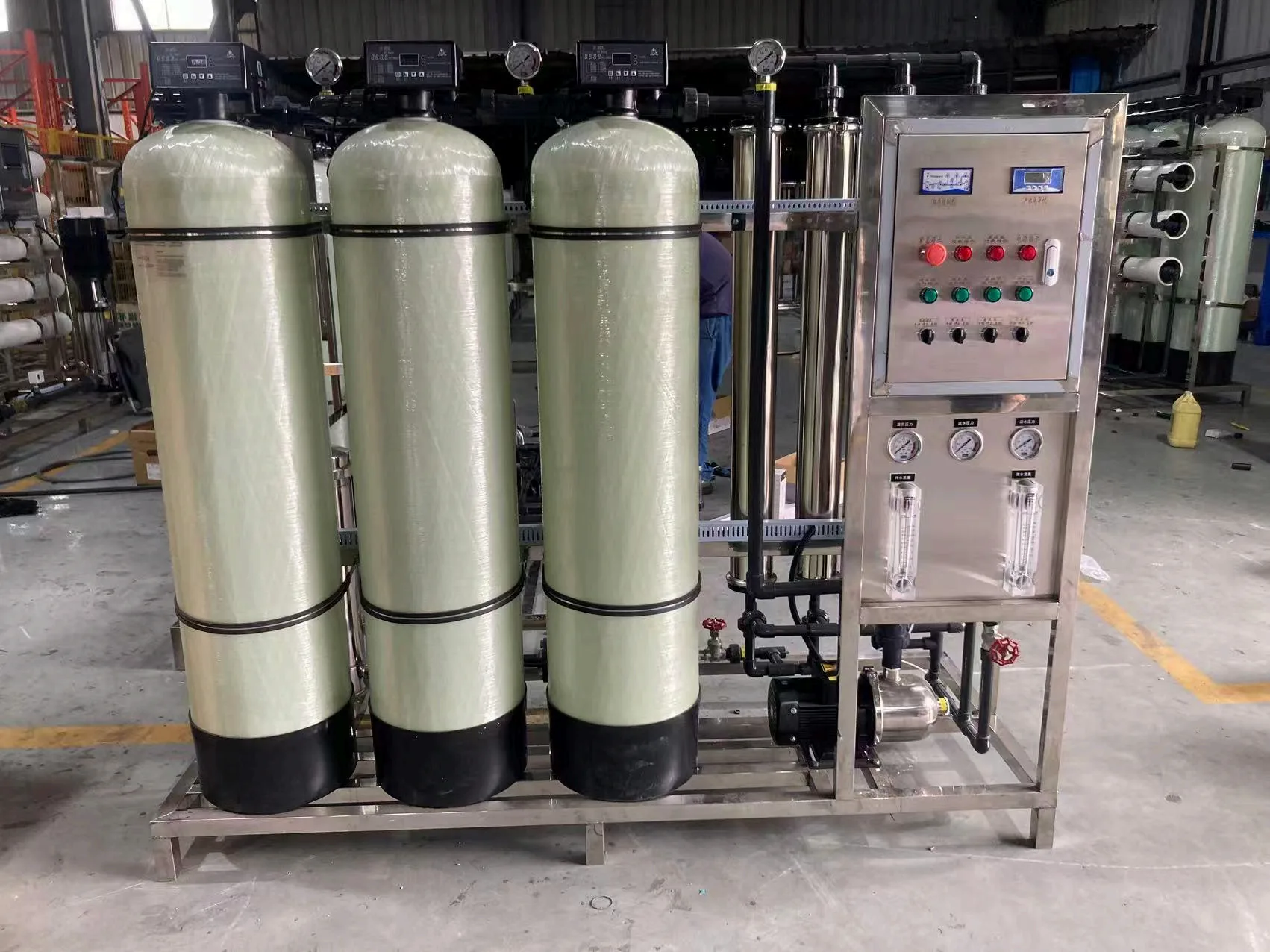
1,000 LPH brackish water RO system specifications at a glance
- Location
- Egypt
- Water source
- Brackish groundwater / deep-well water
- Intended use
- Industrial process and auxiliary water
- Product-water capacity
- At least 1.0 m³/h at 25°C
- Feed-water conductivity
- Up to 5,000 μS/cm
- Estimated feed-water TDS
- Approximately 3,200 mg/L
- Total hardness
- Up to 800 mg/L as CaCO₃
- Feed turbidity
- Up to 5 NTU in the base design
- Feed pH and temperature
- pH 6.5–8.5; 20–35°C
- Specified product-water conductivity
- No more than 1,000 μS/cm under the agreed design basis
- Proposed recovery range
- 60–65%, subject to final water analysis and membrane projection
- Electrical supply
- 380 V, three phase, 50 Hz
- Proposed control mode
- Automatic operation with manual override
Why did this Egypt well-water project require reverse osmosis?
The project combined two conditions that directly affect RO reliability:
- High dissolved salt content. The groundwater required membrane desalination before it could be used as industrial process or auxiliary water.
- High hardness. Calcium and magnesium could concentrate on the RO reject side and increase scaling risk.
The system also had to be compact, straightforward to operate, and suitable for overseas shipment and local operation. Selecting an RO skid only by its nominal flow would not address these conditions. The pretreatment stages had to protect the membrane system first.
Why was softening installed before the RO system?
The proposal used an automatic sodium-ion-exchange softener because the design hardness reached 800 mg/L as CaCO₃. Removing calcium and magnesium before the high-pressure membrane stage reduces the amount of scale-forming hardness entering the RO system.
This was a project-specific decision. A different groundwater source may require antiscalant dosing, iron and manganese removal, clarification, ultrafiltration, or another pretreatment arrangement. Final selection should follow a complete water analysis and membrane projection.
What treatment process was specified for the industrial RO system?
The specified treatment process is shown below. The sequence protects the RO membranes from suspended solids, oxidants, and hardness before desalination, then adds UV treatment after treated-water storage.
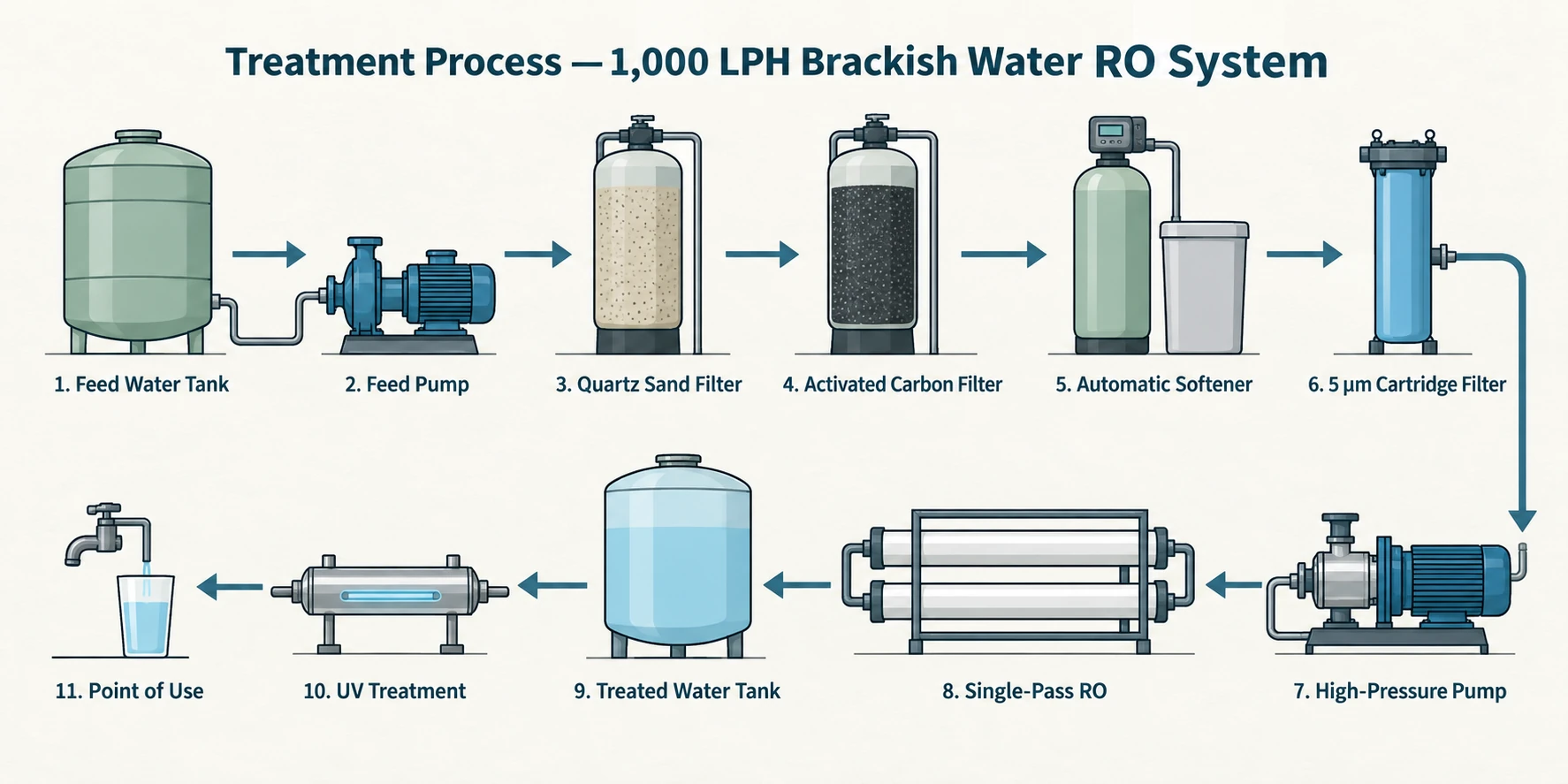
1. Quartz-sand filtration
The first media vessel was designed to reduce suspended solids, sediment, and colloidal material before the downstream treatment stages. Automatic backwashing was included in the proposed configuration.
2. Activated-carbon filtration
The activated-carbon stage was selected to reduce oxidants, organic matter, color, and odor that could affect the downstream polyamide RO membranes.
3. Automatic water softening
The softener used ion-exchange resin to reduce calcium and magnesium hardness before RO. The proposal included automatic regeneration and a brine tank to simplify routine operation.
4. Cartridge filtration
A 5 μm cartridge filter formed the final particle barrier before the high-pressure pump and membrane array.
5. Single-pass brackish-water RO
The proposed RO section used four 4040 anti-fouling brackish-water membrane elements in individual stainless-steel pressure vessels. A high-pressure pump supplied the operating pressure required for water-and-salt separation.
The project used a single pass because the specified industrial-water target did not require the lower conductivity normally associated with a second RO pass or EDI polishing. The final number of passes should always be selected from the feed-water analysis and the required product-water specification.
6. Final UV treatment
An in-line 254 nm UV unit was placed after the treated-water tank as a final microbial-control stage. The proposal specified a UV dose of at least 40 mJ/cm² and a microbial inactivation target of at least 99.9% under the stated design conditions.
The proposal also recommended replacing the 40 W UV lamp after approximately 8,000–9,000 operating hours, or about 12 months under the assumed duty. This is a project maintenance recommendation rather than a universal lamp-life guarantee. Actual replacement timing should also consider operating hours, lamp-output monitoring, quartz-sleeve condition, water quality, and the UV manufacturer's instructions.
UV does not replace hygienic storage, clean distribution piping, or application-specific water-quality requirements.
What equipment was included in the 1,000 LPH brackish water RO system?
| Treatment unit | Proposed configuration | Design purpose |
|---|---|---|
| Feed pump | 2 m³/h nominal flow, 0.75 kW | Maintain flow through pretreatment |
| Sand filter | FRP vessel, automatic valve | Reduce sediment and suspended solids |
| Activated-carbon filter | FRP vessel, automatic valve | Reduce oxidants, organics, color, and odor |
| Softener | 75 L cation resin with automatic regeneration | Reduce hardness before RO |
| Cartridge filter | Five 20-inch, 5 μm cartridges | Protect the pump and membrane surfaces |
| High-pressure pump | 2 m³/h nominal flow, 1.5 kW | Supply RO operating pressure |
| RO membrane array | Four 4040 brackish-water elements | Remove dissolved salts |
| UV unit | 1.5 m³/h nominal flow, 40 W lamp, 254 nm, design dose ≥40 mJ/cm² | Final microbial-control stage; proposal target ≥99.9% microbial inactivation under design conditions |
| Controls and instruments | Conductivity, flow and pressure monitoring; level and pressure interlocks | Support automatic operation and fault protection |
All component selections above describe this proposal. Final brands, models, membrane count, recovery, and power demand may change after confirmation of the complete water analysis and site conditions.
What automatic controls and protection were included?
The proposed control system included automatic and manual modes, tank-level interlocks, low-pressure protection, automatic membrane flushing, and automatic backwashing or regeneration for the pretreatment vessels.
Operators would monitor three groups of information:
- treated-water conductivity;
- product and reject flow;
- pressure before and across the RO section.
These readings help identify cartridge loading, pretreatment problems, membrane fouling, or changes in feed-water conditions. Consumable replacement and membrane cleaning should be based on monitored performance rather than a calendar alone.
What water-quality, recovery, and UV targets were specified?
This source document records design targets, not final operating results. The proposed system was sized for at least 1.0 m³/h of treated water at 25°C, with product-water conductivity specified at no more than 1,000 μS/cm under the agreed feed-water basis.
Before manufacturing or final performance confirmation, the engineering review should verify:
- the complete groundwater laboratory analysis;
- seasonal variation in salinity and turbidity;
- the required treated-water quality for the final process;
- available electrical supply, drainage, and installation space;
- the concentrate-disposal route;
- the final membrane projection and operating recovery.
If feed turbidity regularly exceeds the base-design value, the pretreatment system may need larger media vessels or an additional clarification or membrane-filtration stage.
What affects the price of a 1,000 LPH RO plant?
Two RO plants with the same 1,000 LPH nominal output can require different equipment and therefore different quotations. For this project, the high hardness required automatic softening before RO, while the salinity level influenced the membrane selection, high-pressure pump, membrane projection, and recovery target.
The main quotation variables are:
- the complete feed-water analysis, especially TDS, hardness, silica, iron, manganese, turbidity, alkalinity, sulfate, chloride, and microbiology;
- the required product-water quality and final use;
- the pretreatment stages needed to control scaling, fouling, oxidants, and suspended solids;
- the required recovery, operating hours, redundancy, and automation level;
- materials of construction, membrane and pump selection, instrumentation, tanks, and distribution scope;
- site power, installation space, drainage, concentrate disposal, shipping, commissioning, documentation, and spare-parts requirements.
For this reason, the confidential project quotation is not reproduced on this page. A comparable system should be priced only after the buyer supplies a recent water report and defines the required scope.
What should buyers verify when choosing an industrial RO supplier?
The equipment specification is only one part of supplier selection. Buyers should also review the supplier's quality-management documents, applicable product approvals, project documentation, factory inspection scope, spare-parts support, and the conditions attached to any performance commitment.
The supplied project proposal lists KONCHE's ISO 9001 quality-management, ISO 14001 environmental-management, and ISO 45001 occupational-health-and-safety certifications. It also records national invention patents, AAA credit certification, hygienic approvals for applicable water-related products, CE documentation for applicable products, and independent import/export qualification.
For procurement review, buyers should request current copies and confirm that each certificate or approval applies to the legal entity, product, and destination-market requirement relevant to their project. The project document package can also include the process description, equipment list, control logic, factory inspection records, operation manual, maintenance guidance, and agreed spare-parts list.
Frequently asked questions
Is single-pass RO enough for brackish groundwater?
It can be enough when one RO pass can meet the required product-water specification under the confirmed feed conditions. A second pass should be selected because the final use requires lower conductivity or tighter ion control, not simply because the feed water is brackish.
Why not select the RO system from TDS alone?
TDS indicates overall dissolved salt, but hardness, silica, iron, manganese, alkalinity, sulfate, chloride, turbidity, pH, temperature, and microbiology can change the pretreatment and operating limits. A full water analysis provides a safer basis for the membrane projection and equipment quotation.
Can this configuration produce drinking water?
This proposal was designed for industrial process and auxiliary water. A potable-water project requires application-specific post-treatment, hygienic storage and distribution, and verification against the applicable local drinking-water requirements.
What happens if the well water becomes more turbid?
If turbidity exceeds the design basis or changes seasonally, the media-filter loading and pretreatment arrangement should be reviewed. Larger vessels, clarification, oxidation and filtration, or ultrafiltration may be required depending on the particles and dissolved contaminants present.
What information is needed for a similar RO plant quotation?
Provide a recent laboratory water report, required hourly and daily treated-water volume, intended water use, operating hours, available power supply, installation-space limits, and the proposed route for RO concentrate. KONCHE can then review the treatment sequence and prepare a project-specific configuration.
Request a 1,000 LPH
brackish-water RO quotation.
Send KONCHE your water analysis, required treated-water quality, capacity and site conditions for a project-specific configuration.
Request a Technical Proposal and Quotation ↗