Commercial Desalination Machines: What Size Do You Need and What Will It Cost?
A commercial desalination machine turns salty feed water into drinking or process water, usually by reverse osmosis (RO). Searches for a "machine that turns
A commercial desalination machine turns salty feed water into drinking or process water, usually by reverse osmosis (RO). Searches for a "machine that turns salt water into drinking water" mix two very different products: pocket-sized portable devices for yachts and camping, and engineered plants that supply resorts, factories, and towns. If you are buying for a business or community — anywhere from about 6 to 1,200 m³/d — the right machine is chosen by four inputs: your water analysis, daily demand, required water standard, and available power and space. This guide helps you identify the appropriate scale, avoid three expensive buying mistakes, and compare suppliers on lifecycle performance rather than purchase price alone.
Get an Equipment Quote ↗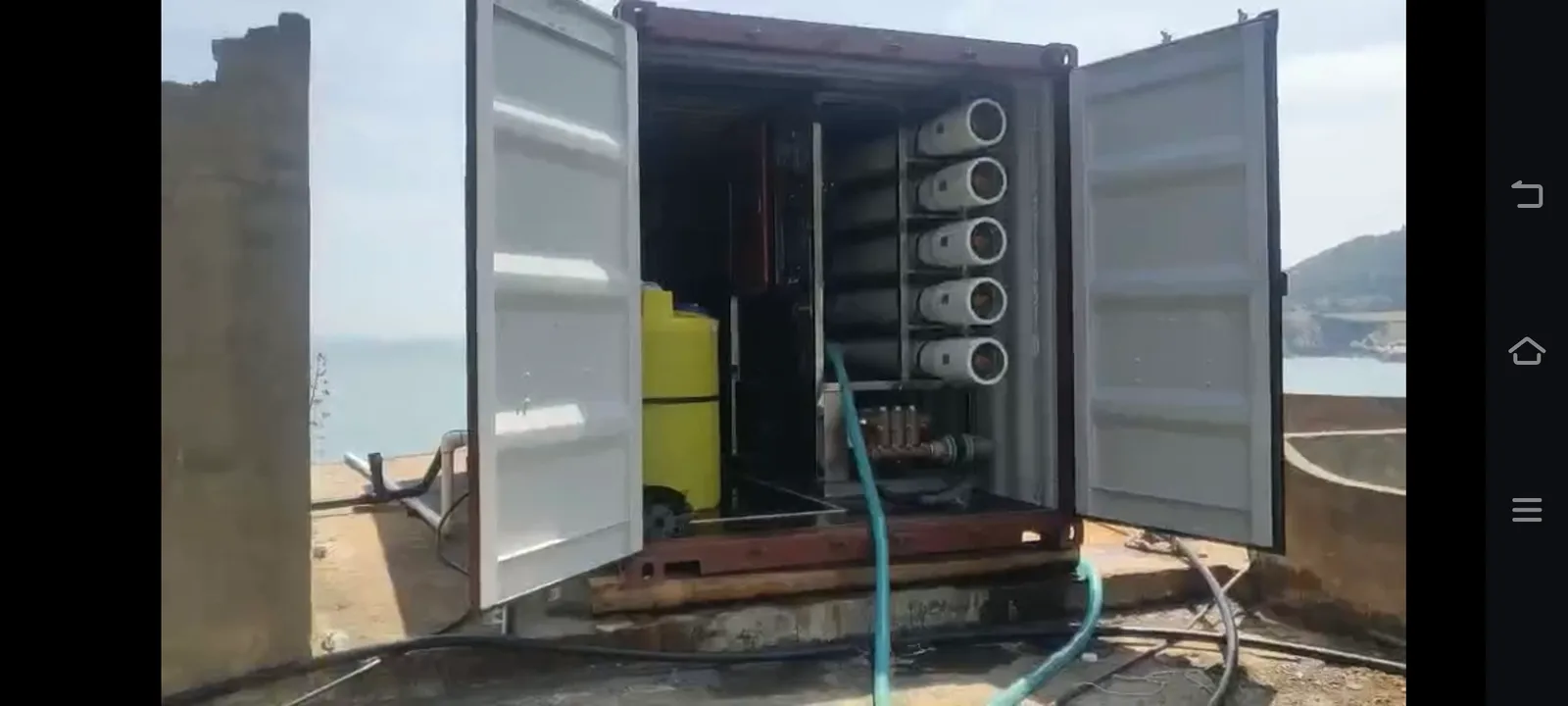
Commercial Desalination Machines: What Size Do You Need and What Will It Cost?
A commercial desalination machine turns salty feed water into drinking or process water, usually by reverse osmosis (RO). Searches for a "machine that turns salt water into drinking water" mix two very different products: pocket-sized portable devices for yachts and camping, and engineered plants that supply resorts, factories, and towns. If you are buying for a business or community — anywhere from about 6 to 1,200 m³/d — the right machine is chosen by four inputs: your water analysis, daily demand, required water standard, and available power and space. This guide helps you identify the appropriate scale, avoid three expensive buying mistakes, and compare suppliers on lifecycle performance rather than purchase price alone.
On this page
- What counts as a commercial desalination machine?
- Why source water decides more than budget
- The three most expensive buying mistakes
- How much does a commercial desalination machine cost to own?
- Containerized machine or traditional plant room?
- What should you send a supplier to get a real quotation?
- Frequently asked questions
Related: brackish borehole-water guide · SWRO vs BWRO decision guide · containerized plant selection guide · containerized system product page
What counts as a commercial desalination machine?
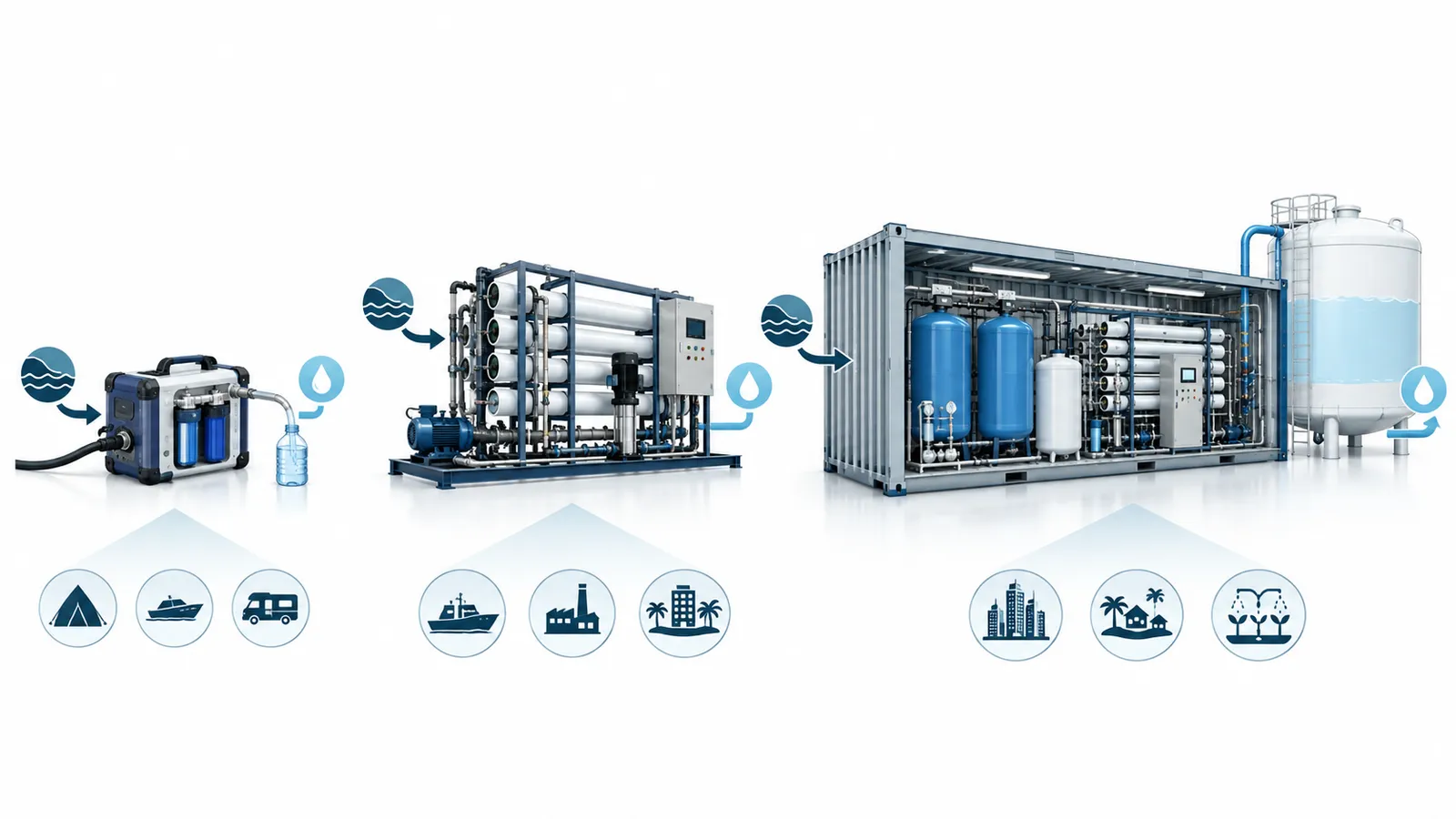
The boundary matters because the equipment, price, and supplier type change completely across it:
| Class | Typical output | What it looks like | Who it serves |
|---|---|---|---|
| Portable / marine watermaker | 0.02–5 m³/d | Compact cartridge unit, DC powered | Yachts, small boats, expeditions |
| Small commercial | 5–60 m³/d | Skid or 20 ft container, RO core | Cafés with wells, small resorts, construction camps, agriculture |
| Midsize commercial / light industrial | 60–300 m³/d | 40 ft container, energy recovery device (ERD), full instrumentation | Hotels, villages, food plants, mining camps |
| Industrial / municipal | 300 m³/d and up | Multi-train plants, field-built or containerized | Towns, power and process water, irrigation |
A yacht watermaker and a 200 m³/d resort plant are both "desalination machines" in a search box, but they share almost no components, standards, or supplier qualifications. If your duty is in the middle two rows, buy from a supplier whose references sit in the same row.
Why source water decides more than budget
The same budget buys different machines depending on the water feeding them:
- Brackish well water (total dissolved solids, or TDS, roughly 1,500–10,000 mg/L) runs at lower pressure. Equipment is cheaper per m³/d, energy use is lower, and pre-treatment is often less complex. The brackish borehole-water guide explains the required analysis and treatment train.
- Seawater (TDS ~35,000 mg/L) demands high-pressure components, energy recovery to stay economical, and pre-treatment sized for storms and seasons.
- Salty wells near the coast often sit between the two — test before assuming.
The full comparison — pressure ranges, energy, recovery, pre-treatment scope — is in our SWRO vs BWRO decision guide. The practical rule: never buy a desalination machine before a written water analysis of your actual source. Suppliers who accept a verbal "the water is salty" are guessing with your money.
The three most expensive buying mistakes
Mistake 1: Buying portable-class equipment for commercial duty. Devices designed for intermittent pleasure-craft use fail quickly at daily commercial duty cycles. The symptom appears six months in: falling flux, rising replacement costs. Commercial duty needs industrial components — confirm pump type, membrane loading, and control philosophy before price.
Mistake 2: Sizing for the peak day instead of the average. Commercial demand swings with weekends, seasons, and production campaigns. Membranes perform best at a steady load. Buy capacity for average demand plus a margin, and use storage to cover peaks; our containerized plant selection guide shows the arithmetic.
Capacity margin must be defined against the real design basis. For example, a skid that can hydraulically produce 450 m³/d on low-salinity factory test water may be conservatively rated around 360 m³/d on the project's seawater conditions. That is not hidden capacity: it is allowance for salinity, temperature, membrane aging and operating stability. Every guaranteed output should therefore name the feed TDS or conductivity, temperature, recovery and membrane condition.
Mistake 3: Comparing prices with different scopes. Differences in exclusions — intake, storage, brine disposal, power connection, and commissioning — can exceed the apparent price gap between bids. Demand a standardized quotation checklist covering the design basis, guaranteed quality against a named standard, kWh/m³ at your conditions, factory testing, spares, and exclusions.
How much does a commercial desalination machine cost to own?
Purchase price is the visible number; operating cost is the real one. Over ten years, energy and membrane replacement typically dominate:
| Cost block | Behavior over 10 years |
|---|---|
| Purchase + freight + installation | Fixed; varies with salinity and scope |
| Energy (kWh/m³ × output) | Accumulates every hour — the ERD and pump efficiency decide it |
| Membranes & cartridges | Replacement cycles 3–7 years (membranes), weeks–months (cartridges) |
| Chemicals (antiscalant, cleaning, remineralization) | Per-m³ dosing rates, priced from your analysis |
| Labor & service | Operator hours + service visits; remote monitoring reduces trips |
World Bank analysis of desalination economics shows the same hierarchy at utility scale: energy and financing dominate lifetime cost. For a buyer, the practical lesson is simple: a 2 kWh/m³ difference in specific energy can outweigh a substantial purchase-price gap over the operating life of a heavily used plant.
Containerized machine or traditional plant room?
Many buyers of small and midsize commercial machines (6–1,200 m³/d) choose containerized systems — complete plants that are factory-assembled and wet-tested in an ISO container — because site work shrinks to a pad and utility connections. Traditional plant rooms still make sense where a suitable building exists or municipal tendering requires civil works. The seven-factor comparison (capacity, process, automation, energy, supplier scope, lifecycle, and logistics) is in our containerized water treatment plant guide, and a typical scope of supply is on the containerized system product page.
What should you send a supplier to get a real quotation?
Send five things, and you will get comparable offers back:
- Water analysis of the actual source (TDS + ion profile + turbidity + temperature range)
- Demand table: average and peak m³/d, and hours of operation
- Product water standard you must meet (national drinking standard for potable use, or your process spec)
- Site facts: power available (kW, or solar array plans), space, distance from source to storage
- Intake situation: existing well, beach well possible, or open intake
With those, a serious manufacturer quotes in days. KONCHE, which has built commercial and industrial RO systems since 1997 across a 0.25–50 m³/h range (≈6–1,200 m³/d), structures quotations around these five inputs — and any supplier unwilling to work from your water data is self-selecting out of commercial projects.
Frequently asked questions
Are "desalination machines" and "RO plants" the same thing?
At commercial scale, reverse osmosis (RO) is usually the process used in packaged desalination machines. Thermal processes such as multi-effect distillation (MED) and multistage flash (MSF) are used mainly at utility scale or where project-specific heat integration supports them. Our SWRO components guide explains what is inside an RO plant, and the seawater desalination systems guide places that equipment in the wider project context.
Can a desalination machine run on solar power?
Yes, but the design work lies in the power system: array sizing, energy storage, water-storage strategy, and planned operating hours. The Philippines island desalination guide explains these trade-offs for remote coastal sites.
What maintenance does a commercial machine need?
Routine work includes daily readings, weekly checks, cartridge replacement, disciplined membrane cleaning, and scheduled membrane replacement. The complete field routine is in our SWRO membrane cleaning and replacement guide. Where ozone is specified for final disinfection or bottled-water duty, review the ozone water-treatment guide separately.
How do I verify a supplier before ordering?
Ask for a factory wet-test video of a comparable unit, reference contacts at similar capacity and water type, and a priced spare-parts list. Manufacturers with two decades of installations — KONCHE has supplied systems since 1997 — provide all three readily.
Do we need staff to run it?
A trained operator, not an engineer: the control system should carry the plant. What you cannot outsource is discipline — the logbook and the cleaning schedule.
What size desalination machine do I need?
Size the plant from net daily and peak demand, operating hours, storage, source-water salinity, recovery, and planned downtime. Do not select from a catalog flow alone; ask the supplier to show the complete water balance at the stated feed conditions.
Recommended systems for this application
Systems commonly specified for the duties discussed in this guide:
0.5–2,000 m³/d seawater RO plants for islands, resorts and industrial sites.
View specifications ↗CONTAINERIZEDContainerized Water Treatment SystemComplete treatment trains factory-built and wet-tested inside ISO freight containers.
View specifications ↗RO SYSTEMSSingle & Double Stage RO System0.25–50 m³/h single- and double-stage RO skids for process and drinking water.
View specifications ↗Start with
your water report.
Send the five inputs — water analysis, demand table, product standard, site facts and intake situation — and receive a comparable, condition-stated quotation.