Do You Need Single-Pass or Double-Pass RO? How to Choose
A single-pass reverse osmosis (RO) system treats the feed through one RO membrane system; a double-pass or two-pass system sends the first-pass permeate through a second RO system for further ion removal. The choice is made from the required product-water quality, not from a rule that "higher feed total dissolved solids (TDS) always means two passes." Single-pass RO is usually the economical choice when one membrane projection can meet the specification, while double-pass RO is used when the target conductivity or a difficult ion requires a second barrier before final use or polishing. The quotation must state the feed conditions, membrane projection, recovery, second-pass arrangement, and guaranteed outlet values for the choice to be meaningful. This guide explains the difference between a pass and a stage, compares performance and cost, shows the water balance, and gives a decision sequence for drinking water, boiler makeup, food production, electronics, and ultrapure-water pretreatment.
Get an Equipment Quote ↗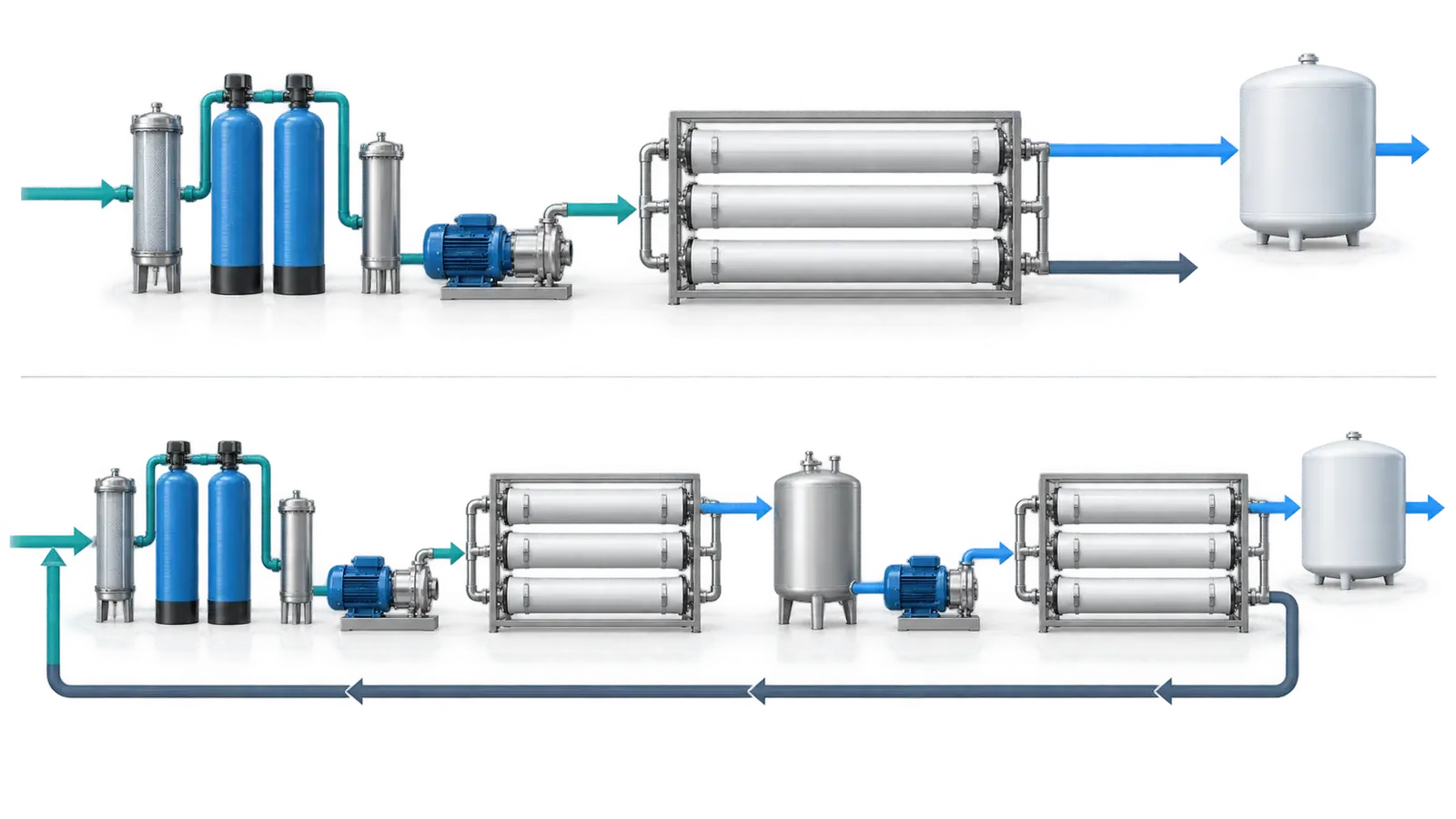
Do You Need Single-Pass or Double-Pass RO? How to Choose
!Side-by-side process comparison of single-pass and double-pass reverse osmosis systems
On this page
- Do you need one or two RO passes, and is that the same as one or two stages?
- How does a single-pass RO system work?
- How does a double-pass RO system work?
- How do single-pass and double-pass RO compare?
- When is single-pass RO usually enough?
- When does double-pass RO make sense?
- How should the two configurations be compared economically?
- What should a single-pass or double-pass quotation include?
- Frequently asked questions
Related: single- and double-stage RO equipment · reverse osmosis water-treatment systems guide · RO storage-tank hygiene guide · water-refilling station business guide
Do you need one or two RO passes, and is that the same as one or two stages?
The terms are often mixed in commercial brochures, but they describe different hydraulic arrangements:
- An RO pass is one complete journey through an RO membrane system. In a double-pass system, first-pass permeate becomes the feed to the second pass.
- An RO stage is a group of pressure vessels within one pass. Concentrate from the first stage feeds the second stage to raise overall recovery.
A single-pass system can contain one, two, or more stages. A double-pass system can also contain multiple stages inside either pass. DuPont's membrane design manual uses permeate-staged, double-pass, and 2-pass for the arrangement in which first-pass permeate feeds a second RO system.
KONCHE's commercial product family is marketed as single- and double-stage RO equipment. For international engineering clarity, this article uses single-pass and double-pass when referring to one or two consecutive desalination passes.
How does a single-pass RO system work?
The process is:
Pretreated feed → high-pressure pump → RO pass → product water + concentrate
One pass is the simplest configuration. It uses fewer pumps, instruments, membranes, valves, and interconnecting pipes than a double-pass plant. It is normally the first option to test in membrane-design software because adding a second pass should solve a defined water-quality problem, not serve as an automatic upgrade.
Single-pass RO commonly fits:
- general industrial washing and process water;
- drinking-water desalination followed by appropriate post-treatment;
- food and beverage ingredient water where the product specification allows it;
- lower- and moderate-pressure boiler makeup where one pass meets the boiler manufacturer's limits;
- brackish-well and municipal-water duties with moderate conductivity targets;
- pretreatment for downstream ion exchange where one pass provides an economical load reduction.
The complete process context is in the reverse osmosis water-treatment systems guide.
How does a double-pass RO system work?
The basic flow is:
Pretreated feed → RO pass 1 → pass-1 permeate → RO pass 2 → final product
The second pass treats water that is already much cleaner and lower in osmotic pressure than the original feed. Its design conditions therefore differ from the first pass. A surge tank may separate the two passes, or the passes may be hydraulically coupled where the equipment and controls allow it. If a tank is used, it must be protected against dust and microbial contamination; the RO storage-tank hygiene guide explains that risk.
Second-pass concentrate is often of better quality than the original feed and may be returned to the first-pass feed, subject to the projected chemistry and hydraulic design. This can improve the overall water balance, but recycle is not automatically safe: it changes first-pass feed concentration, flow, and scaling potential.
Carbon dioxide deserves special attention in low-conductivity systems because dissolved CO₂ passes RO membranes more readily than ionic salts and can raise measured conductivity after the membrane. pH adjustment, degassing, or downstream polishing may be necessary depending on the specification.
How do single-pass and double-pass RO compare?
| Decision factor | Single-pass RO | Double-pass RO |
|---|---|---|
| Flow path | Feed crosses one RO system | First-pass permeate crosses a second RO system |
| Best fit | General purified-water duties when one pass meets the target | Lower and more stable conductivity or difficult ion targets |
| Equipment | One RO pump/array and simpler controls | Second pump or coupled pressure arrangement, second array, more instruments and controls |
| Capital cost | Lower | Higher |
| Energy use | Lower for the same feed and product flow | Higher overall, although the second pass treats low-salinity water at lower pressure |
| Product quality | Determined by feed, membrane, recovery, temperature, and condition | Additional reduction after the first pass; final value remains condition-dependent |
| Recovery | Set from feed chemistry and array design | Must be calculated across both passes and any concentrate recycle |
| Operating burden | Fewer components and simpler troubleshooting | More instruments, membranes, controls, and sanitation points |
| Future polishing | Can feed softening, ion exchange, or some process uses | Common pretreatment for EDI, mixed bed, or high-purity polishing |
KONCHE publishes reference configurations of up to 10 μS/cm for single-pass equipment and up to 3 μS/cm for double-pass equipment. These are product-family references, not universal guarantees: actual conductivity must be projected and guaranteed against the specified feed-water envelope. The required value should come from the process or governing standard, not from the equipment brochure.
When is single-pass RO usually enough?
Choose one pass when all of the following are true:
- A documented membrane projection meets the required product-water parameters at the worst design temperature and feed chemistry.
- The process can tolerate the projected variation as membranes age or the feed changes within its stated envelope.
- No ion-specific limit requires a second pass or another polishing process.
- The risk and cost of extra equipment are not justified by the product specification.
For example, an industrial wash-water plant should not be upgraded to double-pass RO merely to produce a lower number that the process does not need. Over-treatment increases capital cost, energy, maintenance, instrumentation, and concentrate handling without improving the actual production outcome.
Many community and water-refilling duties use one RO pass with correct pretreatment and final microbial control. The application sequence is shown in the water-refilling station business guide, while source-water risks are covered in the well water treatment guide and the river-water RO pretreatment guide.
When does double-pass RO make sense?
Consider two passes when one or more of these conditions apply:
- One pass cannot reliably meet the required conductivity or ion-specific limit across the full feed envelope.
- The RO product feeds electrodeionization (EDI), a mixed bed, or another polishing process that benefits from lower ionic load.
- Boiler pressure, turbine protection, or steam-purity requirements demand lower dissolved solids than a single pass can guarantee; see the boiler feedwater selection guide.
- Electronics, pharmaceutical support, precision rinsing, or analytical duties need a stable low-conductivity feed before polishing; see the industrial ultrapure-water system and laboratory water purification guide.
- Boron, silica, ammonia, nitrate, or another weakly rejected species requires a second barrier, pH adjustment, or a different polishing step supported by a projection and acceptance test.
- The project needs redundancy of treatment barriers for a validated process, and the validation plan recognizes the two-pass arrangement.
Double-pass RO should not be confused with seawater RO. A seawater plant may use one or two passes depending on the product target, while a low-salinity municipal feed can also use two passes for high-purity production. The seawater RO versus brackish-water RO comparison explains the feed-pressure distinction, and the seawater desalination systems guide covers the wider plant.
How should the two configurations be compared economically?
Compare lifecycle cost at the same guaranteed product-water condition:
| Cost block | What changes with a second pass |
|---|---|
| Membranes and pressure vessels | Additional elements and housings |
| Pumping and energy | A second pressure requirement, normally lower than the first pass |
| Instruments and controls | Additional conductivity, flow, pressure, interlocks, and diversion logic |
| Cleaning and sanitation | More membrane area and an additional hydraulic zone |
| Chemicals | Possible inter-pass pH adjustment; changed antiscalant and cleaning demand |
| Water balance | Second-pass concentrate may be recycled, but the full balance must be projected |
| Downstream polishing | Lower ionic load can reduce EDI or ion-exchange burden |
The cheapest plant that misses the product specification is not economical. Equally, a double-pass system that produces quality the process does not use is unnecessary capital. Request both configurations only when the supplier can show the membrane projections and lifecycle comparison against the same feed and outlet requirements.
What should a single-pass or double-pass quotation include?
Require these items in writing:
- Feed-water analysis and design temperature range.
- Product-water flow and guaranteed parameters, including conductivity and any ion-specific limits.
- Separate membrane projections for each pass at start-up and design-aging conditions.
- Recovery, flux, feed pressure, permeate flow, and concentrate flow for each pass.
- Second-pass concentrate destination and its effect on the first-pass feed.
- Inter-pass tank, pH adjustment, degassing, or sanitation provisions where applicable.
- Conductivity-diversion logic and the action taken when either pass is out of specification.
- Energy and chemical consumption at the stated operating point.
- Cleaning, flushing, membrane-replacement, and spare-parts scope.
- Factory acceptance and site-verification methods.
KONCHE has manufactured commercial and industrial water-treatment equipment since 1997, with packaged RO capacities from 0.25 to 50 m³/h. A buyer should still judge the proposal by the declared design basis and acceptance criteria, not company history alone.
Frequently asked questions
Is double-pass RO the same as two-stage RO?
Not necessarily. A pass means that permeate goes through another RO system. A stage usually means that concentrate feeds another group of pressure vessels within the same pass. Ask for a process-flow diagram rather than relying on the label.
Does high feed-water TDS automatically require double-pass RO?
No. Feed salinity affects pressure, recovery, membrane selection, and first-pass permeate quality, but the number of passes is ultimately set by the required product-water specification and the membrane projection.
Can a single-pass system be upgraded to double-pass later?
Yes, if phase one reserves hydraulic connections, electrical capacity, control inputs, floor space, inter-pass provisions, and sufficient pretreatment and feed capacity. Planning those interfaces during the original build is less costly than redesigning the plant later.
Is double-pass RO always required before EDI?
No universal rule applies. EDI suppliers specify acceptable feed conductivity and contaminant limits. Two-pass RO is common because it reduces ionic loading and stabilizes the feed, but the complete RO–EDI design must be verified against the selected equipment.
Does double-pass RO waste twice as much water?
Not automatically. Second-pass concentrate is often recycled because it is cleaner than the original feed. The true water use depends on the recovery of both passes, recycle arrangement, pretreatment losses, cleaning, and the concentrate-disposal design.
Is double-pass RO always better than single-pass RO?
No. It is better only when the second pass solves a defined product-water problem or reduces the cost and load of downstream polishing. If one pass already meets the required specification reliably, a second pass adds capital cost, energy use, membranes, controls, and maintenance without improving the process outcome.
- DuPont, FilmTec Reverse Osmosis/Nanofiltration Membranes Technical Manual, Section 3.7: Permeate-Staged or Double-Pass Systems (45-D01504-en)
- DuPont, FilmTec RO/NF Elements — Operation Excellence and Limiting Conditions (TechFact 45-D04388-en)
- US EPA, Overview of Drinking Water Treatment Technologies — Reverse Osmosis/Nanofiltration
- WHO, Guidelines for Drinking-water Quality, fourth edition incorporating the first addendum
Recommended systems for this application
Systems commonly specified for the duties discussed in this guide:
0.25–50 m³/h single- and double-stage RO skids for process and drinking water.
View specifications ↗ULTRAPUREIndustrial Ultrapure Water SystemPolishing trains for electronics and pharmaceutical grade water.
View specifications ↗LABORATORYLaboratory Ultrapure Water SystemType I laboratory water purification systems for analytical work.
View specifications ↗Start with
your water report.
Send the product-water specification and feed analysis. KONCHE runs the membrane projections for both configurations and quotes the one the process needs.