How Do You Make River Water Safe? River Water Treatment and RO Pretreatment
A river water treatment system must first control suspended solids, turbidity, algae, natural organic matter, and microorganisms; reverse osmosis (RO) is added only when dissolved salts, specific contaminants, or the required process-water quality justify it. A reliable river-water RO train therefore begins with seasonal source data and usually places screening, clarification or ultrafiltration, and cartridge protection ahead of the RO membranes. The design must be based on the worst credible river condition — commonly a storm, flood, algal event, or dry-season concentration period — rather than one clear-water sample. For drinking-water projects, the complete train must also meet the applicable national treatment and disinfection requirements, not merely a conductivity target. This guide explains when river water needs RO, which tests drive the process, how conventional clarification compares with ultrafiltration, what a complete treatment train looks like, and what every supplier quotation should state.
Get an Equipment Quote ↗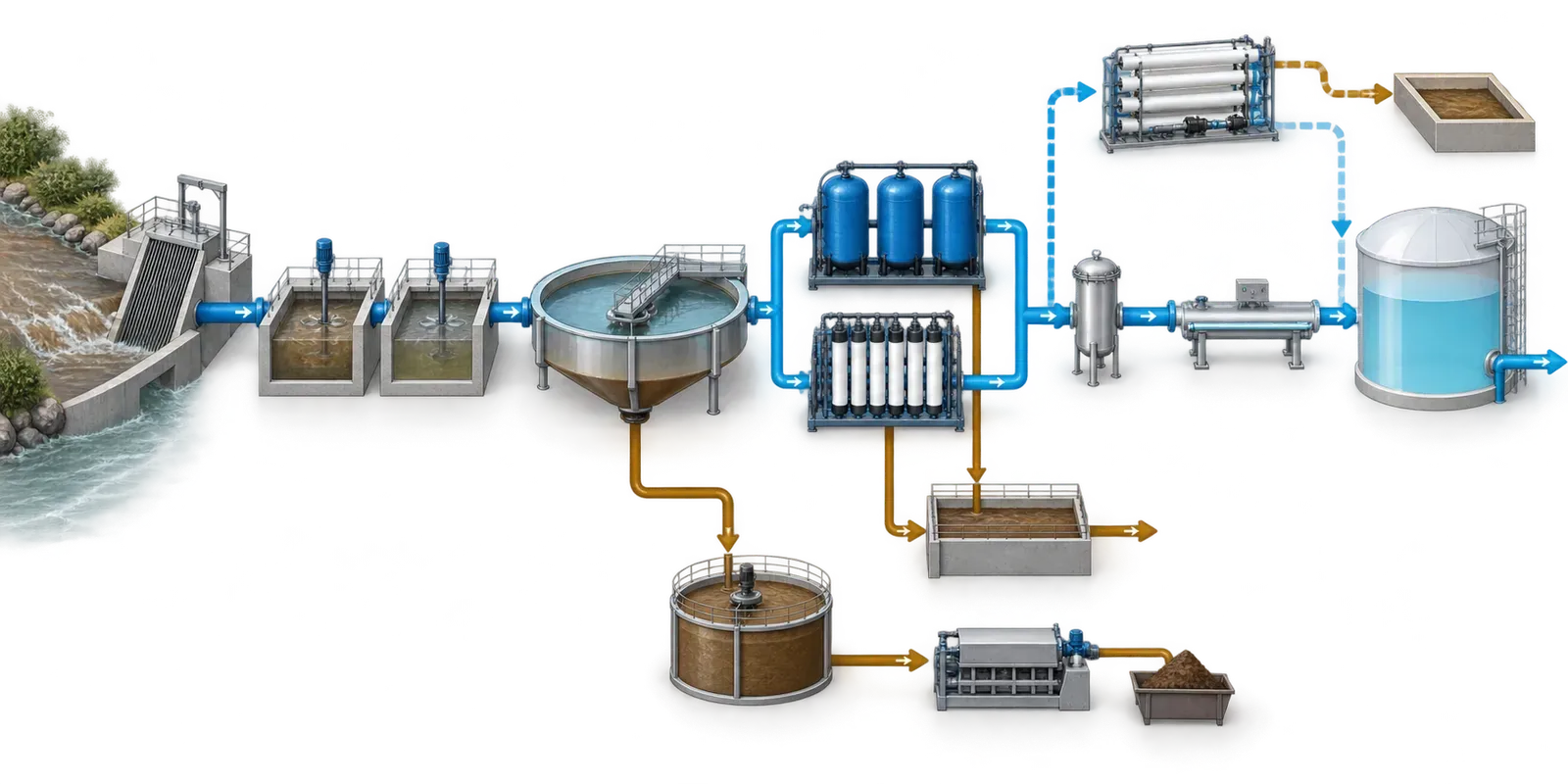
How Do You Make River Water Safe? River Water Treatment and RO Pretreatment
!River-water treatment train with screening, coagulation, clarification, filtration, optional RO, disinfection and residuals handling
On this page
- Do you always need reverse osmosis to make river water safe?
- Why is river water difficult to design for?
- What should be tested before designing the plant?
- What is the standard river-water treatment sequence before RO?
- What filter is needed for river water: conventional filtration or ultrafiltration?
- What inlet conditions should the RO membrane receive?
- How do you size a river-water RO plant?
- How do drinking-water and process-water designs differ?
- How does river-water RO differ from well-water and seawater RO?
- What should a river-water treatment quotation include?
- Frequently asked questions
Related: reverse osmosis water-treatment systems guide · single-pass versus double-pass guide · containerized water treatment system · industrial UF system page
Do you always need reverse osmosis to make river water safe?
No. River water is defined by its source, not by one contaminant. Many rivers have low dissolved-salt levels but high and variable turbidity, organic matter, algae, and microbial risk. In those cases, clarification, filtration, and disinfection may meet the intended use without RO.
RO becomes relevant when the project requires one or more of the following:
- lower total dissolved solids (TDS) or conductivity than conventional filtration can provide;
- reduction of dissolved hardness, chloride, sulfate, nitrate, fluoride, silica, or another specified ion;
- consistent industrial process water despite seasonal source variation;
- boiler, food, electronics, laboratory, or other duties with defined dissolved-water limits;
- a barrier for a mixture of dissolved contaminants that is better addressed by membrane separation than by several targeted processes.
The decision should be recorded as: source-water result → product-water requirement → selected process. The reverse osmosis water-treatment systems guide explains the wider RO selection method, and the single-pass versus double-pass guide covers the number of desalination passes after RO has been justified.
Why is river water difficult to design for?
Unlike many municipal and deep-well sources, a river can change quickly. A design based on average water can fail during the event when treatment is needed most.
| River condition | Likely change | Treatment consequence |
|---|---|---|
| Heavy rain or flood | Turbidity, suspended solids, color, debris, microbial load rise | More screening, coagulant demand, sludge, filter loading, and backwash |
| Dry season or low flow | Dissolved salts and some contaminants may concentrate | Recheck RO pressure, recovery, scaling, and product quality |
| Algal bloom | Cells, dissolved organics, taste/odor compounds, variable pH | Intake management, coagulation or assessment of ultrafiltration, carbon or oxidation assessment |
| Upstream discharge event | Organic, chemical, or conductivity spike | Online monitoring, diversion or shutdown logic, targeted analysis |
| Cold season | Higher viscosity and lower membrane permeate flow | Temperature correction and adequate installed membrane area |
Collect a historical range where available and test representative high-risk periods. If only one sample exists, treat it as a starting point rather than a complete design basis.
What should be tested before designing the plant?
The minimum data package for river-water treatment includes:
- turbidity range and suspended solids;
- temperature range;
- pH, alkalinity, hardness, and full ion profile;
- TDS or conductivity;
- total organic carbon or another agreed organic-load indicator;
- color, ultraviolet absorbance where relevant, and taste/odor observations;
- algae or cyanobacteria risk where the source is susceptible;
- iron and manganese;
- microbiology required by the governing standard;
- any site-specific industrial, agricultural, or geological contaminants;
- silt density index (SDI) after the proposed pretreatment during pilot or commissioning verification.
Sampling points and methods matter. A river-bank intake, reservoir offtake, and infiltration well can produce different water even when they draw from the same catchment. State the exact intake and expected operating envelope on the quotation.
What is the standard river-water treatment sequence before RO?
A typical robust train is:
Intake screening → coagulation/flocculation where required → clarification or dissolved-air flotation → multimedia filtration or ultrafiltration → activated carbon or chemical conditioning where required → cartridge filtration → RO → post-treatment → protected storage
Not every plant needs every stage. The purpose of design is to select only the barriers needed for the measured source and target:
- Screening protects pumps and downstream units from leaves, plastics, aquatic matter, and coarse debris.
- Coagulation and flocculation destabilize fine particles and some natural organic matter so they can be separated.
- Clarification or flotation removes the formed solids before they overload filters; dissolved-air flotation can be useful for low-density algal solids.
- Multimedia filtration or ultrafiltration (UF) controls fine particles and turbidity before the RO guard filter.
- Activated carbon or oxidation may address chlorine demand, organics, taste, odor, or a specific contaminant, but must be evaluated for biological effects.
- Chemical conditioning controls scale and pH and removes oxidants that could damage the selected RO membrane.
- Cartridge filtration is the final physical protection, not the main river-water solids process.
- RO removes the dissolved load required by the product specification.
- Post-treatment conditions the permeate for drinking or process use and protects storage and distribution.
For packaged projects, the treatment stages can be integrated into a containerized water treatment system, but intake works, sludge handling, raw-water equalization, and concentrate disposal may remain outside the container.
What filter is needed for river water: conventional filtration or ultrafiltration?
Both can work when correctly designed. Selection depends on river variability, footprint, operator capability, chemical use, sludge handling, and the membrane supplier's inlet limits.
| Factor | Conventional clarification + multimedia filtration | Ultrafiltration-based pretreatment |
|---|---|---|
| Turbidity handling | Strong when coagulation and clarification are controlled | Strong within the UF operating envelope; extreme solids may still need clarification |
| Footprint | Larger basins and filters | More compact membrane skids |
| Operator tasks | Coagulant control, sludge, filter backwash | Backwash, chemically enhanced cleaning, integrity and transmembrane-pressure monitoring |
| Barrier consistency | Depends strongly on coagulation and filter operation | Consistent physical barrier when membrane integrity is maintained |
| Organic removal | Coagulation can remove a useful fraction | UF alone removes particles, not all dissolved organics |
| Waste streams | Clarifier sludge and filter backwash | UF backwash and cleaning waste; upstream sludge if clarification is retained |
| Best fit | Sites with space, operators, and suitable sludge management | Compact plants, variable turbidity, and projects needing a defined membrane barrier |
The industrial UF system page shows the equipment option, but UF should not be selected from nominal pore size alone. Flux, recovery, backwash source, chemical cleaning, integrity monitoring, and the worst feed condition all affect whether it protects the RO array.
What inlet conditions should the RO membrane receive?
The selected membrane manufacturer's limits govern the final design. Common commercial design practice aims for low turbidity and an SDI suitable for the membrane and warranty, often with turbidity below about 1 NTU and SDI₁₅ no higher than about 5 as upper reference values. Difficult surface-water projects normally target more conservative and stable performance rather than designing exactly at a maximum.
The RO inlet must also control:
- free chlorine or other oxidants against the membrane's tolerance;
- scale-forming ions at the projected concentrate condition;
- iron, manganese, aluminum, and residual coagulant carryover;
- oil, grease, and difficult organics;
- biological growth during operation and shutdown;
- cartridge differential pressure and breakthrough.
A low turbidity reading alone does not prove that colloids, organics, scale risk, and biological fouling are controlled. Trend SDI, differential pressure, normalized permeate flow, salt passage, and pretreatment performance together.
How do you size a river-water RO plant?
Begin with net treated-water demand, then work backward through RO recovery and pretreatment losses.
| Water-balance item | What to include |
|---|---|
| Net product demand | Average and peak m³/d, operating hours, future margin |
| RO recovery | Supported by ion chemistry, scaling projection, temperature, and membrane design |
| Pretreatment recovery | Clarifier sludge withdrawal, filter or UF backwash, chemical cleaning |
| Availability | Planned maintenance, river shutdown events, redundancy requirement |
| Storage | Product buffer for peaks and maintenance; raw-water buffer where the intake is unstable |
| Waste and concentrate | Sludge, backwash, cleaning waste, and RO concentrate as separate streams |
For example, a plant delivering 100 m³/d of RO permeate at 75% RO recovery needs about 133 m³/d at the RO inlet before allowing for pretreatment backwash and cleaning losses. If the pretreatment recovers 90%, the river intake must provide roughly 148 m³/d before other site allowances. Final sizing must use the actual process mass balance rather than these illustrative values.
How do drinking-water and process-water designs differ?
For drinking water, RO product must be stabilized where necessary and protected against microbial recontamination. Applicable regulations may require specific treatment barriers, monitoring, operator qualifications, and reporting for surface-water sources. WHO guidance provides a risk-management framework, but the national authority sets the enforceable requirements.
For industrial process water, the final specification may focus on conductivity, hardness, silica, chloride, organics, or microbial load. The plant should not be designed to a generic "drinking-water" number when a boiler, food process, cooling system, or production rinse has a different limit.
Post-treatment options include the UV water-treatment systems guide for point-of-treatment disinfection, the ozone water-treatment guide for oxidation and selected residual duties, and the RO storage-tank hygiene guide for preventing regrowth after treatment.
How does river-water RO differ from well-water and seawater RO?
River water usually places the heaviest emphasis on variable solids, organics, algae, and microbiology. Well water is often physically clear but may carry hardness, iron, manganese, hydrogen sulfide, or brackish salinity; see the well water treatment guide and borehole desalination guide. Seawater has much higher osmotic pressure and needs seawater membranes, high-pressure pumping, energy recovery, marine-compatible materials, and brine planning; see the seawater desalination systems guide.
The same single- and double-stage RO equipment platform can inform commercial packaging, but pumps, membranes, pretreatment, recovery, materials, and controls must be configured for the actual source. A catalog flow rate does not make three source waters equivalent.
What should a river-water treatment quotation include?
Ask each bidder to provide:
- The source-water dataset and worst-case conditions used for design.
- Intake-screening limits and exclusions for civil or river works.
- Jar testing, pilot testing, or another basis for coagulation and pretreatment where variability is high.
- Stage-by-stage flow, recovery, backwash, sludge, cleaning-waste, and concentrate balance.
- RO membrane projection at minimum and maximum design temperature.
- Guaranteed inlet conditions to the RO membrane and the instruments used to verify them.
- Product-water guarantees against the named drinking-water or process specification.
- Chemical consumption, energy, cartridges, membrane-cleaning assumptions, and priced spares.
- Online monitoring, alarms, diversion or shutdown logic for source-water excursions.
- Factory and site acceptance tests, operator training, and sampling plan.
- Clearly stated exclusions: intake, civil works, sludge handling, tanks, outfalls, concentrate disposal, power, and distribution.
KONCHE has manufactured commercial and industrial water-treatment equipment since 1997, with packaged systems from 0.25 to 50 m³/h. River-water projects within that range still require source-specific pretreatment and should not be quoted as a standard RO skid without seasonal water data.
Frequently asked questions
Can RO treat muddy river water directly?
No. High suspended solids and turbidity can rapidly foul the membrane and block cartridge filters. Screening, clarification and filtration or UF must reduce the solids load before RO.
Is ultrafiltration always required before river-water RO?
No. A well-operated conventional clarification and filtration train can provide effective pretreatment. UF is valuable where footprint, barrier consistency, or variable turbidity justifies it, but it must be designed with appropriate upstream protection, backwash, cleaning, and integrity monitoring.
How many river-water samples are needed before design?
There is no universal number. Use historical utility or environmental data where available and sample conditions that represent seasonal extremes. At minimum, do not treat one favorable sample as proof of the full operating envelope.
Can the same plant treat river water and well water?
The RO skid may be able to operate on both sources if the feed envelope is defined, but the pretreatment and control settings can differ substantially. Design dual-source operation explicitly, including valves, dosing, flushing, alarms, and separate source-water acceptance limits.
What happens to the RO concentrate and pretreatment waste?
They are separate waste streams. Clarifier sludge, filter or UF backwash, chemical-cleaning waste, and RO concentrate have different compositions and may require different handling. The site must confirm the legal discharge or disposal route before equipment selection.
- US EPA, Surface Water Treatment Rules
- US EPA, Overview of Drinking Water Treatment Technologies — Reverse Osmosis/Nanofiltration
- US Bureau of Reclamation, Reverse Osmosis Pretreatment Using a Slow Sand Filter
- WHO, Guidelines for Drinking-water Quality, fourth edition incorporating the first addendum
- DuPont, FilmTec Reverse Osmosis/Nanofiltration Membranes Technical Manual (45-D01504-en)
Recommended systems for this application
Systems commonly specified for the duties discussed in this guide:
0.01 μm ultrafiltration barrier for particles and microbes before RO.
View specifications ↗CONTAINERIZEDContainerized Water Treatment SystemComplete treatment trains factory-built and wet-tested inside ISO freight containers.
View specifications ↗DRINKING WATERCommercial Drinking Water System0.25–50 m³/h drinking-water production with multi-stage pretreatment.
View specifications ↗Start with
your water report.
Send seasonal river data and the product target. KONCHE selects the pretreatment route and designs the RO train around the worst credible feed condition.