What Is a Desalination Plant and How Does It Turn Seawater into Drinking Water?
A desalination plant removes dissolved salt from seawater or brackish water to produce drinking or process water. At commercial scale — roughly 6–1,200 m³/d — reverse osmosis (RO) is usually the practical choice, delivered in a containerized or skid-mounted package. Making ocean water drinkable still requires a complete train: intake, pretreatment, RO desalination, post-treatment, disinfection, protected storage, and verification against the applicable standard. Selection starts with four inputs: the water analysis, daily demand, required product-water standard, and site power and logistics. This hub answers each major buyer question directly and links to detailed guides on components, containers, borehole desalination, island projects, equipment scale, and membrane maintenance.
Get an Equipment Quote ↗
What Is a Desalination Plant and How Does It Turn Seawater into Drinking Water?
A desalination plant removes dissolved salt from seawater or brackish water to produce drinking or process water. At commercial scale — roughly 6–1,200 m³/d — reverse osmosis (RO) is usually the practical choice, delivered in a containerized or skid-mounted package. Making ocean water drinkable still requires a complete train: intake, pretreatment, RO desalination, post-treatment, disinfection, protected storage, and verification against the applicable standard. Selection starts with four inputs: the water analysis, daily demand, required product-water standard, and site power and logistics. This hub answers each major buyer question directly and links to detailed guides on components, containers, borehole desalination, island projects, equipment scale, and membrane maintenance.
On this page
- How does a desalination plant work, step by step?
- Seawater RO or brackish water RO — which do you actually need?
- How do you remove salt from a borehole or well?
- Containerized plant or field-built installation?
- What machine scale does your project need?
- Planning an island or coastal project in the Philippines?
- How do you maintain the membranes — and when do you replace them?
- How much does a desalination plant cost, and how should offers be compared?
- How does desalination connect to the wider water system?
- Frequently asked questions
Related: SWRO Plant Components: What Each Part Does and How to Specify It · Seawater RO vs Brackish Water RO · How to Remove Salt from Borehole and Well Water · Containerized Water Treatment Plant Selection Guide
How does a desalination plant work, step by step?
A seawater RO train contains six component groups in process order: intake, pre-treatment (filtration and dosing), high-pressure pumps, RO membranes in pressure vessels, energy recovery, and instrumentation with programmable logic controller (PLC) control. Post-treatment — remineralization, disinfection, and storage — conditions the product water before use. Each group has a different critical specification: worst-season pre-treatment, certified pump materials, conservative membrane flux, energy-recovery contribution to kWh/m³, and a control philosophy with adequate interlocks.
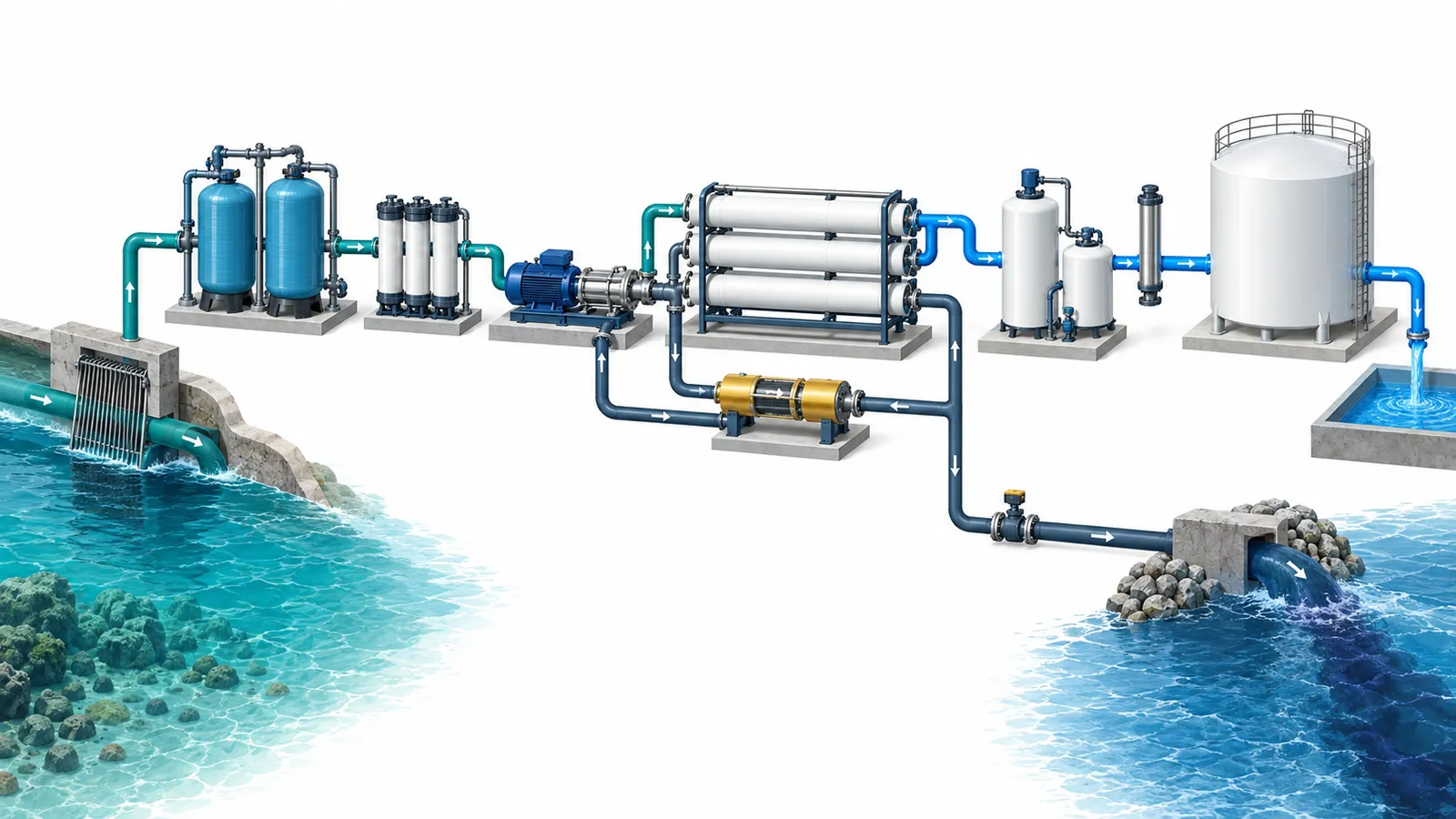
→ Full component-by-component guide with selection tables: SWRO Plant Components: What Each Part Does and How to Specify It
Seawater RO or brackish water RO — which do you actually need?
Source salinity decides. Wells and boreholes up to roughly 10,000 mg/L TDS run as brackish RO at low pressure; open seawater near 35,000 mg/L requires high-pressure SWRO with energy recovery. Between the two — beach wells, intrusion-affected coastal wells — the boundary case deserves a deliberate decision, because it moves 30–40% of the budget through pressure ratings, energy consumption, and pre-treatment scope.
→ The full comparison for coastal projects: Seawater RO vs Brackish Water RO
How do you remove salt from a borehole or well?
Test first, define the water's use, then choose: reverse osmosis for bulk salt removal, nanofiltration for hardness and partial desalination, ion exchange in support (it does not desalinate), distillation only for special duties. Salty wells usually trace to saltwater intrusion, a naturally saline aquifer, or a single problem ion — the cause changes the treatment train and the trend matters as much as the snapshot.
→ The borehole decision guide: How to Remove Salt from Borehole and Well Water
Containerized plant or field-built installation?
For most commercial duties a containerized plant — the complete system factory-assembled and wet-tested inside a 20 ft or 40 ft ISO container — deploys faster and moves quality risk to the factory; field-built plants win at large municipal scale or where a plant room already exists. Compare quotations on seven factors: raw water data, capacity basis, product standard, pre-treatment robustness, automation, energy at your conditions, and lifecycle scope.
→ The seven-factor selection guide with cost structure: Containerized Water Treatment Plant Selection Guide
What machine scale does your project need?
"Desalination machines" span pocket watermakers for yachts and engineered plants for towns; buyers between those extremes — resorts, farms, communities, food plants — should place themselves on the scale ladder (5–60 / 60–300 / 300–1,200 m³/d) and buy from suppliers with references in the same band. The three expensive mistakes: portable-class equipment in commercial duty, sizing membranes for the peak day instead of the average, and comparing prices across different exclusions lists.
| Product-water demand | Typical plant form | Main buyer decision |
|---|---|---|
| 5–60 m³/d | Skid or 20 ft container | Simplicity, service access, source-water variability |
| 60–300 m³/d | 40 ft container or plant room | Energy recovery, automation, storage strategy |
| 300–1,200 m³/d | Parallel trains | Redundancy, intake capacity, brine outfall |
→ Scale and supplier-matching guide: Commercial Desalination Machines: How to Match the Machine to the Real Job
Planning an island or coastal project in the Philippines?
Island desalination planning follows five steps: test the source near the end of the dry season, define demand in m³/d with peaks covered by storage, choose brackish-water or seawater RO from the data, decide the installation and logistics model, and prepare the power, intake, brine, and storage plan before requesting quotations. For Philippine water-refilling businesses using coastal wells that are becoming more saline, brackish-water RO may be the entry point. Solar-powered RO is feasible for off-grid islands when the operating-hours and storage strategy are designed together.
→ The country planning guide: Seawater Desalination in the Philippines: Island Planning Guide
How do you maintain the membranes — and when do you replace them?
Clean on measured triggers (normalized flow −10%, differential pressure +10–15%, rising salt passage), not on a calendar; identify the fouling family (scale, organic, biofilm, iron) before choosing chemistry; and replace when the second CIP fails to restore baseline. Service life in the 3–7 year range is an outcome of conservative flux design, sound pre-treatment, and shutdown flush discipline — all specified at purchase time.
→ The operator's field guide: SWRO Membrane Cleaning and Replacement
How much does a desalination plant cost, and how should offers be compared?
Two plants with the same purchase price can have very different ownership costs. Compare energy use in kWh/m³ at the stated design temperature and salinity, membrane replacement as a priced line, chemical consumption per cubic meter, and exclusions such as intake, storage, brine works, and power. World Bank analysis identifies energy as a major desalination cost driver, so a quotation that highlights only purchase price omits the numbers that shape lifecycle cost. KONCHE has manufactured commercial and industrial RO systems since 1997, covering packaged capacities from 0.25 to 50 m³/h (about 6–1,200 m³/d); use that capacity range as context, not as a substitute for site-specific design.
How does desalination connect to the wider water system?
Desalination is one stage in a supply chain: product water needs remineralization and disinfection (the UV vs ozone choice matters for bottled and food plants), storage hygiene discipline, and — where the offtaker is a refilling or bottling business — the commercial planning in our water refilling station guide. For boiler or process duty, RO is the roughing stage under additional chemistry: see the boiler feed water guide. And for the highest-purity end uses, laboratory water purification explains the polishing train.
Frequently asked questions
Can ocean water be made drinkable, and is desalinated water safe to drink?
Yes, when designed from your water analysis and verified against a named standard (WHO guidance or your national standard) at factory and site acceptance. Safety is a specification and verification outcome, not a property of the technology.
What is the typical energy consumption?
A commercial seawater RO system with energy recovery typically uses a few kWh/m³, while brackish-water RO generally uses less. Compare only values stated at the same feed salinity, temperature, recovery, and product-water conditions.
How long does it take to go from order to first water?
Containerized plants: manufacture and factory test dominate the schedule; site work shrinks to a pad, connections, and commissioning in days to weeks. See the installation and commissioning sequence in the containerized guide.
Can desalination run on solar power?
Yes — especially brackish RO. Design the power arrangement (daylight-only, hybrid, storage-heavy) together with plant sizing; the trade-offs are worked through in the Philippines island guide's solar section.
Who is KONCHE?
A Chinese water treatment manufacturer supplying commercial and industrial RO systems worldwide since 1997, with desalination-relevant systems across a 0.25–50 m³/h capacity range (≈6–1,200 m³/d) — containerized and skid-mounted, including the containerized water treatment system line.
Recommended systems for this application
Systems commonly specified for the duties discussed in this guide:
0.5–2,000 m³/d seawater RO plants for islands, resorts and industrial sites.
View specifications ↗CONTAINERIZEDContainerized Water Treatment SystemComplete treatment trains factory-built and wet-tested inside ISO freight containers.
View specifications ↗RO SYSTEMSSingle & Double Stage RO System0.25–50 m³/h single- and double-stage RO skids for process and drinking water.
View specifications ↗Start with
your water report.
Send the source-water analysis, demand and site constraints. KONCHE matches the desalination process, packaging and acceptance basis to the project.