What Equipment Do You Need for Well Water? Treatment Order, Softening and RO
A working well water treatment system is a sequence of stages — oxidation, filtration, softening, desalination if needed, disinfection, and storage — each selected from the water test and each protecting the next. The configuration, not any individual piece of equipment, determines whether the system performs: a filter that works well after a correctly designed oxidation stage can foul rapidly without it, while a softener in the wrong position can foul itself and the reverse osmosis (RO) membranes downstream. For commercial users requiring about 0.25–50 m³/h, the right buying method is to compare treatment configurations against the test results, not brands against marketing adjectives. This guide covers the standard configuration, the two most common upgrades (softening and RO), when the standard process must change, and the commercial buying checklist.
Get an Equipment Quote ↗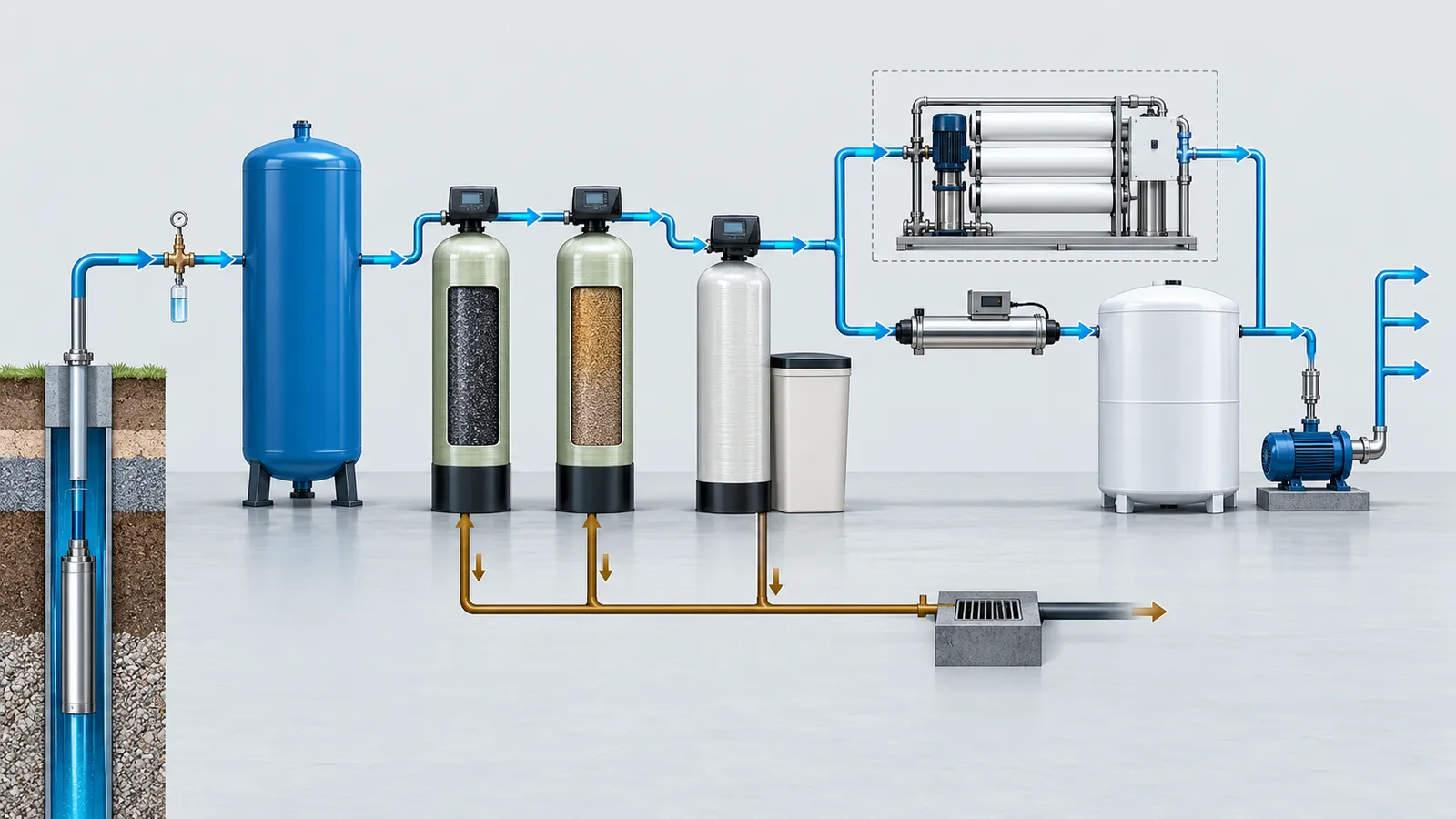
What Equipment Do You Need for Well Water? Treatment Order, Softening and RO
Choose well-water pretreatment, softening and RO from the water test, required flow and treated-water target; compare the treatment order and quotation scope.
On this page
- The standard well water treatment train
- Where should a water softener go, and how is it sized?
- When does the standard process need to change?
- Containerized and skid options for well water plants
- The commercial buying checklist
- Frequently asked questions
Related: RO storage tank guide · iron and manganese removal · sulfur-odor treatment · borehole desalination
The standard well water treatment train
Most well problems are solved by some subset of these six stages, in this order:
| # | Stage | Removes / does | Skip it when |
|---|---|---|---|
| 1 | Oxidation (aeration or dosed) | Dissolved iron, manganese, H₂S → filterable form | Metals/odor not in your test |
| 2 | Media filtration | Precipitated metals, sediment, turbidity | Water already particle-free |
| 3 | Softening (ion exchange) | Hardness (Ca/Mg) | Hardness within tolerance for the use |
| 4 | Brackish RO | Dissolved salt (NaCl), broader ion removal | TDS acceptable for the use |
| 5 | Disinfection (UV / ozone) | Bacteria, viruses | Not advisable to skip on potable systems |
| 6 | Storage & distribution hygiene | Keeps finished water clean | — see our RO storage tank guide |
For details on each problem stage, see iron and manganese removal, sulfur-odor treatment, and borehole desalination for salty wells. The well water treatment hub explains how the test maps to this table.
Where should a water softener go, and how is it sized?
Softening is ion exchange: resin swaps its sodium for your calcium and magnesium. At commercial scale, sizing follows three numbers:
- Peak service flow (m³/h) — the vessel and valve must deliver your simultaneous draw
- Daily hardness load (grains or equivalents per day) — sets resin volume and regeneration frequency
- Regeneration logistics — salt delivery, brine disposal, and backwash drain capacity at your site
Two configuration decisions matter more than brand:
- Single, twin-alternating, or parallel vessels? Communities and processes that cannot interrupt water production often choose a twin-alternating arrangement: one vessel regenerates while the other remains in service. It costs more but can be justified where downtime is more expensive.
- Metered vs timed regeneration: metered (triggered by actual water use) saves salt and is standard on serious commercial units
The position rule: softening protects downstream equipment. Before an RO on hard water, softening (or adequate antiscalant dosing) is what keeps membranes from scaling — the interplay is covered from the RO side in SWRO vs BWRO, and the general RO process and its water balance are explained in the reverse osmosis water-treatment systems guide. After iron removal, softening also lasts longer — iron fouls resin, so the sequence iron-removal → softening is deliberate.
When does the standard process need to change?
The four situations that break the textbook train:
| Situation | What changes |
|---|---|
| Iron bacteria / slime present | Add well sanitation before equipment; media selection tolerates bio-load |
| Salinity rising over the years (intrusion) | Design RO stage for the trend, with modular expansion — see desalination planning |
| High turbidity after storms (surface influence) | Coarser pre-filtration or settling stage; ultrafiltration where cartridge costs would explode |
| Community / food-business use | Verification testing regime, duty/standby, and operator training become part of the specification |
Suppliers who ask about these four before quoting are doing engineering; suppliers who quote from a flow-rate table alone are shipping boxes.
Containerized and skid options for well water plants
For sites without a plant room, complete well-water trains can be supplied as containerized systems — factory-assembled and wet-tested like the desalination plants in our containerized water treatment plant guide. The same seven-factor comparison applies: water-data basis, capacity definition, product standard, pre-treatment robustness, automation, energy, and lifecycle scope. Modular containerized units suit growing communities and multi-farm schemes because a second train can be added later.
The commercial buying checklist
See how pretreatment, softening and RO are combined in our 1,000 LPH well-water RO project design. This proposal illustrates configuration choices for a specific feed-water analysis, rather than verified operating results. For the equipment family, review our single and double-stage RO systems.
Compare quotations on:
- Design basis printed on the quote: your test values (Fe, Mn, hardness, pH, TDS, flow) — not "suitable for well water"
- Stage-by-stage configuration with the purpose of each stage stated
- Treated-water targets for each parameter, and the commissioning test that verifies them
- Regeneration/backwash demands: water, drain, salt at your hardness — operating costs live here
- Automation level: what the programmable logic controller (PLC) does unattended, which conditions trigger alarms, and what data it logs
- Spares & media schedule priced: resin life, media replacement, cartridges
- Exclusions: civil works, storage, power, well improvements
- Manufacturer references at similar duty — KONCHE has built commercial treatment systems since 1997 in the 0.25–50 m³/h range and supplies reference data and factory wet-test evidence with its quotations
Frequently asked questions
Can we start with one stage and add the rest later?
Physically, yes; economically, usually — provided that phase one includes connection points and control capacity for future stages. Tell the supplier at order time, because on-site retrofit hardware and labor can cost substantially more than factory-fitted connections.
What's the maintenance burden of a commercial softener?
Salt replenishment, periodic resin check, valve service. Metered units on reasonable feed are low-touch; the failure mode is usually salt logistics, not equipment.
Does a softener make the water salty?
It adds a small amount of sodium in exchange for removed hardness. For most uses this is insignificant; where a sodium limit applies (drinking standards, irrigation of sensitive crops), the RO stage handles it — see borehole desalination.
Whole-house vs commercial system — what's the actual difference?
The differences are duty cycle, redundancy, materials, verification, and lifecycle economics. The hub guide's commercial section summarizes the three factors that drive cost.
How do we know the system is still working a year later?
Use scheduled, logged treated-water checks. The well water testing guide explains how to set the verification regime.
Should the water softener go before or after the iron filter?
In most commercial trains, remove iron and manganese before softening so they do not foul the ion-exchange resin. The final order still depends on the complete water analysis, oxidation method, media limits, and any downstream RO requirements.
Recommended systems for this application
Systems commonly specified for the duties discussed in this guide:
0.25–50 m³/h drinking-water production with multi-stage pretreatment.
View specifications ↗RO SYSTEMSSingle & Double Stage RO System0.25–50 m³/h single- and double-stage RO skids for process and drinking water.
View specifications ↗COMMUNITY RO1,000 LPH Community RO System1 m³/h RO configuration for refilling stations, schools and small communities.
View specifications ↗Start with
your water report.
Send the water test results and demand profile. KONCHE configures the staged train — oxidation, filtration, softening, RO and disinfection in the right order.