Well Water Testing: What to Test Before You Buy Any Treatment Equipment
Test before you buy: a treatment-grade water test costs far less than incorrectly specified equipment. For a business or community, the test should cover iron, manganese, hardness, pH, total dissolved solids (TDS) with sodium and chloride, turbidity, hydrogen sulfide indicators, and microbiology. These parameters must be measured in a properly collected sample and, where seasonal variation matters, repeated at representative times of year. Read correctly, the report becomes the specification for the treatment train; reduced to a single TDS number, it can lead to the wrong system being purchased.
Get an Equipment Quote ↗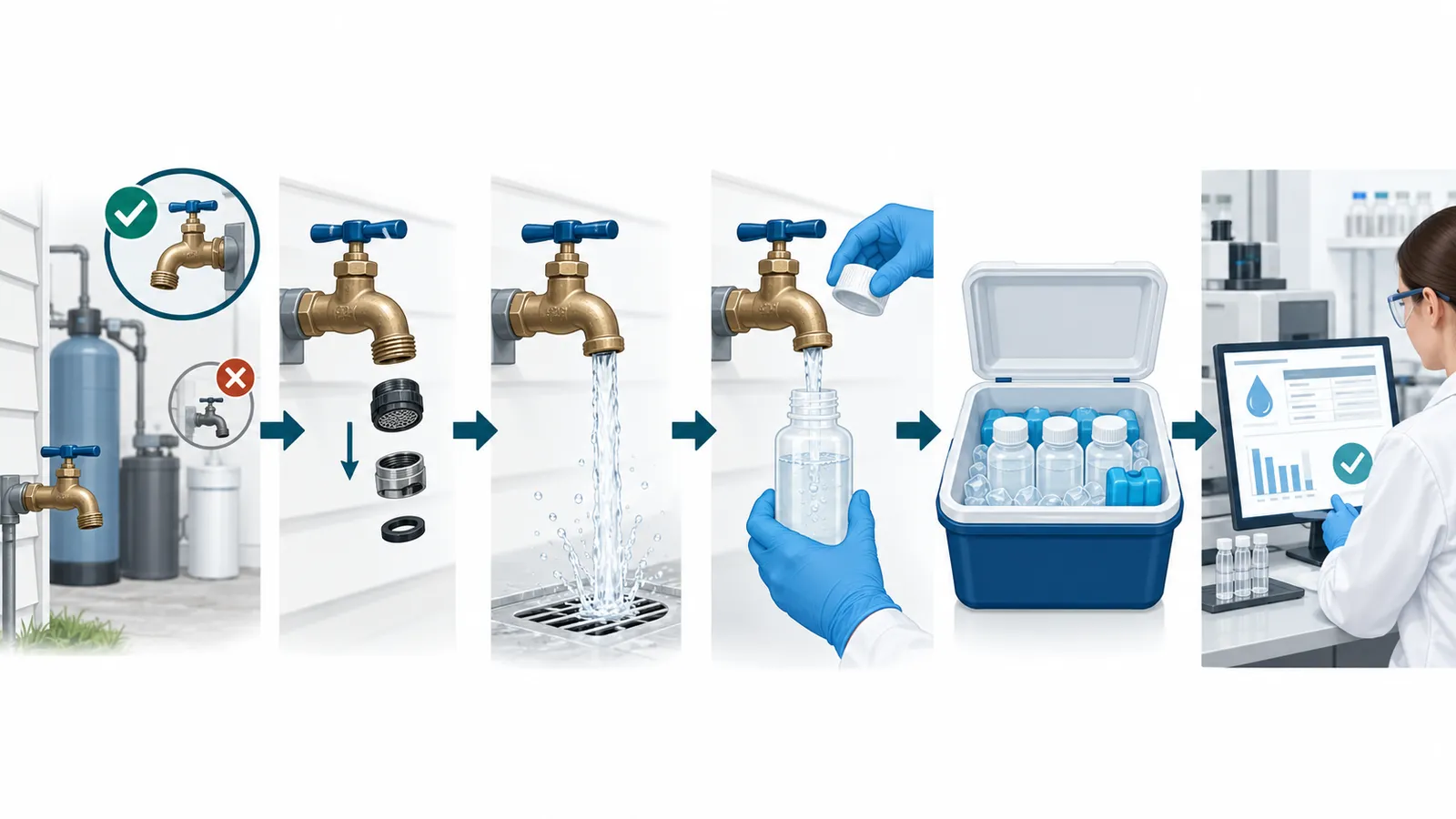
Well Water Testing: What to Test Before You Buy Any Treatment Equipment
!Correct well-water sampling from a clean tap through chilled transport and laboratory analysis
On this page
- What belongs in a treatment-grade water test
- How to sample so the result is real
- How do you read well water test results?
- What if the report is incomplete, old, or single-season?
- What the equipment supplier actually needs from you
- Frequently asked questions
Related: borehole desalination · source diagnosis · system configuration guide · well water treatment hub
What belongs in a treatment-grade water test
| Parameter | Equipment decision it drives |
|---|---|
| Iron — total and dissolved | Oxidation stage: dissolved iron needs it, oxidized iron doesn't |
| Manganese | Stronger oxidation / catalytic media selection |
| Hardness (as CaCO₃) | Softener sizing, or antiscalant strategy before RO |
| pH | Oxidation efficiency, resin selection, corrosion management |
| TDS + sodium, chloride | Is RO needed at all — and which class (borehole desalination) |
| Turbidity / SDI | Filter staging, cartridge budget |
| Hydrogen sulfide (or field odor notes) | Aeration/oxidation sizing — and the source diagnosis |
| Total coliform / E. coli | Disinfection stage and its verification regime |
| Nitrate, arsenic, fluoride (regional) | Targeted removal where geology or agriculture warrants |
Request the panel in exactly these terms. Labs offer cheaper "basic" panels that omit dissolved-vs-total splits and microbiology — the two omissions most responsible for mis-specified systems.
How to sample so the result is real
A perfect lab cannot rescue a bad sample:
- Use the lab's sample kits and instructions — preserved bottles for metals, sterile bottles for microbiology; household containers invalidate results
- Sample at the right point: before any treatment equipment for the raw-water picture (and after it, separately, when troubleshooting); run the tap to clear standing water first
- For dissolved iron: draw and preserve quickly; a sample left open oxidizes and reports falsely low dissolved iron
- Microbiology bottle technique: use the sterile bottle supplied by the laboratory; do not rinse it; fill to the marked line and leave the specified headspace; do not touch the cap interior; keep the sample cool; and deliver it within the laboratory's holding time
- Record the context: date, season, recent rain/drought, which tap — the context turns numbers into a diagnosis
How do you read well water test results?
A useful well-water report is read as a connected treatment problem: concentration, chemical form, pH, flow, seasonal trend, and the intended water use must be interpreted together before equipment is selected.
- Dissolved vs total iron gap — a large gap indicates oxidized, particulate iron already in the water; little or no gap indicates that most measured iron is dissolved, and the oxidation stage is sized differently for each case
- pH row — below ~6.5, iron oxidation slows and resin choices narrow; low pH with corrosion complaints may need its own management
- Hardness × your daily volume — this hardness load, not the concentration alone, sizes the softener; see the system configuration guide
- Chloride trend vs today — if an older report exists, compare; rising Na/Cl is intrusion, and the RO stage should be designed for the trend
- Microbiology against your use standard — positive coliform on a potable system changes the project: disinfection plus source investigation, not just filters
What if the report is incomplete, old, or single-season?
An incomplete, old, or single-season report is not a dependable design basis; fill the missing parameters and re-sample before fixing the treatment train, capacity, or performance guarantee.
- Missing dissolved iron split: ask the lab to add it; if impossible, treat conservatively (design oxidation for dissolved) and verify at commissioning
- Older than a year: re-test — wells change with seasons, rainfall, and nearby pumping
- Single snapshot for a big investment: sample twice (wet and dry season) where feasible; the delta predicts the maintenance your system will need
- Odor present but no H₂S row: hydrogen sulfide can escape from a sample during handling, so field notes — including the pattern described in the sulfur guide — are legitimate design inputs
What the equipment supplier actually needs from you
Send the full report, not a summary, and add the average and peak daily demand, intended use, available power, and site constraints. A supplier should state on the quotation which test values and flow it used and what treated-water targets it guarantees. KONCHE has manufactured commercial water-treatment systems since 1997 in the 0.25–50 m³/h range, but the same evidence standard should be applied to every bidder. The well water treatment hub, iron and manganese guide, and ozone water-treatment guide show how individual results map to process choices.
A simple supplier test: a company that quotes from only "well water, 10 m³/h" without requesting the report is designing for an unknown source.
Frequently asked questions
How often should a commercial well be re-tested?
Repeat the full panel at least annually, subject to local requirements and the site's risk plan. For community supply, test microbiology monthly or quarterly as required, and retest immediately after floods, droughts, nearby drilling, or any change in taste, color, or odor.
Can we use a home test-strip kit?
For quick checks between lab tests, yes — for equipment purchase, no. Strips cannot measure dissolved-vs-total splits or certify microbiology.
What does a lab test cost relative to equipment?
The cost varies by location and analytical scope, but it is usually small compared with buying incorrectly specified equipment. Request a written quotation from an accredited laboratory before budgeting the treatment plant.
Who interprets the report for us?
Any serious supplier interprets it as part of quoting (that is the point of this guide's "what suppliers need" section). Independent review also exists — but send the full report, not your conclusions.
Our test is fine but the water still tastes bad — now what?
Taste, odor, and safety are separate questions. Re-test with detailed field notes and compare hot versus cold water and fresh versus standing water. The sulfur-smell guide and storage-hygiene guide cover two common causes after treatment.
Can I choose a water filter without a laboratory water test?
You can buy equipment, but you cannot make a defensible process selection or performance guarantee. Visual symptoms may suggest iron, manganese, sulfur, hardness, or sediment, yet the concentrations, pH, competing ions, and microbiological risk determine which stages and sizes are appropriate.
Recommended systems for this application
Systems commonly specified for the duties discussed in this guide:
0.25–50 m³/h drinking-water production with multi-stage pretreatment.
View specifications ↗COMMUNITY RO1,000 LPH Community RO System1 m³/h RO configuration for refilling stations, schools and small communities.
View specifications ↗COMPACT RO500 LPH Compact RO System0.5 m³/h compact drinking-water RO system for tight installation spaces.
View specifications ↗Start with
your water report.
Send the full laboratory report and demand. KONCHE turns the results into a staged treatment specification with guaranteed treated-water targets.