Sulfur Smell in Well Water: Diagnose the Source First, Then Treat It
A rotten-egg smell in well water usually indicates hydrogen sulfide (H₂S). Common causes include naturally occurring H₂S in the aquifer, sulfur-reducing bacteria in the well or plumbing, and reactions inside a water heater; contamination is a less common possibility that testing must rule out. The treatment depends on where and when the odor appears: persistent source-water H₂S may need aeration or oxidation-filtration, while a localized bacterial problem may require well or plumbing disinfection. For commercial wells serving farms, communities, resorts, and food operations, diagnose the odor pattern and test the water before selecting equipment. This guide gives the diagnostic table first, then the treatment options by H₂S level, then the prevention routine that keeps it from returning.
Get an Equipment Quote ↗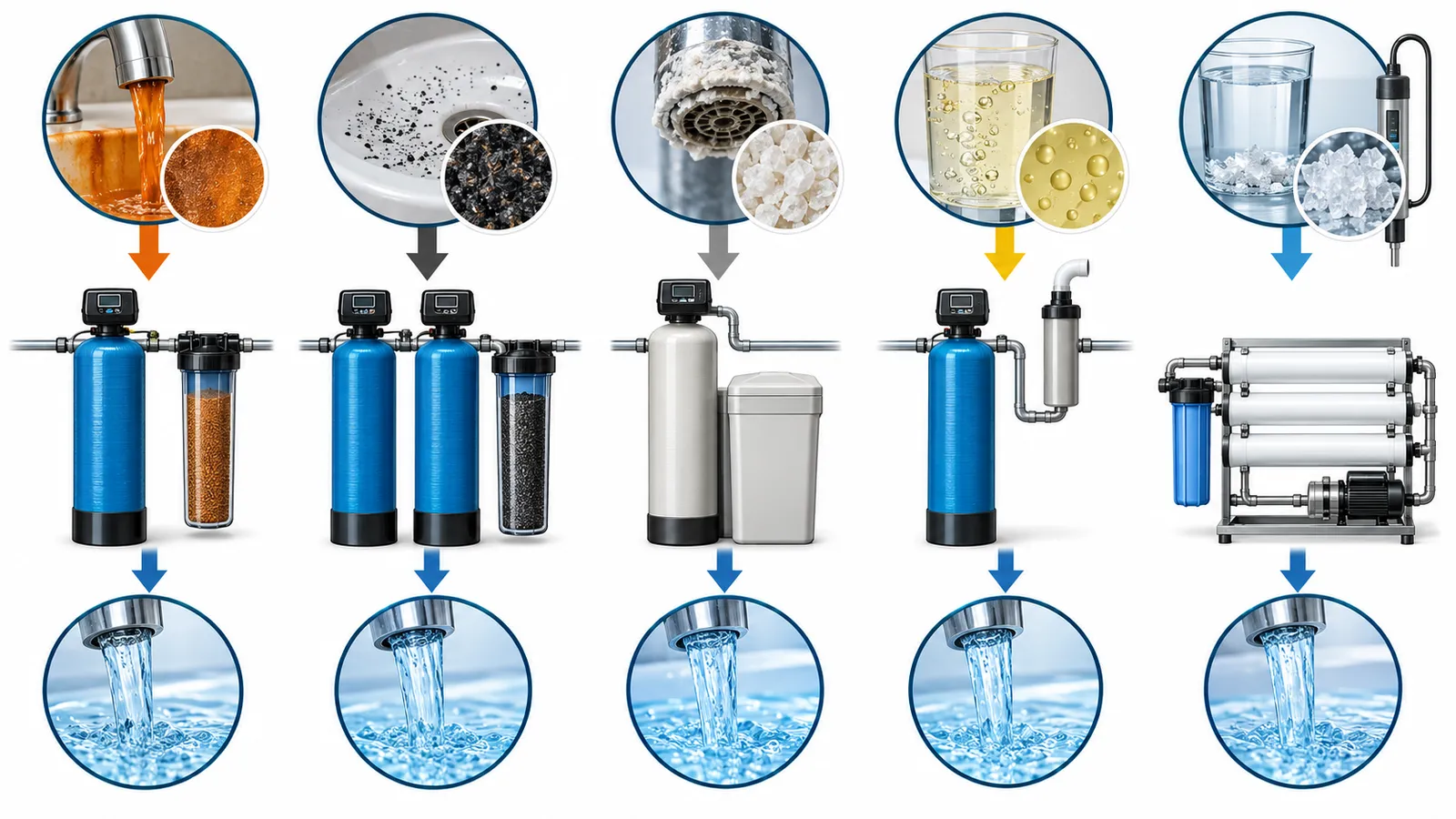
Sulfur Smell in Well Water: Diagnose the Source First, Then Treat It
!Well-water symptom map showing sulfur odor alongside iron, manganese, hardness and salinity clues
On this page
- The diagnostic table: where and when does the smell appear?
- How do you get rid of the rotten-egg smell in well water?
- If it's bacteria: shock chlorination done properly
- Designing the commercial treatment step
- Frequently asked questions
Related: ozone water-treatment guide · UV systems · RO storage tank hygiene guide · well water treatment guide
The diagnostic table: where and when does the smell appear?
| Pattern | What it means | First response |
|---|---|---|
| Smell at every tap, hot and cold, immediately | Geological H₂S in the aquifer | Treat at the plant (aeration/oxidation) |
| Smell mainly in hot water | Bacterial growth in the heater or a reaction involving the magnesium anode | Sanitize and inspect the heater; have a qualified technician assess the anode before changing it |
| Smell strongest after weekends/low use, fades with running | Bacteria growing in well/plumbing during stagnation | Shock chlorinate well + system; fix stagnation |
| Smell arrived suddenly, never before | Contamination event, well disturbance, or water table change | Test (H₂S + bacteria + coliform) before assuming |
| Smell + slime + recurring iron staining | Iron bacteria community (classic pairing) | Well sanitation + iron removal train |
Two low-cost checks help before any purchase. First, collect water in a clean glass and smell it away from the drain, where sewer gases cannot confuse the result; note whether the odor fades quickly as hydrogen sulfide escapes. Second, compare hot-only and cold-only samples to determine whether the water heater is involved. Record these observations for the laboratory and equipment supplier.
Safety note: H₂S is measurable and, at high concentration, hazardous. If the smell is strong in the wellhouse or causes symptoms, ventilate and test with proper equipment before working in the space — commercial sites should treat this as a confined-space rule, not an inconvenience.
How do you get rid of the rotten-egg smell in well water?
Once the source is confirmed as geological H₂S in the water, concentration drives the method:
| H₂S level (typical bands) | Working treatment | Notes |
|---|---|---|
| Low (below about 0.3 mg/L) | Aeration + retention, or catalytic carbon | Odor threshold is far below health thresholds — small amounts are very noticeable |
| Moderate (0.3–3 mg/L) | Oxidation (chlorine, permanganate, or ozone) + filtration | Needs contact time and dosing control; the ozone water-treatment guide explains ozone-system requirements |
| High (> 3 mg/L) | Engineered oxidation train; consider well management | Rarely a filter-only problem; design from the test |
Three properties of H₂S drive all the designs: it outgasses (so aeration works, but the stripped gas needs venting — never into an enclosed plant room), it oxidizes to elemental sulfur (fine particles — the filter stage must catch pale yellow deposits or they coat downstream media), and it feeds bacteria (so post-treatment disinfection — UV systems — belongs on community and food systems even after the odor is gone).
If it's bacteria: shock chlorination done properly
Bacterial H₂S (and its frequent partner, iron bacteria) is treated at the source:
- Shock chlorinate the well to a calculated dose, agitate, and hold per protocol (public-health extension services publish standard procedures)
- Disinfect the plumbing, pressure tank, and heaters — bacteria reseed the system from any untreated surface
- Re-test after the system is flushed to confirm that the H₂S odor is gone and bacterial counts have fallen to the applicable target
- Fix the habitat: stagnant legs, dead-end pipes, and warm idle equipment are where the smell regrows — circulation and use are prevention
For a community or business system, schedule repeat sanitation and keep records — recurring bacterial H₂S is an operations problem with an operations solution, not an equipment deficiency. Our RO storage tank hygiene guide covers the same discipline on the treated-water side.
Designing the commercial treatment step
Where source-water H₂S persists year-round, the plant needs an odor-removal stage in sequence with the rest of the train. The ordering logic and stage table are in the well water treatment guide, while the well water treatment-system guide explains equipment sizing and softening interactions:
- Position: aeration/oxidation early (with iron removal — H₂S and iron share oxidant demand and are cheapest removed together)
- Venting: aerators need safe gas discharge — an indoor plant without venting design trades an odor problem for a corrosion-and-safety problem
- Materials: H₂S is corrosive to copper and some steels — piping and vessel material specs matter more than usual
- Verification: agree the treated-water H₂S target on the quotation and test at commissioning, exactly as with iron and manganese acceptance criteria
KONCHE has manufactured commercial water-treatment systems since 1997, with packaged capacities from 0.25 to 50 m³/h. Regardless of supplier, require the odor-removal stage to be designed from measured H₂S, pH, flow, iron, manganese, and microbiological results rather than selected as a catalog add-on.
Frequently asked questions
Is H₂S in well water a health problem?
At the concentrations typical of wells it is primarily an aesthetic and corrosion problem — but it signals conditions (bacteria, stagnation) that can co-occur with real hazards. Test the full panel; treat the cause. WHO guidance treats taste/odor within drinking-water quality frameworks.
Will a carbon filter fix the smell?
Temporarily, at low levels. Carbon adsorbs H₂S until it exhausts — weeks to months — and does nothing to the source. It is a bandage, not a treatment train.
We chlorinate already — why do we still smell it?
Usually insufficient contact time or dose for the H₂S actually present, or the smell is bacterial in the plumbing downstream of dosing. Re-check the pattern table above before adding equipment.
Does RO remove hydrogen sulfide?
Partially — but using RO as the odor stage wastes membrane life; oxidize and filter first, then RO only if the water is also salty (see borehole desalination).
The smell comes and goes with the seasons. What does that mean?
Seasonal changes in the water table can alter reducing conditions in the aquifer, and periods of stagnation can also change the odor. A two-season test history, collected according to the well water testing guide, lets the treatment be sized for the more difficult season.
Recommended systems for this application
Systems commonly specified for the duties discussed in this guide:
1–200 g/h ozone generation with injection, contact and off-gas control.
View specifications ↗DRINKING WATERCommercial Drinking Water System0.25–50 m³/h drinking-water production with multi-stage pretreatment.
View specifications ↗CONSUMABLESWater Treatment ConsumablesCartridges, filter media and spares for commercial treatment plants.
View specifications ↗Start with
your water report.
Send the odor pattern and water test. KONCHE designs the aeration or oxidation stage — sized to measured H₂S, pH and flow, not a catalog add-on.