How Does Seawater Reverse Osmosis Work? SWRO Plant Components, Pressure and Process
A seawater reverse osmosis (SWRO) plant turns seawater into drinking or process water by pushing pretreated feed through salt-rejecting membranes at high
A seawater reverse osmosis (SWRO) plant turns seawater into drinking or process water by pushing pretreated feed through salt-rejecting membranes at high pressure. The process has six core component groups: intake, pretreatment, high-pressure pumps, membranes in pressure vessels, energy recovery, and controls. A post-treatment stage then conditions the product water for its intended use. Understanding the process diagram, typical pressure duty, and critical specification of each group lets you read a supplier's quotation line by line and spot an under-specified system. For broader project context, start with the seawater desalination systems guide; this article focuses on the equipment itself.
Get an Equipment Quote ↗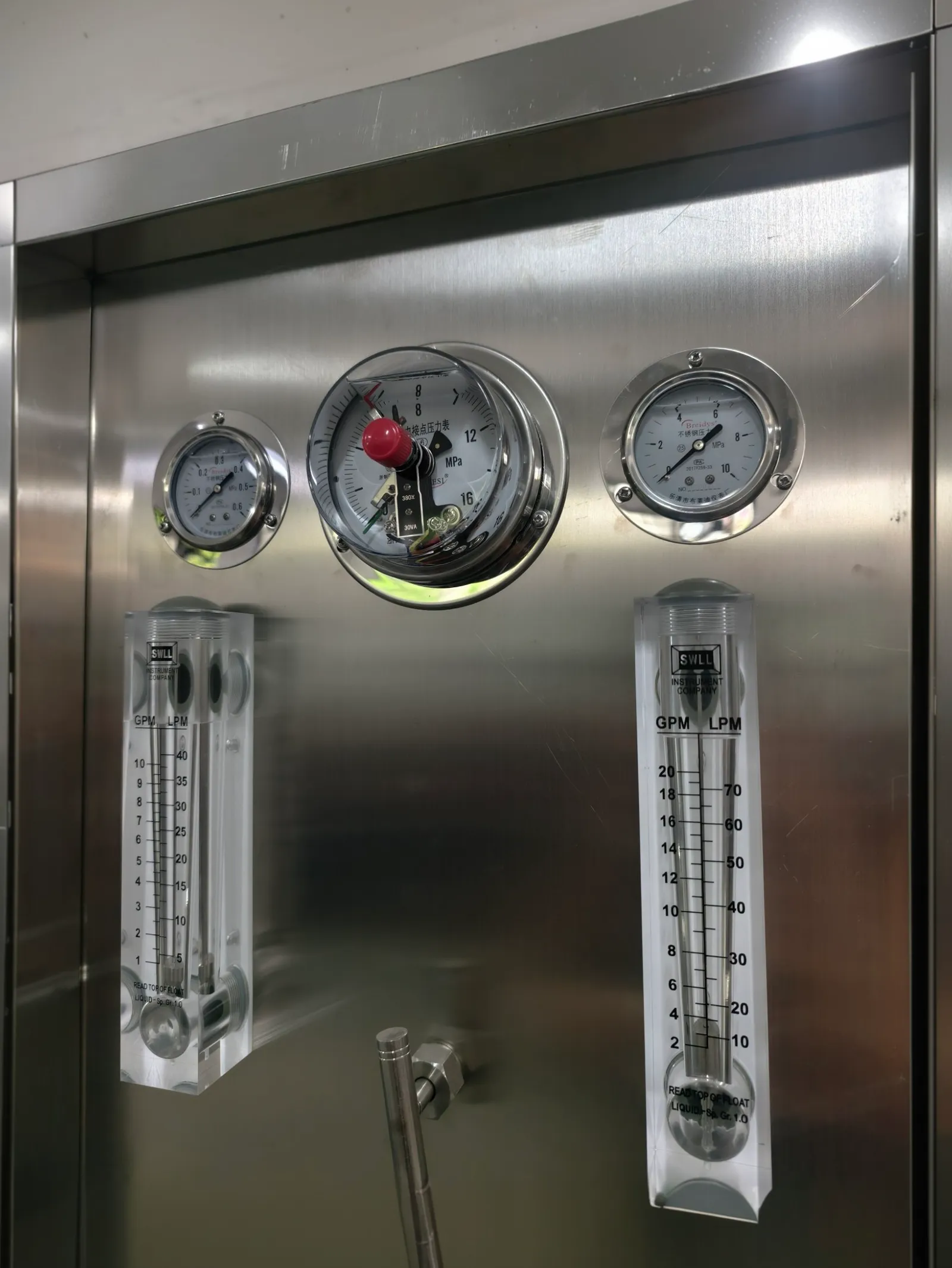
How Does Seawater Reverse Osmosis Work? SWRO Plant Components, Pressure and Process
A seawater reverse osmosis (SWRO) plant turns seawater into drinking or process water by pushing pretreated feed through salt-rejecting membranes at high pressure. The process has six core component groups: intake, pretreatment, high-pressure pumps, membranes in pressure vessels, energy recovery, and controls. A post-treatment stage then conditions the product water for its intended use. Understanding the process diagram, typical pressure duty, and critical specification of each group lets you read a supplier's quotation line by line and spot an under-specified system. For broader project context, start with the seawater desalination systems guide; this article focuses on the equipment itself.
On this page
- How does a seawater reverse osmosis plant work?
- What does the intake do, and why do suppliers ask about it first?
- What does pre-treatment protect, and what should it include?
- Why does seawater RO need a high-pressure pump, and what pressure is typical?
- What do the membranes and pressure vessels contribute?
- What does an energy recovery device do — and when is it worth it?
- What does the control system do beyond "automatic"?
- What comes after the membranes: post-treatment
- How do the components scale with plant size?
- Frequently asked questions
Related: SWRO membrane cleaning and replacement guide · SWRO vs BWRO comparison · UV water treatment overview · UV vs ozone
How does a seawater reverse osmosis plant work?
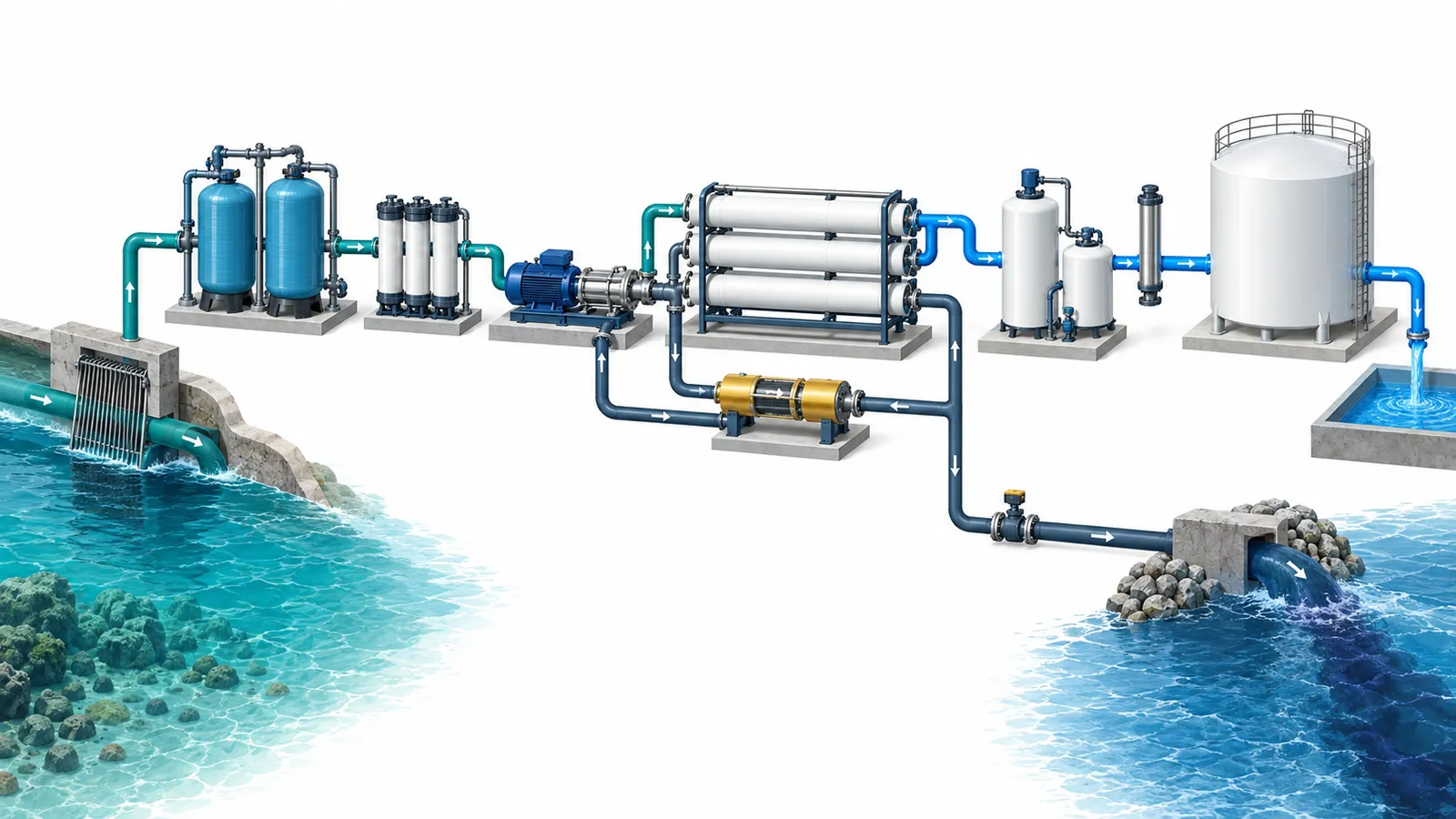
Seawater is drawn in, filtered and chemically conditioned, then forced at high pressure — typically in the range of 55–70 bar for standard seawater salinity, higher in hot or hypersaline feeds — against a semi-permeable membrane. Water molecules pass; dissolved salts are rejected (modern seawater membranes reject on the order of 99.5% of salt under standard test conditions), so the stream splits into low-salinity permeate and a concentrated brine. Because the brine leaves the membrane still at almost full operating pressure, an energy recovery device (ERD) transfers that pressure back to the incoming feed, which is what makes modern SWRO economical: recovered energy can cover a large share of the pumping energy, cutting specific consumption to a few kWh per cubic meter in well-designed mid-size plants.
Recovery — the fraction of feed that becomes product — is typically around 35–45% for seawater, set by the physics of osmotic pressure and the scaling limits of the concentrate. A supplier quoting unusually high recovery for seawater should explain how scaling is controlled at that recovery.
What does the intake do, and why do suppliers ask about it first?
The intake is the first component and the one most often under-scoped:
| Intake type | How it works | Trade-off |
|---|---|---|
| Open (surface) intake | Pipe from sea, with screens | High flow, but storm turbidity, oil, and marine life need robust pre-treatment |
| Beach well / infiltration gallery | Well near the shoreline; sand acts as a natural filter | Cleaner, more stable feed; permitting and yield depend on the site |
The intake decides your pre-treatment load. Feed water that arrives already filtered by a beach well can use simpler pre-treatment; open-intake plants after monsoons or storms need pre-treatment sized for the worst week of the year, not the average.
What does pre-treatment protect, and what should it include?
Pre-treatment exists to protect the membranes, which are the most damage-prone and cost-concentrated part of the plant. A complete SWRO pre-treatment train typically includes:
- Filtration — multimedia or activated-carbon filters; ultrafiltration for difficult open-intake feeds. The target is a feed silt density index (SDI) the membrane manufacturer's warranty requires, measured at the membrane inlet.
- Chemical dosing — antiscalant to delay carbonate and sulfate scaling at the concentrate end, and pH adjustment where the water chemistry requires it. Dosing rates should be stated per m³ of feed, with chemical consumption priced in the operating cost.
- Cartridge guards — 5-micron cartridges as the final physical barrier before the high-pressure pump.
The specification that matters is pre-treatment sized for the worst-case seasonal feed, supported by water-analysis data. A common SWRO failure mode is not a membrane defect; it is membrane fouling because pre-treatment was sized for the best month of the year.
The sequence is conditional, not a fixed shopping list. A common route is multimedia or quartz-sand filtration followed by activated carbon when organics or free chlorine must be controlled, then scale-control treatment and a final cartridge guard. Clean offshore feed with no oil, low organics and no chlorine residual may not need carbon; near-shore, harbor or chlorinated feeds often do. Oil must be removed before carbon or membranes. Where two cartridge housings are provided, the quotation should state whether they operate in series, parallel or lead/standby service and include differential-pressure monitoring.
Why does seawater RO need a high-pressure pump, and what pressure is typical?
The high-pressure pump raises feed water to membrane operating pressure. For SWRO these are positive-displacement or multistage centrifugal pumps in corrosion-resistant materials (duplex or super-duplex stainless steel in the wetted parts — ask, because this is a common cost-cutting point in low quotations). The three numbers to demand:
- Duty point: flow and pressure at your design salinity and temperature
- Material certification for wetted parts
- Motor power and the resulting kWh/m³ contribution
Do not accept unspecified 304 stainless steel for continuously wetted seawater duty. Depending on pressure, chloride exposure and component function, practical specifications may use fiberglass-reinforced plastic (FRP), selected 316L in limited lower-risk duties, and duplex or super-duplex stainless steel in high-pressure seawater zones. The supplier should identify each wetted material rather than state only "stainless steel."
What do the membranes and pressure vessels contribute?
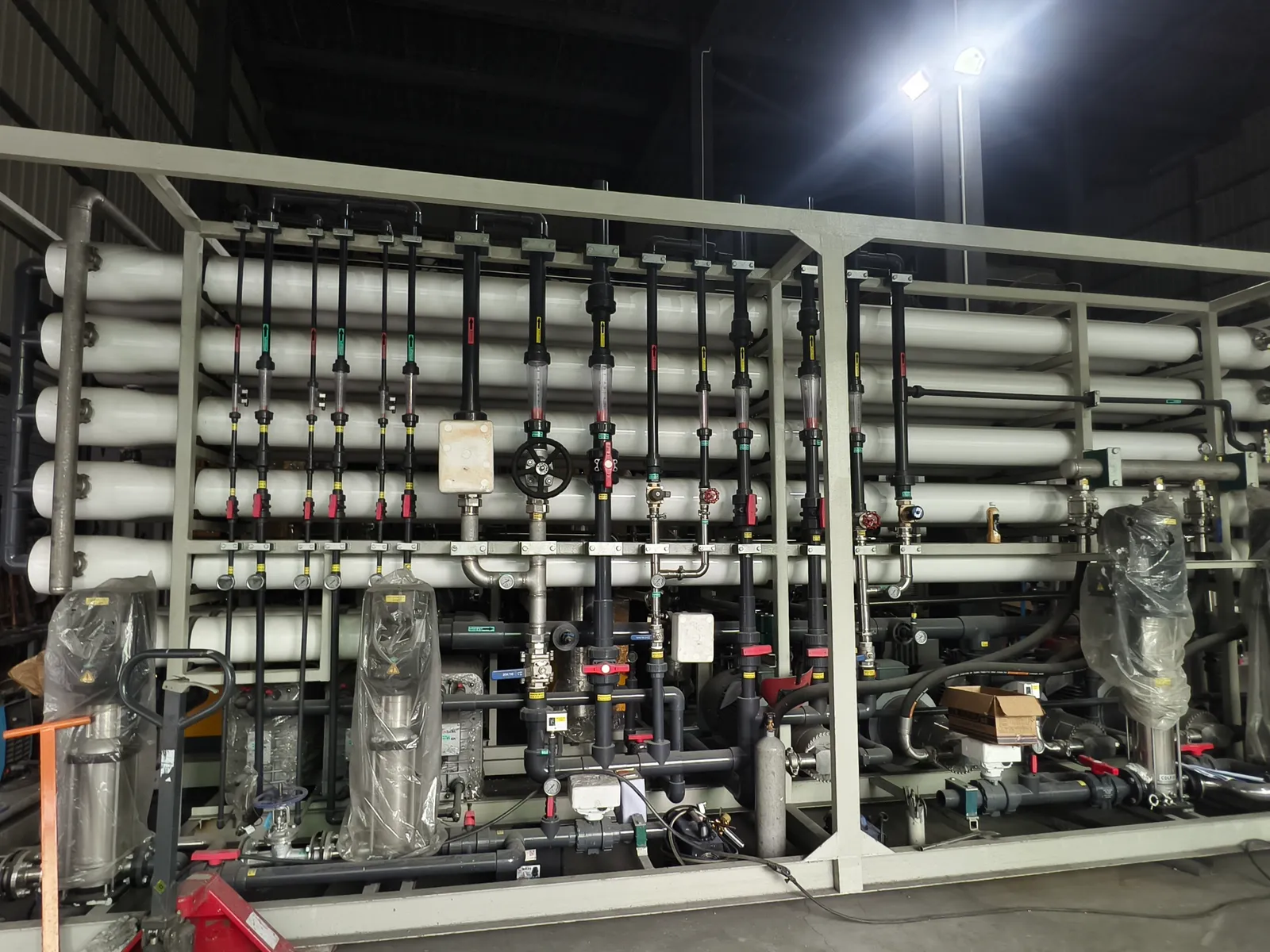
Membranes are where the desalination happens. Seawater elements are 8-inch spiral-wound modules, loaded in series inside fiberglass pressure vessels (typically 6–8 elements per vessel). Selection considerations:
| Spec item | What it means in practice |
|---|---|
| Element type (standard vs high-rejection vs low-energy) | Trade-off between flux, rejection, and pump energy |
| Staging (single vs two-stage) | Two-stage extracts more water from the same feed; adds complexity |
| Number of elements vs capacity | More elements at lower flux = longer membrane life |
| Replacement schedule as priced line item | Usually 3–7 years depending on feed and operation; "5 years guaranteed" without conditions is a red flag |
A system that runs elements conservatively — with lower flux, effective pre-treatment, and disciplined cleaning — replaces membranes less often than one that squeezes maximum flow from the minimum number of elements. This difference can dominate ten-year operating cost; see our SWRO membrane cleaning and replacement guide.
What does an energy recovery device do — and when is it worth it?
The energy recovery device (ERD) helped turn SWRO into a mainstream technology. The three main families are:
| ERD type | How it works | Typical efficiency | Where it fits |
|---|---|---|---|
| Pressure exchanger (isobaric) | Brine pressure transferred directly to new feed via a rotor | Up to about 95%, model- and condition-dependent | Midsize and large SWRO |
| Turbocharger / hydraulic turbine | Brine drives a turbine coupled to the pump | Lower | Small plants, retrofit |
| Pelton wheel | Brine spins a wheel driving the pump shaft | Moderate | Legacy and specific duties |
For small containerized SWRO plants, ERDs in some form are increasingly standard because the alternative — paying for pressure and discarding it in the brine — wastes energy at every operating hour. The specification that matters: net specific energy (kWh/m³) of the complete plant at your design conditions, with the ERD contribution stated. If your project compares seawater RO against brackish RO, the ERD is central to the economics — our SWRO vs BWRO comparison shows how the two processes diverge in pressure, energy, and pre-treatment.
What does the control system do beyond "automatic"?
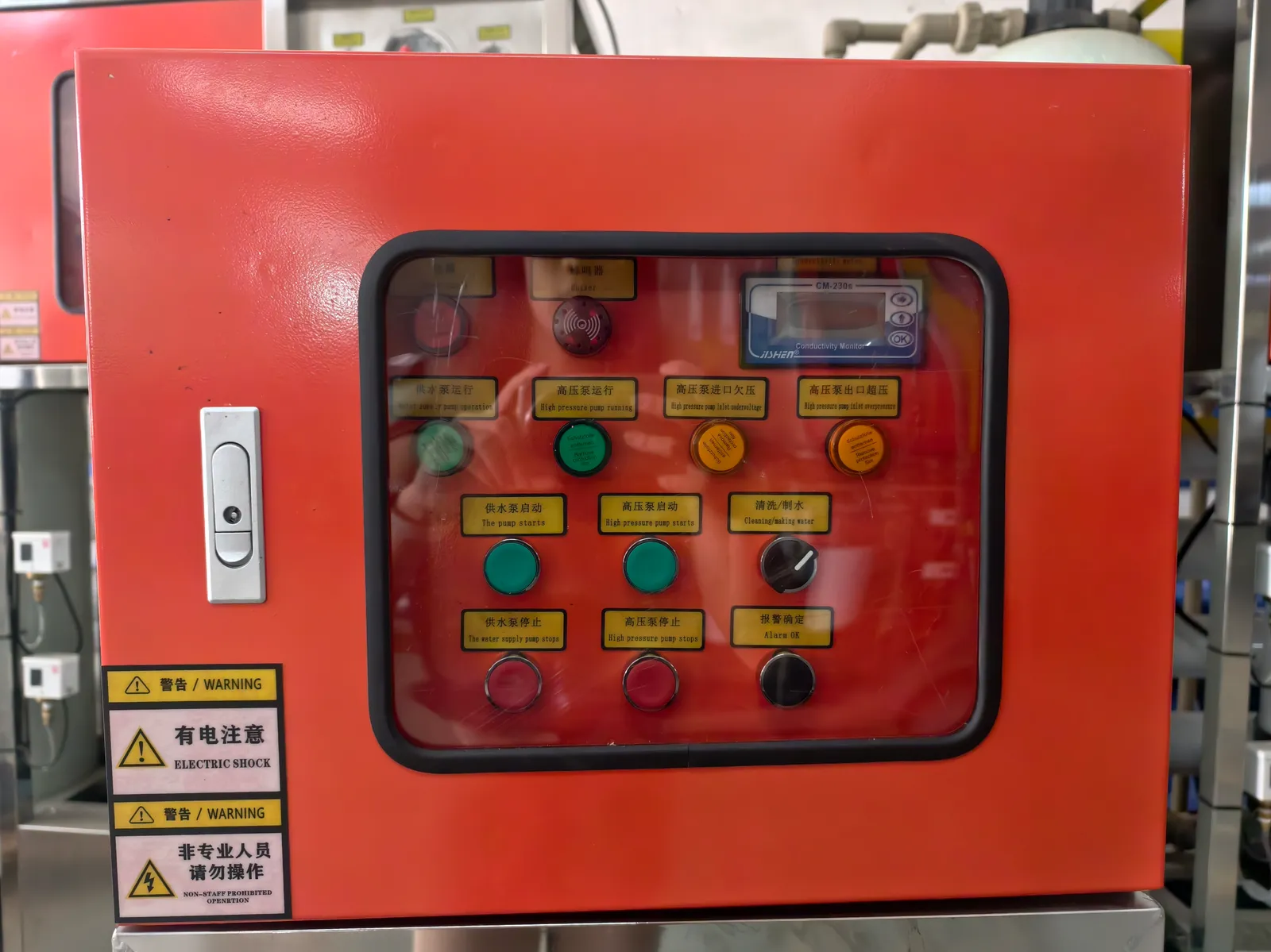
The programmable logic controller (PLC) and instruments allow a small team to run a desalination plant safely. A specification adequate for unattended or lightly staffed operation includes:
- Online instruments: conductivity (feed, permeate, and brine), pressure, flow, temperature, oxidation-reduction potential (ORP), or chlorine residual where dosing applies
- Interlocks: low suction pressure, high permeate conductivity diversion, membrane flush on stop
- Automatic flush on shutdown — the single feature that most reduces biofouling during intermittent operation
- Data logging and remote access, so your supplier can diagnose without a site visit — valuable on islands and remote sites
- Clear, local-language operator screens
Ask what the plant does during a power cut. The correct answer includes an automatic freshwater flush of the membranes.
What comes after the membranes: post-treatment
Permeate from SWRO is aggressive, low-mineral water. Post-treatment for drinking or food use typically includes:
- Remineralization (lime, limestone contactor, or dosing) to raise hardness and alkalinity to the target standard — WHO guidance covers the health and taste considerations of drinking-water mineralization
- Disinfection — ultraviolet (UV) light is a common final barrier; our UV water treatment overview explains dose and validation, and UV vs ozone compares the two options for product water
- Storage hygiene — product water tanks are where clean systems grow problems; practices are in our RO storage tank guide
How do the components scale with plant size?
Component choices shift as capacity grows:
| Capacity band (m³/d) | Typical configuration choices |
|---|---|
| 6–60 | Single skid or 20 ft container; turbocharger or compact PX; manual-friendly controls |
| 60–300 | 40 ft container or plant room; pressure-exchanger ERD; full instrumentation |
| 300–1,200 | Multiple parallel trains; staged membranes; dedicated CIP (clean-in-place) skid |
| Above ~1,200 | Field-built; multiple intake/pre-treatment lines — containerized modules serve as trains within the plant |
KONCHE, a manufacturer of commercial and industrial RO systems since 1997, builds SWRO and brackish-water reverse osmosis (BWRO) systems across 0.25–50 m³/h (about 6–1,200 m³/d), covering the containerized and skid-mounted range above. The containerized plant selection guide explains the enclosure and site decisions, while the commercial desalination-machine guide compares complete quotations. Across this capacity range, check that the component list scales honestly: a 600 m³/d quotation with no CIP connection points, or a 60 m³/d quotation built around full-time attendance, can indicate copy-and-paste engineering.
Frequently asked questions
What is the single most important component?
Pre-treatment. Membranes rarely fail on their own — they fail because of what the intake and pre-treatment let reach them.
How many membranes does a small SWRO plant need?
The number follows from capacity, element size, and the selected flux; a supplier should show the calculation. More elements operating at lower flux cost more up front but can reduce membrane replacement and cleaning costs over the plant's life.
Can we add components later — ERD, second pass, CIP?
Physically often yes; economically it is better to order the connection points (valves, spools, PLC I/O) with phase one. Retrofits on remote sites cost far more than the fittings.
Is a two-pass SWRO necessary?
Only when product targets demand it — boron limits for irrigation in some markets, or ultrapure feed applications. For ordinary potable use, single-pass SWRO with correct post-treatment meets standards; the general decision framework is in our single-pass versus double-pass RO guide. Facilities feeding high-purity processes should plan polishing stages, as in laboratory water purification.
Do SWRO plants need operators?
A modern plant needs trained operators, not engineers: daily readings, weekly checks, disciplined cleaning. The control system's job is to make that achievable — see the automation section above.
What equipment is needed to turn seawater into drinking water?
A complete plant needs an intake, pretreatment, a high-pressure RO membrane train, controls, post-treatment, protected storage, and a safe concentrate route. Pumps and membranes alone do not make finished drinking water; the complete process must meet the named water-quality standard at acceptance.
Recommended systems for this application
Systems commonly specified for the duties discussed in this guide:
0.5–2,000 m³/d seawater RO plants for islands, resorts and industrial sites.
View specifications ↗RO SYSTEMSSingle & Double Stage RO System0.25–50 m³/h single- and double-stage RO skids for process and drinking water.
View specifications ↗CONTAINERIZEDContainerized Water Treatment SystemComplete treatment trains factory-built and wet-tested inside ISO freight containers.
View specifications ↗Start with
your water report.
Send the seawater or beach-well analysis and target capacity. KONCHE states the component specification, recovery, energy basis and factory test for the offered train.