RO CIP Cleaning: When to Clean or Replace Seawater RO Membranes
Clean-in-place (CIP) is the controlled circulation of approved cleaning solutions through an RO membrane system without removing the membrane elements.
Clean-in-place (CIP) is the controlled circulation of approved cleaning solutions through an RO membrane system without removing the membrane elements. Seawater RO membranes should be cleaned when normalized performance drifts past defined triggers — not on a fixed calendar — and replaced when cleaning no longer restores performance. Well-operated seawater membranes commonly serve in the 3–7 year range, but that range is an outcome of feed-water quality, pretreatment discipline, and cleaning practice, not a guarantee. This guide gives operators the monitoring numbers, cleaning trigger table, CIP sequence, and replacement economics that decide "clean again or replace now."
Get an Equipment Quote ↗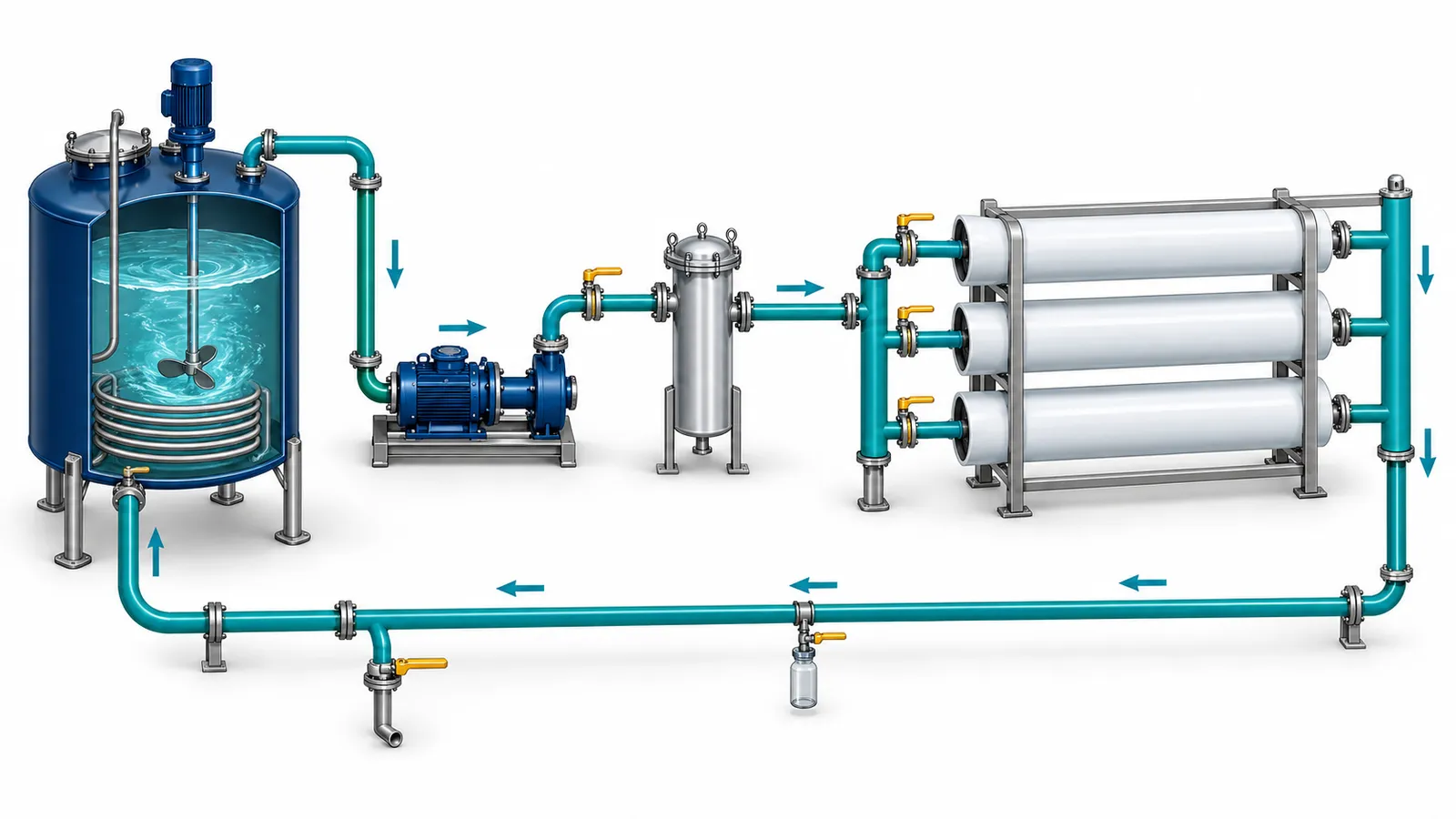
RO CIP Cleaning: When to Clean or Replace Seawater RO Membranes
Clean-in-place (CIP) is the controlled circulation of approved cleaning solutions through an RO membrane system without removing the membrane elements. Seawater RO membranes should be cleaned when normalized performance drifts past defined triggers — not on a fixed calendar — and replaced when cleaning no longer restores performance. Well-operated seawater membranes commonly serve in the 3–7 year range, but that range is an outcome of feed-water quality, pretreatment discipline, and cleaning practice, not a guarantee. This guide gives operators the monitoring numbers, cleaning trigger table, CIP sequence, and replacement economics that decide "clean again or replace now."
On this page
- What actually happens to SWRO membranes over time
- The four numbers that tell you when to clean
- How to identify the fouling type before you clean
- What is CIP cleaning in an RO plant, and what sequence works?
- How long do seawater desalination membranes actually last?
- Replace or clean again? The economics
- Keeping records: the operator's real leverage
- Frequently asked questions
Related: SWRO components guide · seawater desalination systems guide · containerized plant guide · borehole-water desalination guide
What actually happens to SWRO membranes over time
Three fouling families cover nearly everything that degrades a seawater membrane:
| Fouling type | Typical source | Early symptom |
|---|---|---|
| Scaling (mineral) | Concentrate end exceeding solubility — carbonate, sulfate | Gradual pressure-rise, flux loss first at tail elements |
| Organic / colloidal | Feed organics, silt breakthrough after storms | Slow flux decline, rising differential pressure |
| Biofouling | Microbial growth on membrane surface | Rapid increase in differential pressure, often after shutdowns without flushing |
The fourth degradation mode is oxidation damage — chlorine and other oxidants destroying the membrane polymer. It is not fouling and cannot be cleaned: it is prevented by dechlorination upstream (carbon or chemical dosing) and verified by ORP monitoring. If someone proposes "shocking the system with chlorine" to fix a seawater RO, they are proposing to destroy it.
The four numbers that tell you when to clean
Modern RO control systems log what you need. Track these as trends, not single readings:
- Normalized permeate flow — flow corrected to a reference temperature and pressure. A 10% decline from the commissioning baseline is a common first trigger
- Differential pressure (ΔP) across each stage — a 10–15% rise signals accumulating fouling
- Normalized salt passage — rising permeate conductivity at constant conditions
- Feed pressure needed to hold output — creeping upward as membranes load
| Trigger (vs. commissioning baseline) | What it usually means | First response |
|---|---|---|
| Normalized flow −10% | Early fouling | Schedule CIP within days, check pre-treatment |
| ΔP +10–15% | Accumulating scale or biofouling | Identify the type below and clean promptly |
| Salt passage doubling | Scaling, o-ring damage, or oxidation | Element probe test; check dechlorination first |
| Feed pressure +10% for same output | Advanced fouling | Clean now; overdue cleaning loses elements |
Cleaning too late is the expensive mistake: fouling layers compact and age, becoming resistant to chemicals, and the membrane is permanently derated. Cleaning on trigger protects the 3–7 year service range.
How to identify the fouling type before you clean
Cleaning chemistry must match the foulant, or you make it worse (acid cleaner can turn biofilm to concrete; alkaline cleaner can precipitate scale on the spot):
- Scale concentrates at the tail elements and last stage — sample the first and last element positions when probing
- Biofilm announces itself by smell and slime in cartridge housings; ΔP rises before flow falls
- Organics behave like slow biofouling without the smell; feed water SDI and turbidity history tell the story
- Iron fouling follows pre-treatment bypass events; it discolors cartridges orange ahead of membrane symptoms
When in doubt, pull the lead element and the tail element and inspect: lead elements catch particulate/organic load; tail elements scale. That single inspection redirects the whole CIP plan.
What is CIP cleaning in an RO plant, and what sequence works?
CIP, or clean-in-place, removes membrane fouling by circulating a foulant-specific cleaning solution through the RO train at controlled flow, pressure, pH, and temperature without dismantling the pressure vessels.
A standard two-stage CIP for a fouled seawater train:
- Flush with permeate water to displace brine and loose foulants
- Apply the first cleaner selected for the identified foulant — typically an alkaline detergent for organic or biological fouling, or an acid cleaner for mineral scale — and circulate it at low pressure within the membrane manufacturer's pH and temperature limits
- Soak — several hours to overnight for stubborn organic/bio layers
- Acid clean (citric or other mild acid) for scale, again circulated then soaked
- Final flush to drain until pH/conductivity return to spec, then restart to drain until permeate quality is confirmed
Rules that protect elements during CIP: use permeate (not raw feed) for solutions; respect maximum solution temperature and pH windows from the membrane manufacturer's datasheet; never mix acid and alkaline wastes in the same hose run without flushing between; and record before/after performance readings in the logbook — that record is your warranty evidence and your replacement-planning data.
For intermittent or marine service, shutdown protection matters between cleanings. A correctly engineered plant replaces concentrated seawater in the membrane train with product water during shutdown, limits salt crystallization and biological growth, and flushes to drain before returning product water to service. The flush volume, valve sequence and behavior after a power loss should be written into the control philosophy.
Smaller containerized plants often ship with a CIP connection skid (tanks, heater, circulation pump on quick-connects); if your quotation lists none, you are choosing between manual bucket cleaning and downtime waiting for a service visit. Ask for the CIP scope in writing — it is standard on commercial plants in the 0.25–50 m³/h class; KONCHE has manufactured systems in this class since 1997.
How long do seawater desalination membranes actually last?
Honest ranges, and what moves you inside them:
| Service life band | Typical operating condition |
|---|---|
| 1–3 years | Marginal pre-treatment, storm-season upsets, irregular cleaning |
| 3–5 years | Average commercial discipline — triggered cleaning, decent pre-treatment |
| 5–7+ years | Conservative flux design, excellent pre-treatment, disciplined CIP from day one |
The largest single lever is flux: systems designed with more membrane area and lower flux per element tend to run cleaner and longer. This is a purchase-time decision, not an operating adjustment. The second lever is shutdown hygiene: an automatic permeate flush at every stop reduces the risk of biofilm growth while brine sits in the elements. Both features must appear in the original quotation, which is why the SWRO components guide treats them as selection items. The seawater desalination systems guide explains how maintenance fits the overall plant lifecycle.
Replace or clean again? The economics
When a CIP cycle no longer restores performance to within about 10–15% of the normalized baseline, another cleaning may deliver only a short-lived improvement. Compare the two options:
| Factor | Clean again | Replace elements |
|---|---|---|
| Cost this quarter | CIP chemicals + downtime | Element set + downtime |
| Performance recovery | Partial, shrinking each cycle | Full, factory-fresh |
| Energy | Rising (fouled membranes need more pressure) | Back to design |
| Risk | Fouling locks in; element failure in service | Low, planned |
A practical planning rule is to budget membrane replacement as a priced line from day one — see the checklist in our containerized plant guide — and track normalized performance monthly. Treat repeated failure to recover after correctly selected cleaning as a replacement signal. Staggered replacement can improve lifecycle economics in some plants, but discuss it with the membrane supplier before mixing element ages in one vessel. Feed-water risks and their implications are covered in the borehole-water desalination guide and the Philippines island guide.
Keeping records: the operator's real leverage
A one-page monthly log — normalized flow, ΔP, salt passage, feed pressure, CIP dates and recovery — turns every dispute, warranty claim, and expansion decision in your favor. It also feeds the next plant: suppliers quoting your phase-two system should ask for that log, and a manufacturer who doesn't ask is not planning your uptime.
Frequently asked questions
Can I clean membranes with well or tap water?
No — use RO permeate (or demineralized water) for CIP solutions and rinses; hardness and chlorine in tap water create new fouling or damage during the clean itself.
How often should CIP happen in a normal plant?
Commonly two to four times per year for seawater duty with sound pre-treatment. Monthly CIP is a symptom of a pre-treatment problem, not a cleaning schedule.
Do cleaning chemicals damage membranes?
Cleaning is safe when the approved chemical is used within the membrane manufacturer's published pH, temperature, concentration, and exposure-time limits. Exceeding those limits can damage the element. Treat the product datasheet and cleaning bulletin as operating instructions.
Is performance loss always fouling?
No — check o-rings, probe individual vessels, and verify dechlorination dosing before concluding "membranes." Salt passage jumping suddenly is more often a mechanical/seal event than a membrane one.
What spare parts should we hold on site?
Keep cartridge filters, a CIP chemical kit sized for one full cleaning, critical pump seals, instrumentation spares, and a repair kit containing O-rings and couplings. The containerized plant selection guide explains what belongs in the original quotation, while the SWRO components guide provides the wider system context. Also maintain the downstream barriers described in the UV-lamp replacement guide, the RO storage-tank hygiene guide, and the ozone water-treatment guide.
How do I know when an RO membrane needs cleaning?
Use normalized data rather than appearance or elapsed time. A sustained loss of normalized permeate flow, rise in normalized pressure drop, or increase in normalized salt passage beyond the membrane supplier's trigger requires investigation and may justify CIP after mechanical faults and instrument errors are excluded.
Recommended systems for this application
Systems commonly specified for the duties discussed in this guide:
0.25–50 m³/h single- and double-stage RO skids for process and drinking water.
View specifications ↗CONSUMABLESWater Treatment ConsumablesCartridges, filter media and spares for commercial treatment plants.
View specifications ↗SWROSeawater Desalination System0.5–2,000 m³/d seawater RO plants for islands, resorts and industrial sites.
View specifications ↗Start with
your water report.
Send the normalized performance trend and water analysis. KONCHE defines the CIP scope, trigger values and membrane replacement plan for your plant class.